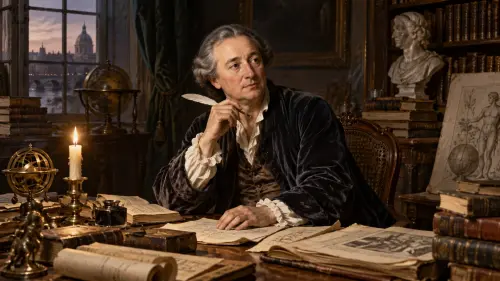
The Irreverent Philosopher: 15 Fascinating Facts About Voltaire
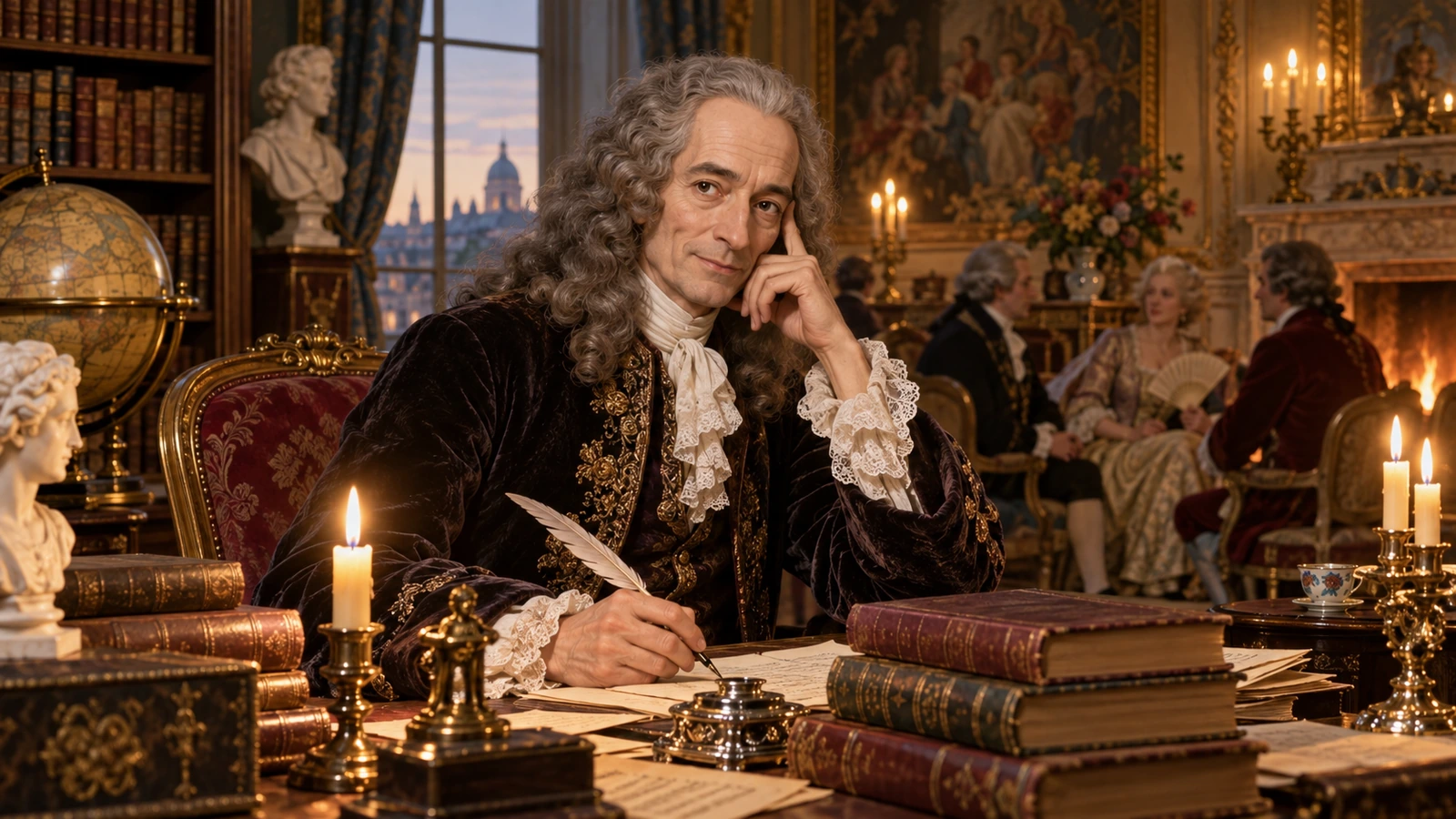
François-Marie Arouet, better known by his pen name Voltaire, was the undisputed titan of the French Enlightenment. Famous for his biting wit, sharp political satires, and relentless defense of civil liberties, he challenged the tyranny of the monarchy and the Catholic Church throughout the 18th century. Behind his literary genius lies a life full of astonishing drama, from rigging the national lottery and spying for kings to using over 170 pseudonyms. Discover fifteen fascinating facts about the irreverent philosopher who shaped modern freedom of thought.
1. The Name "Voltaire" Was a Clever Anagram
François-Marie Arouet adopted the pseudonym "Voltaire" in 1718 after his imprisonment in the Bastille. The name is an anagram of the Latinized spelling of "Arouet l[e] j[eune]" (Arouet the younger), where 'u' is written as 'v' and 'j' as 'i'. He also wanted to distance himself from his authoritarian father and a family name associated with the French word for "soft" or "unstable." Creating his own name allowed him to forge a distinct identity in European society. By shedding his birth name, he symbolically broke free from traditional social ties.
2. He Made a Fortune by Beating the National Lottery
In 1729, Voltaire joined forces with mathematician Charles Marie de La Condamine to exploit a flaw in the French national lottery. The government issued bonds that allowed bondholders to purchase lottery tickets, but improperly calculated the prize money relative to ticket prices. Voltaire and a small syndicate purchased as many tickets as possible, accumulating millions of livres. This windfall freed Voltaire from financial worries for the rest of his life, allowing him to write without seeking royal patronage. He later expanded his wealth through smart investments and international trade.
3. He Was Fueled by an Astonishing Coffee Habit
Voltaire was famously addicted to coffee, reportedly drinking between 40 and 50 cups of the brew every single day. He preferred a mixture of coffee and chocolate to keep his energy levels high during grueling writing sessions. When his personal physician warned him that coffee was a slow-acting poison that would eventually kill him, Voltaire dryly replied that it must indeed be slow, as he had been drinking it for over eighty years. Despite his doctor's grim warnings, Voltaire lived to the advanced age of 83. His legendary caffeine intake became a central part of his literary mythos.
4. He Penned His First Hit Play While Imprisoned in the Bastille
In 1717, the young writer was arrested and imprisoned in the infamous Bastille for writing satirical verses mocking the Regent of France, the Duke of Orléans. Unfazed by his eleven-month confinement, he used his time behind bars productively by composing his first major tragedy, Oedipe. Upon his release, the play was staged in Paris to overwhelming critical and commercial success, launching his literary reputation. It was during the theatrical run of this very play that he officially began using the name Voltaire. The prison stint proved to be a pivotal turning point in his rise to fame.
5. His Most Famous Quote Was Never Actually Said by Him
The iconic line, "I disapprove of what you say, but I will defend to the death your right to say it," is widely attributed to Voltaire, yet he never wrote or uttered those words. The sentence was actually created by an English biographer named Evelyn Beatrice Hall in her 1906 book The Friends of Voltaire. Hall wrote the phrase as a summary of Voltaire's core philosophy regarding free speech and tolerance during the Enlightenment. Although Voltaire expressed similar sentiments throughout his extensive philosophical writings, this specific catchy phrasing belongs entirely to his biographer. The quote nevertheless remains the ultimate summary of his defense of intellectual freedom.
6. Exile in England Transformed His Political Philosophy
After an argument with the aristocrat Chevalier de Rohan in 1726, Voltaire was given a choice between extended imprisonment or exile to England. He chose exile and spent nearly three years in Great Britain, where he learned English and immersed himself in British culture. He was profoundly influenced by the works of Isaac Newton and John Locke, as well as Britain's constitutional monarchy and relative religious tolerance. Upon returning to France, he published his Letters Concerning the English Nation, praising British liberty while implicitly criticizing French absolutism. The book was promptly banned and burned by French authorities, forcing Voltaire to flee Paris once again.
 Philosophers Through the Ages
From wrestling rings and pirate kidnappings to sword duels and secret brotherhoods, the greatest thinkers in history led lives as dramatic as their ideas. Explore the surprising human stories behind the brilliant minds who shaped Western and Eastern philosophy.
See All Facts
Philosophers Through the Ages
From wrestling rings and pirate kidnappings to sword duels and secret brotherhoods, the greatest thinkers in history led lives as dramatic as their ideas. Explore the surprising human stories behind the brilliant minds who shaped Western and Eastern philosophy.
See All Facts
7. He Conducted Scientific Experiments with a Female Genius
For sixteen years, Voltaire carried on an intense intellectual and romantic partnership with Émilie du Châtelet, a brilliant noblewoman and scientist. Together, they lived at her husband's country estate in Cirey-sur-Blaise, converting it into a thriving intellectual hub complete with a laboratory and a theater. Madame du Châtelet was a pioneer in physics who produced the definitive French translation and commentary of Isaac Newton's Principia Mathematica. Voltaire heavily relied on her mathematical expertise while co-authoring works that popularized Newtonian physics in Continental Europe. Their collaborative dynamic produced some of the most influential scientific writing of the 18th century.
8. His Body Was Secretly Smuggled Out of Paris for Burial
When Voltaire died in Paris on May 30, 1778, his lifelong criticism of the Catholic Church caught up with him. The Archbishop of Paris denied the famous philosopher a Christian burial, intending to cast his remains into a common grave. Foreseeing this outcome, Voltaire's friends and relatives secretly dressed his corpse in clothes, propped him upright in a carriage, and smuggled him out of Paris before the official ban arrived. They rushed him to the Abbey of Scellières in Champagne, where his nephew served as an abbé and provided a proper burial. It was only years later that his remains were given public recognition.
9. His Heart Was Removed and Kept in a National Library
Following Voltaire's death, embalmers extracted his heart and brain as relics before his secret burial. His heart was embalmed and preserved in a metal box, which eventually came into the possession of the French state in the 19th century. Today, his heart is enshrined inside the pedestal of a famous statue depicting Voltaire, housed within the Bibliothèque Nationale de France in Paris. The inscription on the container famously reads, "His heart is here, his spirit is everywhere." This unusual physical preservation reflects the cult of personality that grew around the philosopher after his death.
10. He Worked as a Secret Diplomat and Spy
Beyond his literary career, Voltaire occasionally operated as an informal diplomat and secret agent for the French government. In the 1740s, French officials used his close personal friendship with King Frederick the Great of Prussia to gather intelligence on Prussian military and political intentions. Voltaire traveled to the Prussian court in Potsdam, sending confidential reports back to government ministers in Paris. However, his dual role as courtier and spy was fraught with tension and personal rivalries. Eventually, Voltaire had a falling out with Frederick the Great, leading to a hasty and chaotic flight from Berlin.
11. He Employed Over 170 Pseudonyms to Evade Censors
To avoid state censorship, fines, and imprisonment, Voltaire routinely published his controversial writings under pseudonyms. Scholars have identified at least 178 different pen names used by Voltaire throughout his prolific writing career. He frequently published books in other countries and falsely attributed them to fictional authors, deceased scholars, or even rival theologians. Even when his distinctive style made his authorship blatantly obvious to everyone in Paris, Voltaire would adamantly deny having written the works. This game of cat-and-mouse with royal censors allowed him to publish radical ideas while keeping his liberty.
12. He Spent Years Fighting to Clear the Name of an Executed Protestant
In 1762, a Protestant merchant named Jean Calas was tortured and executed on the wheel in Toulouse after being falsely accused of murdering his son to prevent his conversion to Catholicism. Outraged by religious intolerance and judicial misconduct, Voltaire launched a relentless international campaign known as the Calas Affair. He published passionate tracts, mobilized European public opinion, and funded legal appeals to overturn the verdict. In 1765, King Louis XV's council officially declared Calas innocent, clearing his family's name and awarding them financial compensation. This victory established Voltaire as Europe's premier champion of civil rights and judicial reform.
13. He Was a Millionaire Money Lender to Monarchs
Thanks to his lottery fortune, shrewd grain speculation, real estate investments, and watchmaking enterprises in Ferney, Voltaire became one of the wealthiest commoners in 18th-century Europe. He used his immense personal wealth to act as a private banker, lending substantial sums to European nobility and sovereign princes at high interest rates. Because powerful aristocrats and rulers owed him money, Voltaire gained a degree of political immunity that few other writers enjoyed. This financial independence allowed him to criticize kings and church officials without fear of total ruin. Money was not just a luxury for Voltaire; it was his ultimate shield.
14. He Wrote His Masterpiece Candide in a Burst of Fury
Voltaire published his most famous novella, Candide, or Optimism, in 1759, reportedly writing the text in a sudden burst of inspiration over just a few days. The story was written in response to the devastating 1755 Lisbon earthquake and the atrocities of the Seven Years' War. It fiercely satirizes Gottfried Wilhelm Leibniz's philosophical optimism, which claimed that we live in "the best of all possible worlds." Through the absurd misfortunes of the protagonist Candide, Voltaire mocked passive optimism and argued for practical human effort summarized in the famous line, "We must cultivate our garden." The book became an instant international bestseller despite being immediately banned by religious authorities.
15. He Now Rests Opposite His Greatest Philosophical Rival
During the height of the French Revolution in 1791, the National Assembly decided to honor Voltaire as a founding father of revolutionary ideals. His body was exhumed from Champagne and brought back to Paris in a grand procession attended by hundreds of thousands of citizens. He was reburied in the Panthéon, a grand monument dedicated to the great men of France. Ironically, just three years later, the remains of his fierce intellectual rival, Jean-Jacques Rousseau, were placed in a tomb directly facing Voltaire's. Today, the two great thinkers who bickered continuously in life spend eternity resting mere feet apart.
Sources & References
This AI-assisted post was rigorously curated and fact-checked for accuracy by:
 Martin Roháček
How fun was this article? 🤔
Tap a star to rate it
🧠 Quiz: How closely were you paying attention?
10 questions — all answers are in the article above!
Enjoyed these facts? There's more! 💌
Fresh fun facts in your inbox. No spam, ever.