1. A Frenchman Invented the World Cup
While countries like Brazil and Germany dominate the historical trophy counts, the entire existence of the FIFA World Cup is a fundamentally French creation. Jules Rimet, a highly ambitious French soccer administrator who served as the third president of FIFA, completely conceptualized and organized the very first global tournament in 1930. To honor his massive contribution to the sport, the original World Cup trophy was officially named the Jules Rimet Trophy.
2. The Gallic Rooster is a Linguistic Pun
The iconic symbol of the French national team is a proud rooster, prominently displayed on the left breast of their jerseys. This aesthetic choice actually originates from a massive, centuries-old linguistic pun. In Latin, the word gallus means a co-habitant of Gaul, which was the ancient Roman name for the region of France. However, gallus also translates directly to rooster. The French eventually embraced this historical wordplay, adopting the rooster as an official national symbol of bravery and pride.
3. Just Fontaine Holds an Unbreakable Record
Modern soccer fans frequently marvel at the incredible goal-scoring abilities of players like Lionel Messi and Cristiano Ronaldo. However, a French striker named Just Fontaine holds a massive World Cup record that will likely never be broken. During the 1958 World Cup in Sweden, Fontaine scored an astonishing thirteen goals in a single tournament. Despite modern World Cups featuring more matches, no player in history has ever come close to touching his legendary single-tournament tally.
4. The Black, Blanc, Beur Generation
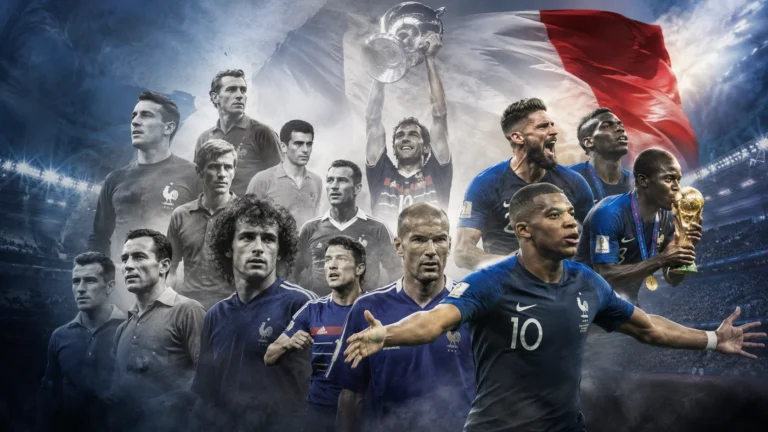
When France hosted and miraculously won the 1998 World Cup, the victory served as a highly profound sociological moment for the country. The championship roster was affectionately dubbed the Black, Blanc, Beur (Black, White, Arab) team, highlighting the incredibly diverse, multicultural, and immigrant backgrounds of the players. Led by the brilliant Zinedine Zidane, whose parents emigrated from Algeria, the team became a massive, highly celebrated symbol of modern, integrated French society.
5. Didier Deschamps Joined an Elite Club
Winning a World Cup is the absolute pinnacle of a soccer career, but doing it twice in different roles is nearly impossible. When Didier Deschamps guided the French team to victory as their head coach in 2018, he secured a massive piece of sporting immortality. Having already captained the 1998 team as a player, Deschamps became only the third man in the entire history of the sport to win the World Cup as both a player and a manager, joining Brazil’s Mario Zagallo and Germany’s Franz Beckenbauer.
6. The Infamous South African Mutiny
The 2010 World Cup in South Africa was an absolute, highly public disaster for the French squad. Following poor performances and massive internal locker-room drama, the team completely completely rebelled against their eccentric head coach, Raymond Domenech. In a shocking display of defiance, the entire roster refused to step off their team bus to attend a scheduled practice session, officially going on strike in front of global media. The catastrophic mutiny resulted in their humiliating elimination in the group stages.
7. Kylian Mbappe Matched Pele
During the 2018 World Cup final against Croatia, French teenage sensation Kylian Mbappe completely electrified the globe. By scoring a brilliant goal from outside the penalty box, the nineteen-year-old completely shattered modern expectations. He officially became only the second teenager in the entire history of the sport to score a goal in a World Cup final match. The only other teenager to ever accomplish this massive feat was the legendary Brazilian striker Pele, who did it exactly sixty years prior in 1958.
8. Michel Platini’s Perfect Tournament
Before Zidane or Mbappe, Michel Platini was the undisputed king of French soccer. During the 1984 European Championship hosted in France, Platini delivered what is widely considered the absolute greatest individual performance in the history of international tournaments. Playing as a midfielder, he scored a staggering nine goals in just five matches, single-handedly carrying France to their very first major international trophy. His nine-goal record remains completely untouched in European Championship history.
9. They Suffered the Ultimate Champion’s Curse
After completely dominating the globe by winning the 1998 World Cup and the 2000 European Championship, the French team entered the 2002 World Cup in South Korea as overwhelming favorites. What followed was a massive, historically shocking collapse. The defending champions failed to win a single match, suffered a humiliating opening-day defeat to Senegal, and were eliminated in the group stages. Most shockingly, a roster featuring the top scorers from the English, Italian, and French leagues failed to score a single goal.
10. The Golden Goal Broke Italian Hearts
The French team is intimately tied to the short-lived, highly dramatic Golden Goal rule, which dictated that the first team to score in extra time instantly won the match. During the incredibly tense final of the Euro 2000 tournament against Italy, the game went into extra time. French striker David Trezeguet violently smashed a volley into the roof of the net, instantly ending the match and securing the European championship for France in one of the most cinematic finishes in sports history.
11. Zidane’s Shocking Final Act
Zinedine Zidane’s final match as a professional soccer player is etched into global history for entirely the wrong reasons. During extra time of the 2006 World Cup final against Italy, the French captain engaged in a verbal altercation with Italian defender Marco Materazzi. In a sudden, shocking moment of rage, Zidane forcefully headbutted Materazzi directly in the chest and was immediately issued a red card. France ultimately lost the match in a penalty shootout, ending a legendary career with a deeply tragic exit.
12. Clairefontaine is a Soccer Factory
The massive, continuous success of the French national team is not an accident; it is the direct result of arguably the greatest soccer academy system on the planet. Located deep in a forest near Paris, the elite Clairefontaine academy serves as the highly exclusive training ground for the nation’s most gifted young players. Since opening in 1988, this meticulous, highly structured development center has successfully produced a massive conveyor belt of global superstars, including Thierry Henry, Nicolas Anelka, and Kylian Mbappe.
13. They Hold a Unique Grand Slam
The French national team has successfully collected every single major piece of international silverware available in men’s football. They are the only European nation to have won the FIFA World Cup, the UEFA European Championship, the Olympic Gold Medal, the FIFA Confederations Cup, and the UEFA Nations League. This massive, unprecedented international grand slam proves their incredible ability to adapt and completely dominate across multiple generations and different tournament formats.
14. The Original Shirts Were Actually White
While they are globally famous for their iconic blue jerseys, earning them the beloved nickname Les Bleus, the French national team did not originally wear this color. During their very first official international match against Belgium in 1904, the French players completely walked onto the pitch wearing plain white shirts with the two interlocking rings of the national sports committee on the chest. They did not fully adopt the iconic blue, white, and red kit inspired by the French flag until several years later.
15. The Controversy of the Hand of Gaul
To qualify for the 2010 World Cup, France had to survive a highly tense, two-legged playoff against the Republic of Ireland. During extra time in the second match, French legendary striker Thierry Henry clearly and intentionally used his hand to control the ball inside the penalty area before passing it to a teammate for the game-winning goal. The referee completely missed the massive infraction. The highly controversial incident, dubbed the Hand of Gaul by the media, sparked massive international outrage and heavily accelerated FIFA’s eventual adoption of video replay technology.