The Prehistoric Monarchs: 15 Fascinating Facts About Dinosaurs
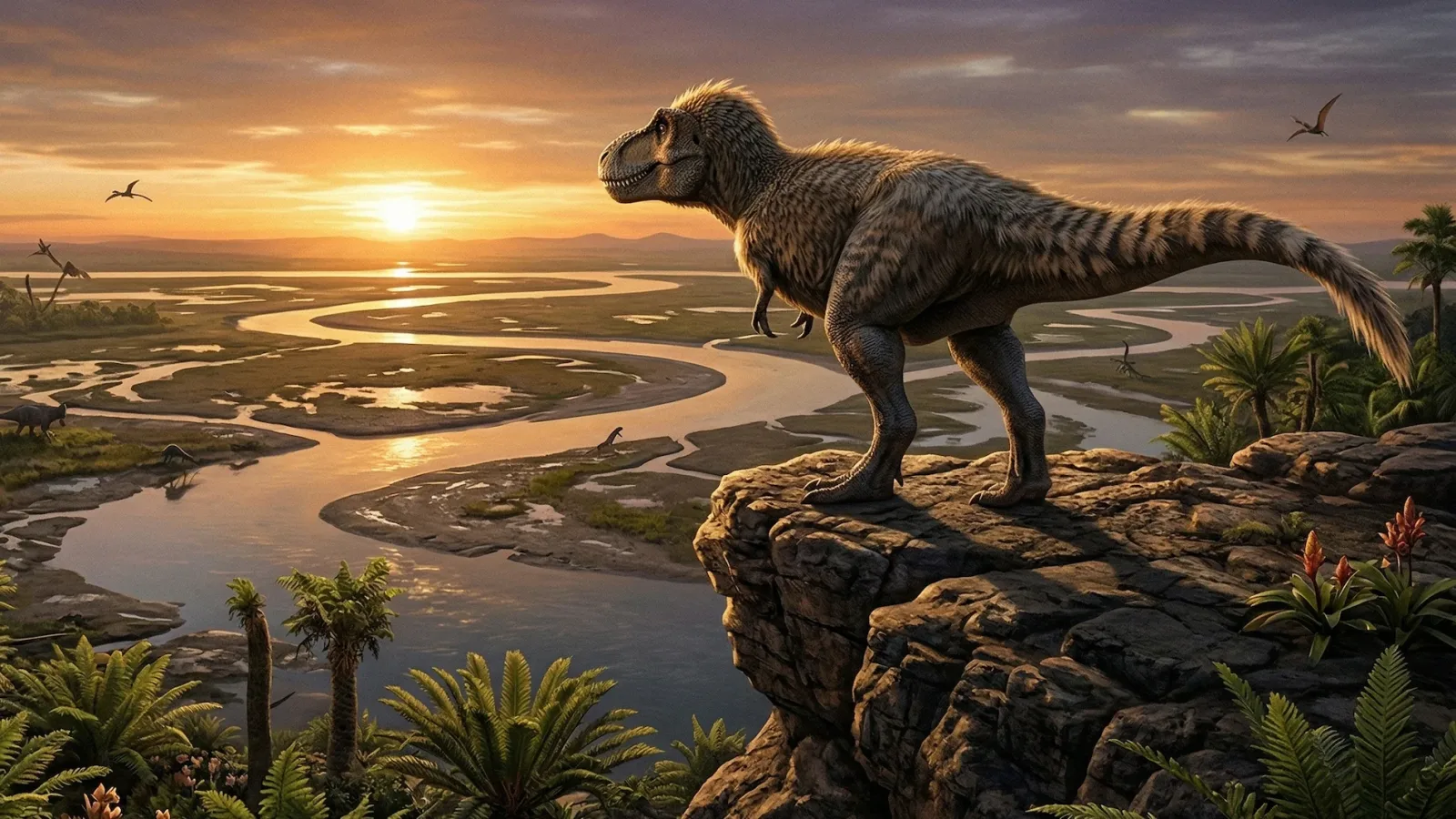
For over 160 million years, dinosaurs dominated every continent on Earth, evolving into an astonishing array of armored titans, feathered predators, and airborne survivors. Contrary to cinematic myth, Tyrannosaurus rex never fought Stegosaurus, Velociraptors were no bigger than turkeys, and modern birds are living dinosaurs actively flying among us today. From fossilized mummies with intact stomach contents to fierce 19th-century scientific wars waged with dynamite, the true history of these ancient creatures is far stranger than fiction. Here are 15 fascinating facts about the real giants that once ruled our planet.
1. Tyrannosaurus Rex Rumbled Instead of Roaring
The terrifying cinematic roar of Tyrannosaurus rex is largely a Hollywood invention created by blending lion, tiger, and elephant sounds. Modern biomechanical research and anatomical comparisons with extant archosaurs—such as crocodilians and birds—indicate that the apex predator actually produced deep, closed-mouth vocalizations. Rather than opening its jaws wide to roar, T. rex likely emitted low-frequency rumbles, infrasonic vibrations, and guttural coos. These ultra-low sound waves could travel for miles and were physically felt through the ground before they were heard. Additionally, fossil evidence suggests that juvenile T. rex individuals were covered in a delicate coat of insulating proto-feathers before losing them as they reached massive adult sizes.
2. T. Rex and Stegosaurus Never Coexisted
Popular media frequently depicts Stegosaurus battling a ferocious Tyrannosaurus rex, but the two species existed millions of years apart. Stegosaurus thrived during the Late Jurassic period roughly 150 million years ago, whereas T. rex ruled the Late Cretaceous era around 66 million years ago. An astonishing chronological gap of over 80 million years separates these iconic creatures. Remarkably, this means that modern humans are chronologically closer in time to T. rex than T. rex was to Stegosaurus. The Mesozoic Era was so vast that completely different evolutionary dynasties rose and fell long before the famous asteroid hit.
3. The Bone Wars Fueled Paleontology with Sabotage and Explosives
During the late 19th century, American paleontology experienced an explosive period of rapid discovery driven by an intensely bitter rivalry known as the Bone Wars. Paleontologists Edward Drinker Cope and Othniel Charles Marsh engaged in a fierce competition to discover and name the highest number of fossil species. Their feud devolved into extreme tactics, including financial ruin, character assassination, and bribery. Both men routinely hired armed guards and ordered their field crews to destroy excavation sites with dynamite to prevent the other from retrieving intact fossils. Despite the destruction, their feverish rivalry resulted in the discovery of over 130 new dinosaur species, including Triceratops and Diplodocus.
4. Ancient Terrestrial Crocodiles Galloped Alongside Dinosaurs
While modern crocodilians are amphibious ambush predators with sprawled limbs, their prehistoric relatives included formidable land-dwelling hunters. During the Mesozoic Era, groups like the sebecids and baurusuchids evolved long, heavily muscled legs positioned directly beneath their bodies. This upright limb posture allowed these terrestrial archosaurs to effortlessly gallop across dry plains at high speeds. Equipped with narrow, blade-like serrated teeth, these sprinting land crocs competed directly with theropod dinosaurs for prey. Some of these terrestrial crocodilian lineages survived well into the Cenozoic Era before finally succumbing to environmental changes.
5. The Iconic "Death Pose" Is Created by Underwater Decay
Museum skeletons are frequently displayed with their necks dramatically arched backward and their tails rigidly extended in an extreme posture. Known to scientists as the opisthotonic death pose, this dramatic contortion was long believed to represent the agonizing final moments of a dying dinosaur. Modern taphonomic studies have revealed that the pose is actually a natural post-mortem physical phenomenon caused by water immersion. After an animal dies and sinks into a body of water, buoyant forces and decomposing tissue allow the strong, elastic ligament along the spine to contract. As the neck muscles relax and decay, this elastic ligament pulls the head back over the spine automatically.
6. The Largest Land Animal Was as Tall as a Six-Story Building
The absolute largest terrestrial animal known to science is Patagotitan mayorum, a colossal titanosaurian sauropod unearthed in the Patagonia region of Argentina. This herbivorous titan stretched over 120 feet from snout to tail and weighed an estimated 70 tons. Its incredibly long neck allowed it to browse foliage at heights equivalent to a modern six-story building. To support such immense body mass, Patagotitan possessed pillar-like legs and hollow spaces inside its vertebrae to reduce skeleton weight without sacrificing structural integrity. Finding multiple specimens together suggests these gargantuan plant-eaters traveled in social herds across Cretaceous floodplains.
7. Avian Dinosaurs Survived the Mass Extinction
The catastrophe that struck Earth 66 million years ago did not wipe out all dinosaurs. While the giant sauropods, horned ceratopsians, and massive theropods perished during the global nuclear winter caused by the Chicxulub asteroid impact, one specialized group survived. Small, feathered avian dinosaurs managed to endure the ecological collapse by eating seeds and seeking shelter in microhabitats. Over millions of years, these resilient survivors diversified into every single modern bird species alive today. Biologically speaking, every robin, eagle, and penguin in the world is a living, breathing dinosaur.
8. A Perfectly Preserved Dinosaur Mummy Was Found by Accident
In 2011, heavy machinery operators at an oil sands mine in Alberta, Canada, accidentally struck a massive stone nodule containing a 110-million-year-old Borealopelta markmitchelli. This armored nodosaur had died and washed out to sea, sinking upside down into oxygen-deprived marine mud that preserved it in three dimensions. The resulting fossil is widely considered one of the best-preserved dinosaur specimens ever discovered, retaining original scale patterns, horn sheaths, and delicate soft tissue. Chemical analysis of the mummy even revealed its countershaded camouflage skin pigmentation. Scientists were even able to examine its stomach contents, finding fossilized ferns from its final meal.
9. Giant Parasites Specially Evolved to Attack Dinosaurs
Prehistoric ecosystems were home to terrifying parasitic insects that made life miserable for large reptiles. Fossil discoveries in China revealed ancient flea ancestors, belonging to the group Pseudopulicidae, that grew up to an inch in length. These giant wingless parasites possessed long, heavily serrated, syringe-like mouthparts specifically designed to saw through thick dinosaur hide. Unlike modern fleas, which have compressed bodies for moving through mammal fur, these ancient pests had flattened bodies and specialized clawed legs for anchoring onto feathers and tough scales. They likely targeted brooding dinosaurs anchored to nests or young chicks with softer skin.
10. Dinosaurs Thrived in the Lush Forests of Antarctica
During the Mesozoic Era, the global climate was vastly warmer than it is today, with no permanent polar ice caps covering the poles. As a result, diverse dinosaur populations successfully colonized and established breeding colonies on every continent, including Antarctica. Fossils of creatures like the crested predator Cryolophosaurus show that dinosaurs adapted to high-latitude environments that experienced months of continuous darkness during winter. Ancient Antarctica was not a frozen wasteland, but a humid, temperate forest filled with conifers, ferns, and abundant animal life. Dinosaurs residing at the poles developed specialized vision and physiological traits to endure prolonged polar nights.
11. Real Velociraptors Were Turkey-Sized and Covered in Feathers
The terrifying, human-sized predators popularized by the movie Jurassic Park bear almost no resemblance to the actual animal discovered in Mongolia. Real Velociraptors stood only about two feet tall at the hip, stretched six feet long including their stiff tail, and weighed roughly 30 pounds—making them roughly the size of a modern turkey. Fossil discoveries featuring preserved quill knobs on their forearm bones definitively prove that Velociraptor was fully covered in feathers. Instead of hunting large mammals in coordinated packs, they used their sharp sickle claws to ambush small desert lizards and early mammals. The giant killers seen on screen were actually modeled after a related raptor called Deinonychus.
12. Duck-Billed Dinosaurs Possessed Thousands of Self-Sharpening Teeth
Herbivorous duck-billed dinosaurs, known as hadrosaurs, developed one of the most complex dental structures in evolutionary history. Rather than having a single row of teeth, their jaws contained complex dental batteries composed of up to 1,400 individual teeth packed tightly together. As the top surface of the teeth wore down from chewing tough, fibrous pine needles and twigs, lower teeth continuously moved up to replace them. The teeth were made of six different tissue types—far more complex than human teeth—which wore away at different rates to create self-sharpening ridged grinding surfaces. This sophisticated chewing apparatus allowed hadrosaurs to become one of the most successful plant-eaters of the Cretaceous Period.
13. Dinosaurs Suffered from Bone Cancer and Modern Diseases
Fossilized bones reveal that dinosaurs suffered from many of the same ailments and diseases that afflict modern animals today. Paleopathologists examining a deformative leg bone of a horned Centrosaurus discovered evidence of advanced osteosarcoma, a malignant bone cancer. Detailed CT scans and cellular comparisons matched the malignant bone growth precisely with human cancer cases. Other fossils have provided clear evidence of arthritis, gout, avian tuberculosis, and infected bite wounds sustained during territorial fights. These discoveries prove that prehistoric life was subject to the same biological vulnerabilities and cellular mutations that affect living organisms today.
14. Prehistoric Mammals Actively Hunted Dinosaurs
The classic narrative that early mammals were tiny, helpless creatures hiding in the shadows of dominant giant reptiles is not entirely accurate. In 2005, paleontologists in China uncovered the fossilized remains of Repenomamus robustus, a badger-sized mammal with a small dinosaur preserved inside its stomach. A subsequent 2023 discovery revealed an extraordinary fossil catch: a Repenomamus caught in mortal combat with a plant-eating Psittacosaurus three times its size. The mammal had trapped the dinosaur beneath its body and was actively biting its ribs when a volcanic mudslide buried them both instantly. This provides direct fossil evidence that carnivorous mammals actively preyed upon dinosaurs.
15. The Asteroid Impact Left a Permanent Metallic Stripe in Earth's Crust
The exact moment the age of the non-avian dinosaurs came to an abrupt halt is recorded permanently in Earth's geological layers. Around the globe, geologists can locate a distinct thin band of dark clay known as the K-Pg (Cretaceous-Paleogene) boundary layer. This sediment layer contains abnormally high concentrations of iridium, a heavy metal that is extremely rare in Earth's crust but exceptionally abundant in asteroids. Dated to precisely 66 million years ago, this global iridium blanket represents the fallout from the massive Chicxulub asteroid impact off the coast of Mexico. Suspended in atmosphere-choking clouds for months, the pulverized cosmic debris settled worldwide, marking the definitive boundary of a mass extinction event.
Sources & References
This AI-assisted post was rigorously curated and fact-checked for accuracy by:
 Martin Roháček
How fun was this article? 🤔
Tap a star to rate it
🧠 Quiz: How closely were you paying attention?
10 questions — all answers are in the article above!
Enjoyed these facts? There's more! 💌
Fresh fun facts in your inbox. No spam, ever.