The Popcorn-Scented Bearcat: 15 Fascinating Facts About Binturongs
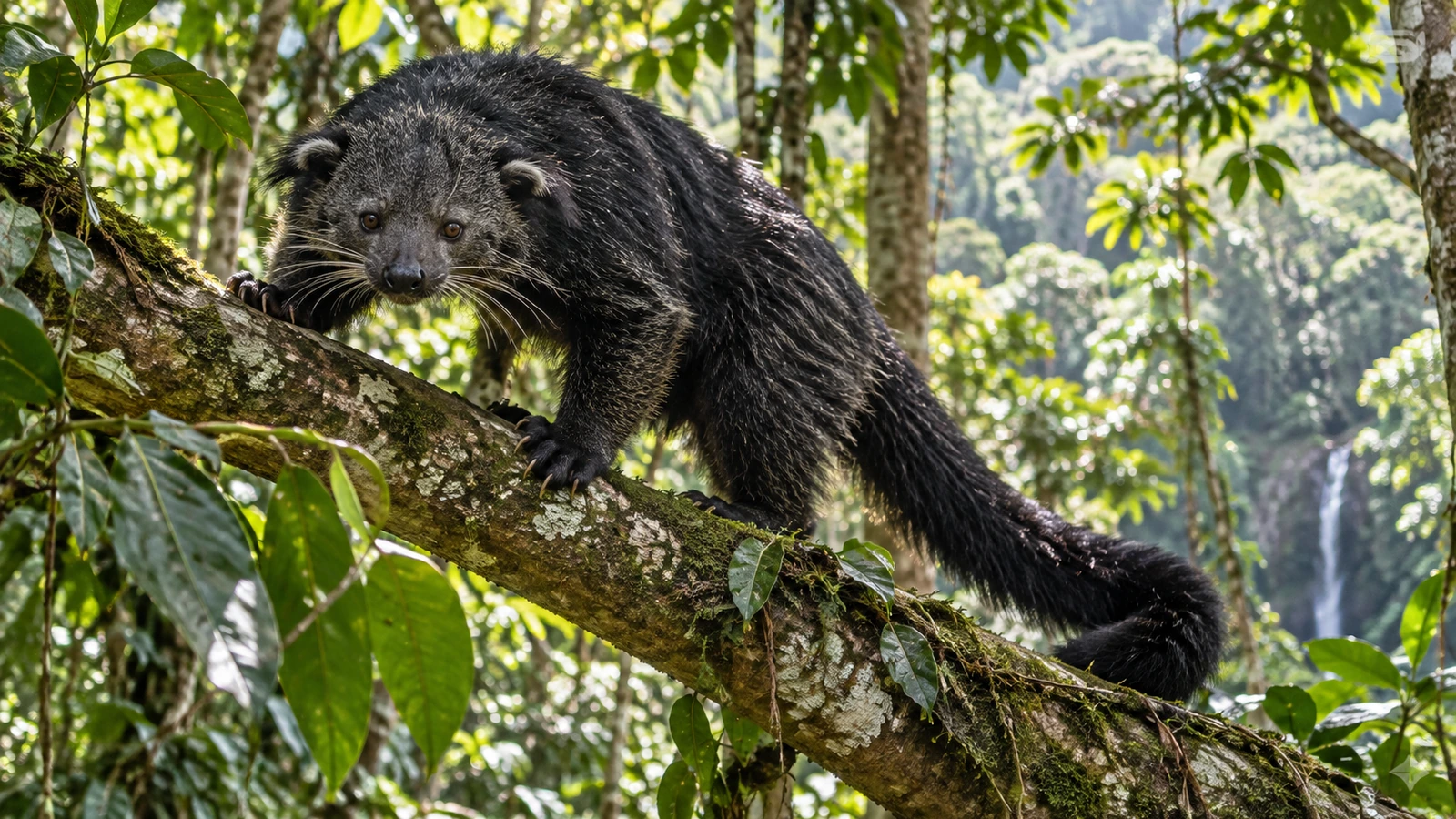
Deep within the dense rainforests of Southeast Asia dwells one of the animal kingdom's most peculiar creatures: the binturong. Often called the 'bearcat,' this arboreal mammal is neither a bear nor a cat, yet it walks flat-footed like a bear and grooms itself like a feline. Famous for smelling remarkably like warm, buttered popcorn, the binturong boasts a prehensile tail, swivel ankles, and a crucial role in replanting tropical jungles. Read on to discover fifteen extraordinary facts about this enigmatic, popcorn-scented tree dweller.
1. They Naturally Smell Like Warm Buttered Popcorn
Walk near a binturong enclosure, and you will immediately notice the distinct aroma of freshly popped, buttered popcorn. This trademark scent comes from a organic chemical compound called 2-acetyl-1-pyrroline (2-AP), which is produced in their scent glands and excreted through their urine. Coincidentally, 2-AP is the exact same volatile compound created when heat turns corn kernels or baking bread crusts golden brown. As binturongs drag their tails and lower bodies across tree branches, they leave behind a fragrant chemical path to mark territory and signal their presence to potential mates. Because the scent does not wash away easily, entire sections of the rainforest canopy end up smelling like a movie theater snack bar.
2. They Are Neither Bears nor Cats
Despite their common nickname, the "bearcat," binturongs are completely unrelated to bears or felines. Instead, they belong to the family Viverridae, an ancient group of feliform mammals that includes civets and genets. Evolutionary biologists trace the lineage of viverrids back millions of years, making them key representatives of early carnivoran evolution in Asia. While their shaggy dark fur and heavy build give them a bear-like appearance, their agile movements and long facial whiskers evoke feline traits. Recognizing their true taxonomy is essential, as their ecological needs and physiological adaptations are entirely distinct from true cats or bears.
3. The Meaning of Their Name Is Lost to History
The word "binturong" originates from an indigenous language once spoken in Malaysia and Indonesia that has since gone extinct. Because the language vanished before linguists could fully document its vocabulary, the original literal definition of the name remains a complete mystery. Local oral traditions suggest it may have referred to their tree-dwelling habits or shaggy dark coats, but no definitive translation exists. Despite the loss of its linguistic roots, the name was adopted worldwide by European naturalists during the nineteenth century. Today, it stands as a rare biological name that survives long after the culture that coined it has disappeared.
4. They Have a True Prehensile Tail
The binturong possesses a long, muscular tail that functions almost like a fifth limb while navigating high tree canopies. It is one of the very few Old World mammals—and the only carnivoran native to Asia—equipped with a fully prehensile tail. The underside of the tail's tip features leathery, hairless skin that provides superior traction against slick bark and branches. This powerful tail can support the animal's entire body weight, allowing it to hang securely while reaching for fruit on outer twigs. Young binturongs even use their tails to anchor themselves while resting or sleeping high above the forest floor.
5. Their Ankles Can Rotate 180 Degrees
Navigating the vertical world of rainforest trees requires extreme physical flexibility, and binturongs have evolved an extraordinary anatomical trick. Their hind ankles are double-jointed and capable of swiveling a full 180 degrees backward. This specialized mobility allows their sharp claws to maintain a firm grip on tree bark whether they are climbing upward or descending vertically. Most mammals are forced to back down tree trunks awkwardly, but binturongs can climb down headfirst with remarkable ease and speed. Combined with their flexible spine, these rotating ankles make them astonishingly agile despite their bulky frames.
6. They Walk Flat-Footed Like Humans and Bears
Unlike cats and dogs that walk on their toes, binturongs are plantigrade animals that place the entire sole of their feet flat on the ground. This walking stance is shared with humans, bears, and raccoons, giving binturongs a heavy, slow-looking waddle when on flat ground. However, this flat-footed stance provides immense stability and balance when moving along thick, slippery jungle branches. Their wide paws feature long, semi-retractable claws that dig deeply into bark to prevent falls. This combination of plantigrade balance and curved claws allows them to navigate unsteady canopy pathways with absolute confidence.
7. Females Can Pause Their Own Pregnancies
Female binturongs possess a rare reproductive adaptation known as embryonic diapause, or delayed implantation. After mating occurs, the fertilized egg develops into a tiny blastocyst but postpones implanting into the uterine wall for several weeks or months. This physiological pause allows the female to delay gestation until environmental conditions, such as fruit availability and warm weather, are optimal. Consequently, she can ensure her offspring are born during seasons when food is abundant enough to support lactation. This remarkable ability gives binturongs a significant evolutionary advantage in unpredictable tropical climates.
8. They Are Vital Seed Dispersers for Strangler Figs
Ecologists classify the binturong as a vital keystone species due to its crucial role in forest regeneration. Although classified as carnivores, their diet consists primarily of tropical fruits, especially strangler figs (Ficus altissima). Binturongs possess specialized digestive enzymes that break down the tough outer coat of fig seeds without damaging the internal germ. As they travel across vast territories, they excrete these intact seeds high up in tree forks wrapped in natural fertilizer. Without the binturong to soften and spread these seeds, many giant fig trees would struggle to propagate across the rainforest.
9. They Are Surprisingly Competent Swimmers
Although binturongs spend the vast majority of their lives high in the forest canopy, they are not afraid to take to the water when necessary. When crossing swollen jungle rivers or seeking relief from humid tropical heat, they swim with strong, confident strokes. Researchers and zookeepers have observed them paddling effortlessly and even diving beneath the surface to forage. On occasion, wild binturongs will use their aquatic skills to hunt for fish, frogs, and crustaceans along riverbanks. This unexpected amphibious capability adds another layer of versatility to an already adaptable rainforest mammal.
10. They Express Happiness Through "Chuckling" Sounds
Binturongs communicate using a surprisingly diverse range of vocalizations, depending on their mood and situation. When a binturong feels content, relaxed, or playful, it produces a distinct high-pitched sound reminiscent of a gentle giggle or chuckle. Mother binturongs frequently use these soft chuckling noises to reassure their young while grooming them or exploring the trees. Conversely, if a binturong feels threatened or cornered, its demeanor changes drastically, producing deep growls, fierce hisses, and loud rasps. These varied vocal cues allow binturongs to maintain social boundaries without resorting to unnecessary physical fights.
11. They Are the Largest Members of Their Family
Within the family Viverridae, which comprises mostly slender, small-bodied creatures like civets, the binturong is an absolute giant. Adult binturongs can grow up to six feet in total length, with their thick tails accounting for roughly half of that figure. Healthy adults typically weigh between 20 and 50 pounds, with exceptionally large females reaching even heavier weights. In fact, binturongs exhibit sexual dimorphism where females are generally 20 percent larger and heavier than males. This impressive mass makes them the heaviest canopy-dwelling carnivoran in the Asian rainforest.
12. They Follow a Mostly Crepuscular Schedule
Binturongs are primarily crepuscular animals, meaning their peak activity occurs during the twilight hours of dawn and dusk. While they can be active periodically during the night, they spend the brightest daylight hours curled up in shaded tree hollows or dense foliage. Sleeping high above the ground protects them from ground predators like tigers and leopards while conserving energy in the tropical heat. As dusk falls, they emerge from their elevated resting spots to begin their endless search for fruit, small prey, and suitable mates. Their eyes are adapted to low-light conditions, allowing them to navigate dark branch networks with precision.
13. Their Tongues Are Covered in Microscopic Barbs
Similar to domestic cats and big felines, the binturong's tongue features a rough texture lined with microscopic, backward-facing hooks called papillae. These keratinized papillae act like a miniature coarse comb, allowing binturongs to clean their thick coat thoroughly during daily grooming sessions. In addition to coat maintenance, this rough tongue plays a vital role during feeding time. It enables the animal to easily rasp flesh from the bones of small prey and scrape out the sweet flesh of tough-skinned tropical fruits. This dual-purpose adaptation ensures they maximize nutritional intake from every meal.
14. Long Whiskers Help Them Navigate in Total Darkness
Because binturongs often travel through dense foliage under the cover of night, visual cues alone are not enough to navigate safely. To compensate, they possess exceptionally long, sensitive white whiskers growing from their muzzle and above their eyes. These whiskers, or vibrissae, are packed with nerve endings that detect air currents and physical obstacles in complete darkness. By sweeping their whiskers forward as they climb, binturongs can measure branch distances and avoid collisions without making a sound. Combined with their keen sense of smell, these tactical sensors allow them to move gracefully through pitch-black canopies.
15. Habitat Loss Threatens Their Wild Populations
Despite their adaptability and broad historical range across Southeast Asia, wild binturong populations are currently declining. The International Union for Conservation of Nature (IUCN) classifies the binturong as a Vulnerable species facing an elevated risk of extinction. The primary driver of this decline is widespread deforestation caused by palm oil plantations, logging, and agricultural expansion. Additionally, binturongs are hunted for their meat, captured for the exotic pet trade, and poached for traditional medicine. Protecting intact forest corridors and supporting sustainable agriculture are critical steps toward ensuring these popcorn-scented creatures survive in the wild.
Sources & References
This AI-assisted post was rigorously curated and fact-checked for accuracy by:
 Martin Roháček
How fun was this article? 🤔
Tap a star to rate it
🧠 Quiz: How closely were you paying attention?
10 questions — all answers are in the article above!
Enjoyed these facts? There's more! 💌
Fresh fun facts in your inbox. No spam, ever.