The Walking Pinecone: 15 Fascinating Facts About Pangolins
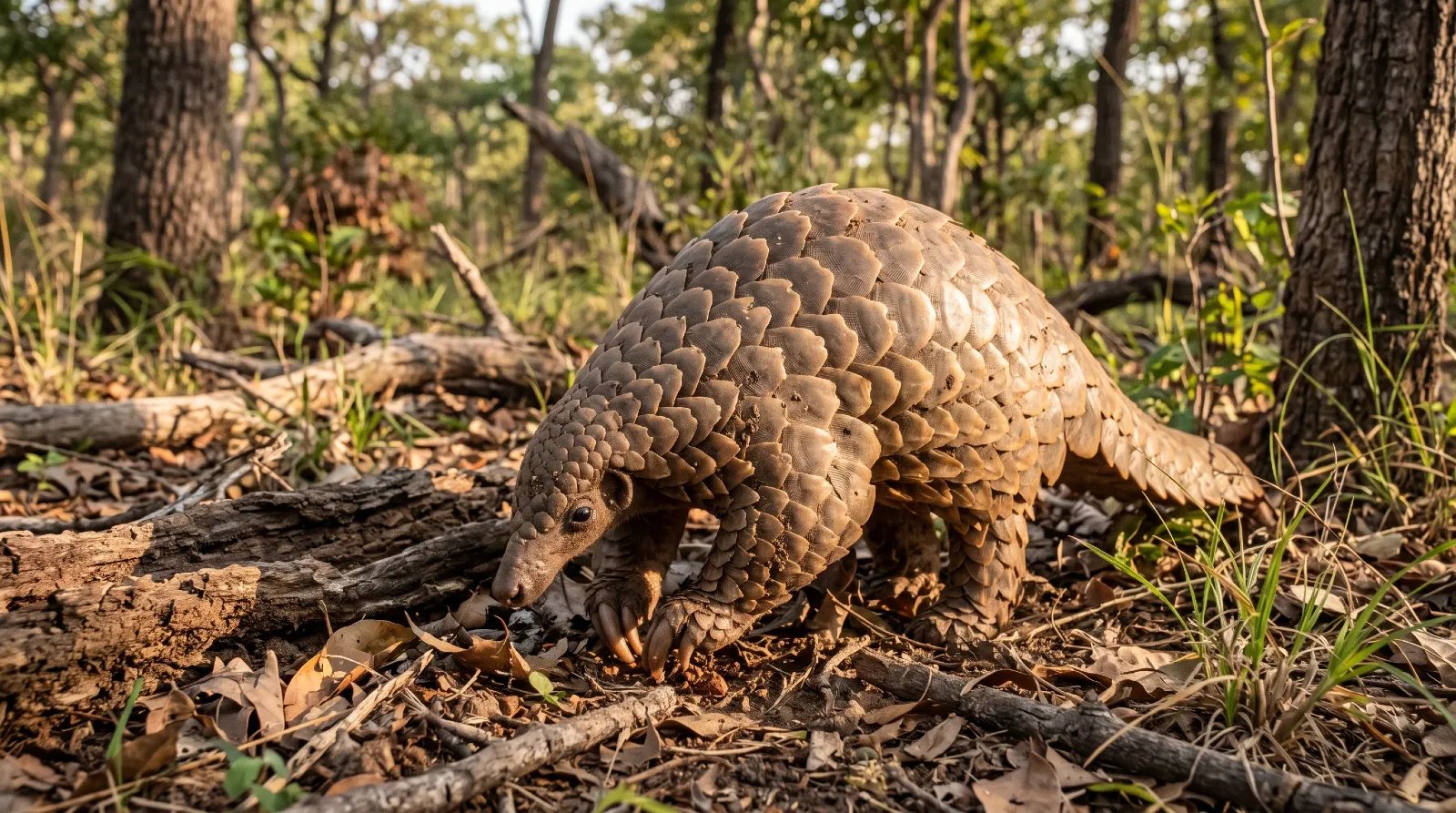
Pangolins look like walking pinecones, have no teeth and carry a tongue that starts deep inside their chest. They are the only mammals covered in true scales, and sadly also the most trafficked mammals on Earth. Here are the surprising facts about one of the strangest and most vulnerable animals alive.
1. Pangolins are the only mammals covered in true scales.
A pangolin's body is protected by large, overlapping scales that make it look like a living pinecone or a small dinosaur. The scales are made of keratin, the same material as human fingernails and hair. They are soft when a pangolin is born and harden as the young animal grows. Depending on the species, a pangolin can have hundreds of these scales.
2. Their name means "one who rolls up".
The word "pangolin" comes from the Malay word "pengguling", meaning "one who rolls up". When threatened, a pangolin curls into a tight ball, tucking its soft belly and face inside its armoured shell. The edges of the scales are sharp, and the grip is so strong that even a lion can struggle to unroll one.
3. Their tongue is anchored deep inside the chest.
In most mammals, the tongue is attached to a small bone in the throat. In pangolins, the root of the tongue sits much further back, inside the chest between the breastbone and the windpipe. This allows the sticky tongue to shoot out a remarkable distance, reaching around 40 centimetres in the giant pangolin, and slip deep into ant and termite tunnels.
4. They have no teeth, so they swallow stones.
Pangolins cannot chew because they have no teeth at all. Instead, they swallow small stones and sand, which collect in a muscular part of the stomach and grind up the insects they eat. This works in a similar way to a bird's gizzard, and the stomach lining even has tough, horny spines to help with the job.
5. One pangolin can eat tens of millions of insects a year.
Pangolins feed almost entirely on ants and termites, which they sniff out with their excellent sense of smell. An often-quoted estimate is that a single adult can eat around 70 million insects a year. By keeping termite numbers in check, pangolins play an important role in protecting forests and farmland.
6. They can close their ears and nostrils.
Raiding an ant nest can be a painful business. To protect themselves, pangolins can seal their nostrils and ears shut with special muscles while they feed. Thick eyelids shield their eyes from biting insects, which they mostly ignore while they eat.
💡 You might also like The Futuristic City-State: 15 Fascinating Facts About Singapore7. Their closest relatives are cats, dogs and bears.
Because they eat ants, pangolins were long thought to be related to anteaters and armadillos. Genetic studies have revealed a surprise: their closest living relatives are the carnivorans, the group that includes cats, dogs, bears and hyenas. The pangolin and carnivoran lineages split from each other around 75 million years ago, when dinosaurs still roamed the Earth.
8. Some pangolins live in trees.
Not all pangolins dig burrows. Some species, such as the African white-bellied pangolin, are excellent climbers that spend much of their time in trees. They use their strong, prehensile tails to grip branches and can even hang from them. Other species shelter in deep underground burrows.
9. Babies ride on their mother's tail.
A pangolin usually gives birth to a single baby. Once the young pangolin is a few weeks old, it rides around clinging to the base of its mother's tail as she forages. If danger approaches, the mother curls into a ball with her baby safely wrapped inside.
10. They can spray a foul-smelling liquid like a skunk.
As well as rolling up, pangolins have another line of defence. They can release a noxious-smelling fluid from glands near the anus, similar to the spray of a skunk. Combined with their sharp scales, it makes them an unappealing meal for most predators.
11. There are eight species on two continents.
Four pangolin species live in Asia and four in Africa. They range in size from the small black-bellied pangolin, which weighs only a couple of kilograms, to the giant pangolin, which can be well over a metre long and weigh more than 30 kilograms. All eight species are classified as threatened by the IUCN, and three are Critically Endangered.
12. They are the most trafficked mammals in the world.
Pangolins are hunted for their meat, which is considered a delicacy in some countries, and for their scales, which are used in traditional medicine even though they are made of the same substance as fingernails. Around 100,000 pangolins are estimated to be smuggled every year, mainly to China and Vietnam. This makes them the most trafficked mammals on the planet.
🤔 Quick guess
Why do some pangolins, like the ground pangolin, walk only on their hind legs?
13. International trade in pangolins is completely banned.
In 2016, the countries that are party to the CITES convention voted to move all eight pangolin species to Appendix I, which bans commercial international trade. Despite this, huge shipments of smuggled scales are still seized by customs officers every year, sometimes weighing several tonnes.
14. Some pangolins walk on two legs.
Some pangolins, such as the ground pangolin of southern Africa, often walk on their hind legs alone, using their tail for balance. This keeps their long front claws, which they use for ripping open termite mounds, from wearing down. From a distance, a walking pangolin can look a little like a tiny armoured dinosaur.
15. Very little is known about how many remain.
Pangolins are shy, nocturnal and solitary, which makes them extremely hard to study in the wild. Scientists still do not know how many of them are left, and they are notoriously difficult to keep in captivity because of their specialised diet. To raise awareness, conservationists celebrate World Pangolin Day every year in February.
How did these facts land?
Know someone who'd love these facts? Share them 👇
🧠 Quiz: How closely were you paying attention?
Think you remember the facts? 10 questions, tap an answer.