The Defiant Protest: 15 Fascinating Facts About the Boston Tea Party
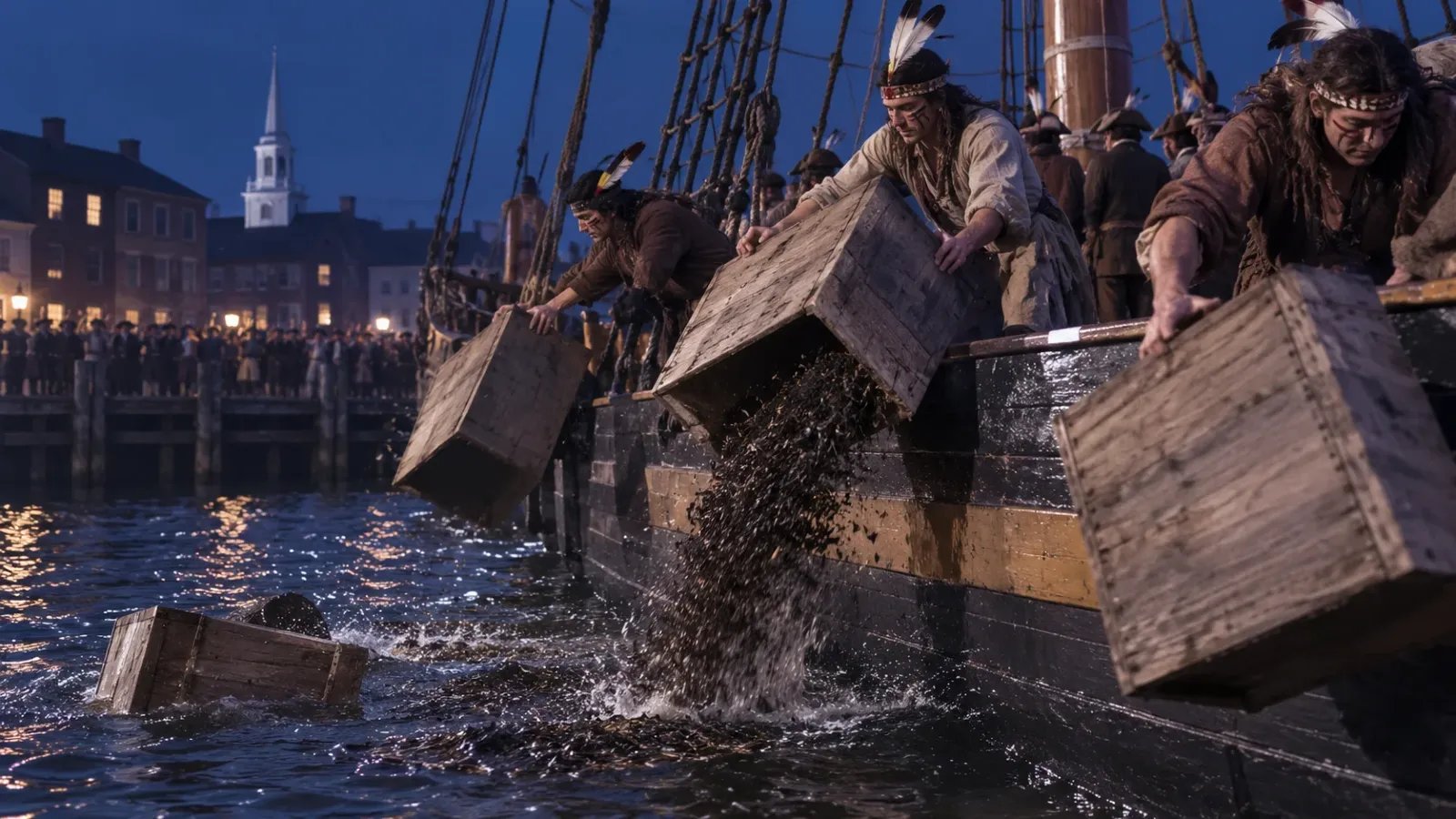
The Boston Tea Party wasn't a rowdy riot against high taxes, but an organized corporate sabotage protesting a tax cut. Far from a chaotic mob, the Sons of Liberty executed a disciplined strike against a British monopoly. Strip away the legends of wild men tossing tea, and you will find a complex web of smuggling, corporate bailouts, and political theater that ignited a revolution.
1. The protest was actually sparked by a massive tax cut, not a tax increase.
The Tea Act of 1773 drastically lowered the tax on British East India Company tea. This allowed the megacorporation to undercut local colonial smugglers like John Hancock. The colonists rebelled because this tax cut created a monopoly that threatened their own economic interests, not because the cost of tea had suddenly become unbearably expensive.
2. George Washington strongly condemned the destruction of the tea.
While modern history views the event as a patriotic triumph, many founding fathers were horrified by the destruction of private property. Washington argued that the East India Company should be fully compensated for their lost goods, believing that such lawless behavior undermined the colonists' claims to legal rights and moral high ground.
3. The event wasn't called the Boston Tea Party until more than fifty years after it happened.
For decades, the incident was simply referred to in letters and newspapers as the destruction of the tea. The catchy moniker we use today didn't appear in print until 1826, and it only became widely popularized in the 1830s when a new generation of Americans began romanticizing the rebellion of their ancestors.
4. The participants did not destroy any property other than the tea, and even swept the ship decks clean afterward.
To prove their actions were a principled political protest rather than a riotous looting spree, the Sons of Liberty were incredibly disciplined. They broke open the tea chests and threw them overboard, but they left the rest of the ships' cargo untouched. One protester even brought a replacement padlock the next day to replace one that had been broken during the raid.
5. The tea thrown into the harbor was mostly sourced from China, not India.
Despite being imported by the British East India Company, the tea destroyed in Boston harbor was actually grown in China. The shipment consisted largely of Bohea, a black tea from the Wuyi Mountains of Fujian province, along with smaller amounts of green teas like Hyson and Singlo. India would not become a major tea producer for the British Empire until the 19th century.
6. A protester who tried to steal some of the tea for himself was violently stripped and beaten by the others.
The organizers of the protest were militant about ensuring no one profited personally from the event. When a man named Charles Conner was caught stuffing his pockets with loose tea leaves to sell later, the other participants tore his clothes off, beat him, and threw him into the mud, ensuring the act remained entirely symbolic rather than criminal.
7. The three ships boarded that night were actually built in America and owned by Americans.
The Dartmouth, the Eleanor, and the Beaver were not British royal vessels, but privately owned colonial merchant ships that had been chartered by the East India Company. The owners of these ships were actually sympathetic to the colonial cause, but they were trapped between the royal governor's refusal to let them leave the harbor and the colonists' refusal to let them unload.
8. The disguises worn by the Sons of Liberty were less about hiding their identities and more about political symbolism.
The protesters famously dressed as Mohawk warriors, smudging their faces with soot and wearing blankets. While this provided a thin veil of anonymity, it was primarily a symbolic gesture to express their new American identity. By adopting indigenous dress, they were signaling that they no longer considered themselves subjects of the British Crown, but true inhabitants of the American continent.
9. The amount of tea destroyed was staggeringly valuable, equivalent to nearly two million dollars in today's currency.
The protesters smashed open 342 chests containing roughly 92,000 pounds of tea. In 1773, this haul was valued at nearly ten thousand British pounds. In modern terms, the financial blow to the British East India Company was catastrophic, prompting the harsh and punitive legislative response from British Parliament that would eventually spark the Revolutionary War.
10. The polluted harbor waters smelled so bad in the following days that citizens had to go out in boats to beat the floating tea into the mud.
Because the water in Boston Harbor was relatively shallow during low tide, the massive volume of dumped tea piled up in giant mounds above the waterline. Rather than washing out to sea, the tea began to rot in the sun. Protesters had to row out and actively thrash the floating piles with oars so the leaves would sink, ensuring it couldn't be salvaged and mitigating the foul stench.
11. A fourth ship carrying tea ran aground before reaching Boston and its cargo was saved from the protest.
The William, a brig joining the other three tea ships, encountered a severe storm and wrecked off the coast of Cape Cod. Its cargo of tea was salvaged by a local merchant and heavily guarded, eventually making its way to Boston loyalists. Had the William successfully navigated into Boston Harbor, the Sons of Liberty would have undoubtedly destroyed its cargo as well.
12. Only one person was ever arrested and imprisoned for participating in the Boston Tea Party.
Despite hundreds of onlookers and an estimated 116 participants, the tight-lipped nature of the Boston community meant the British could not secure reliable witnesses. A single man, a barber named Thomas Eckley, was arrested and briefly jailed. The rest of the participants maintained a code of silence that lasted for decades, long after the Revolutionary War was won.
13. The British response to the protest included shutting down the entire civilian government of Massachusetts.
Furious over the destruction of the tea, Parliament passed the Coercive Acts in 1774. Not only did they close the port of Boston until the tea was paid for, but they also revoked the Massachusetts charter. This ended democratic town meetings and placed the colony under direct military rule, a draconian overreaction that unified the other twelve colonies in sympathy with Massachusetts.
14. The Boston Tea Party inspired a surge of coffee consumption in America as a patriotic duty.
Following the destruction of the tea, drinking British-imported tea became a social taboo across the colonies. John Adams wrote to his wife Abigail that tea must be universally renounced, famously declaring that he would wean himself off the beverage. Coffee quickly became the patriotic caffeine of choice, fundamentally shifting American beverage culture to this day.
15. Boston was not the only city to destroy tea in defiance of the British Crown.
While Boston's protest became the most famous, similar tea parties occurred up and down the eastern seaboard. In New York and Philadelphia, angry crowds forced tea ships to turn around and sail back to England. In Charleston, South Carolina, tea was seized and left to rot in damp vaults, and in Annapolis, Maryland, protesters forced a merchant to burn his own tea-laden ship to the waterline.
Sources & References
This AI-assisted post was rigorously curated and fact-checked for accuracy by:
 Martin Roháček
How fun was this article? 🤔
Tap a star to rate it
🧠 Quiz: How closely were you paying attention?
10 questions — all answers are in the article above!
Enjoyed these facts? There's more! 💌
Fresh fun facts in your inbox. No spam, ever.