
The Notorious Cipher: 15 Fascinating Facts About the Enigma Machine
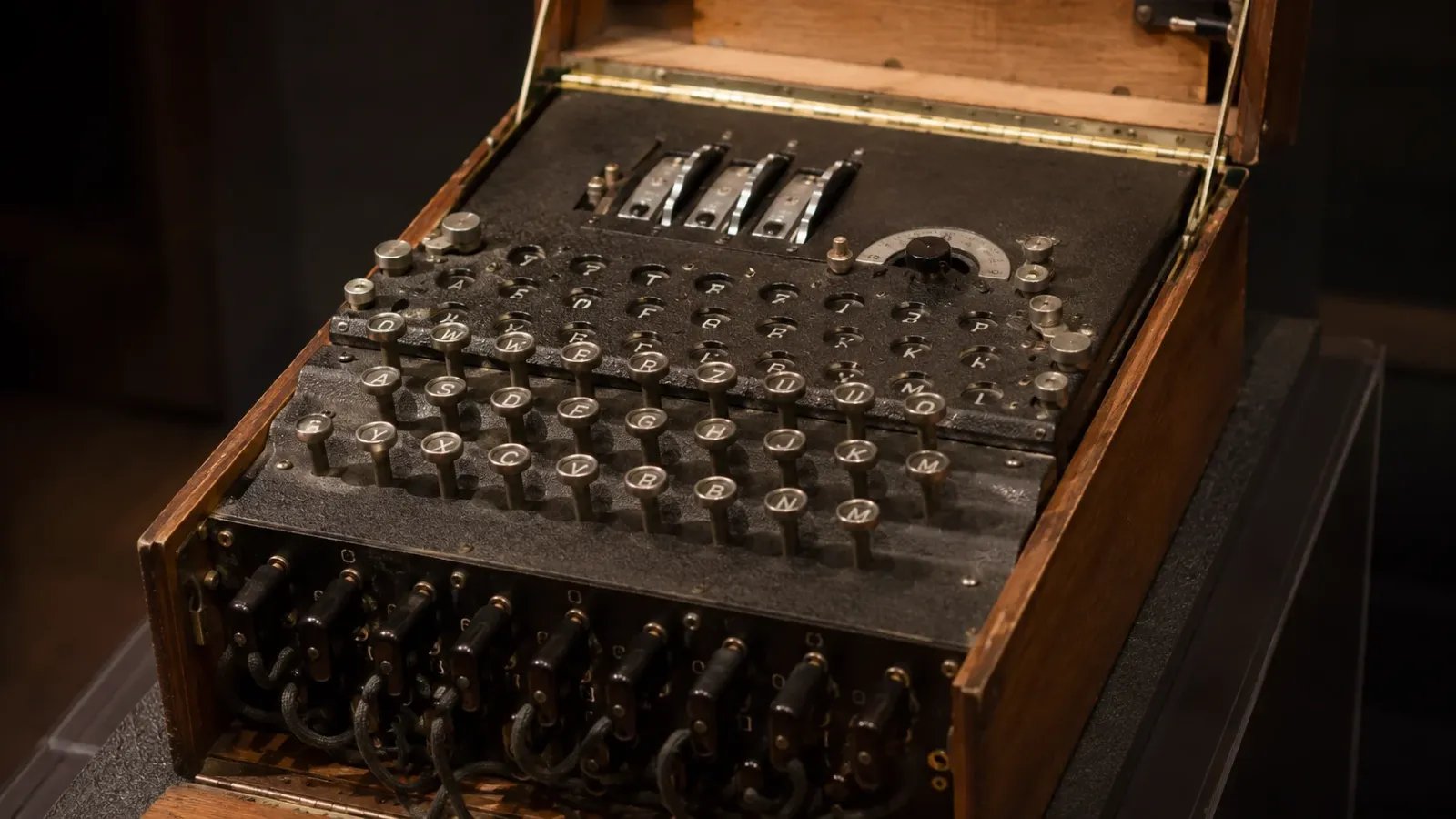
Contrary to popular myth, Alan Turing did not break the Enigma alone, nor was it a single unbreakable device. Polish mathematicians actually cracked its early versions years before World War II. Far from a perfect puzzle, this notorious family of electromechanical rotors was plagued by mechanical quirks and human errors. Discover the obscure truths behind history's most famous cipher.
1. Polish mathematicians successfully cracked the military Enigma code years before Alan Turing and the British team at Bletchley Park even began their work.
The common pop-culture narrative credits the British, but Marian Rejewski, Jerzy Rozycki, and Henryk Zygalski of the Polish Cipher Bureau decoded German military texts as early as 1932. They used a combination of espionage, mathematical permutation theory, and early mechanical computers called "bombas" to reverse-engineer the machine's internal wiring. Recognizing an impending invasion in 1939, Poland handed their entire body of research, including replica Enigma machines, over to British and French intelligence. Without this crucial foundational gift, the wartime successes at Bletchley Park would have been delayed by critical, potentially war-losing months.
2. The Enigma machine was originally invented at the end of World War I to protect corporate secrets, not for military espionage.
German engineer Arthur Scherbius patented the Enigma in 1918, marketing it heavily to businesses, banks, and post offices as a way to secure commercial communications from industrial rivals. In fact, anyone could buy an early Enigma model off the shelf in the 1920s, and they were openly displayed at international trade shows. The German military initially showed no interest in the expensive device until they discovered that British forces had intercepted and read their naval communications throughout the First World War. This realization prompted the German armed forces to adopt a modified, highly complex military version of the commercial machine in 1926.
3. A catastrophic design flaw in the Enigma's reflector meant that a letter could never be encrypted as itself, drastically narrowing down the possibilities for codebreakers.
Scherbius added a component called a reflector to the machine, which sent the electrical current back through the rotors by a different path. This made the machine reciprocal, meaning the exact same daily settings could be used for both encrypting and decrypting messages without needing to switch modes. However, the reflector physically prevented the electrical circuit from connecting a key to its own output bulb. Codebreakers heavily exploited this massive cryptographic weakness, known as a lack of "fixed points," by using intercepted text and instantly ruling out any cipher letters that matched the original plaintext word.
4. Despite the fame of its spinning rotors, the stationary plugboard added to the military Enigma provided the vast majority of its cryptographic strength.
While the commercial Enigma relied solely on the mathematical permutations of three interchangeable rotors, the military version included a "Steckerbrett" or plugboard on the front of the machine. Operators used cables to swap pairs of letters before the electrical current ever reached the spinning rotors, exponentially increasing the complexity of the signal's path. Three standard rotors offered about 105,456 possible starting positions, but swapping just ten pairs of letters on the plugboard introduced over 150 trillion new configurations. This relatively simple electrical swapping mechanism is what truly elevated the military Enigma from a strong commercial cipher to a supposedly unbreakable wartime fortress.
5. Routine daily weather forecasts transmitted by the Germans provided the predictable text that Allied codebreakers needed to crack the daily cipher settings.
Cryptanalysts rely heavily on "cribs," which are known or highly suspected words hidden within an encrypted message. The German military meticulously transmitted daily weather reports from localized outposts and U-boats, strictly adhering to a rigid formatting protocol. Because the British knew exactly when these broadcasts occurred and what structure they followed, they could easily guess the presence of words like "Wetter" (weather) or numbers spelled out as letters. By overlapping these known words with intercepted cipher text and exploiting the reflector flaw, British cryptanalysts could deduce the rotor settings for the entire day.
6. The rigid military discipline of ending nearly every transmission with the phrase "Heil Hitler" routinely gave Allied codebreakers the exact key they needed to decrypt messages.
A cipher is only as secure as the human operating it, and the German military's insistence on uniformity ultimately proved disastrous for their cryptography. Operators consistently closed their routine reports with the mandatory Nazi salute, creating an easily identifiable pattern at the bottom of intercepted communications. Bletchley Park analysts eagerly hunted for these repeated sign-offs, as knowing a precise chunk of plaintext allowed them to work backward through the Enigma's electrical pathways. This predictable human behavior repeatedly nullified the machine's brilliant electromechanical engineering.
 Wars and Conflicts of the 20th Century
Explore the hidden realities of 20th-century warfare and geopolitical conflicts. From world-altering military campaigns and covert intelligence operations to the eccentricities of ruthless dictators, uncover the surprising truths behind the events that shaped the modern world.
See All Facts
Wars and Conflicts of the 20th Century
Explore the hidden realities of 20th-century warfare and geopolitical conflicts. From world-altering military campaigns and covert intelligence operations to the eccentricities of ruthless dictators, uncover the surprising truths behind the events that shaped the modern world.
See All Facts
7. The Enigma was not a single standardized machine, but a diverse family of devices with varying rotor counts and specialized military applications.
A common misconception views the Enigma as a monolithic piece of technology utilized uniformly across the Axis powers. In reality, the German army, air force, and navy all used distinct variations of the machine, with the Kriegsmarine (Navy) implementing the most notoriously complex versions. While the standard army machine used three rotors chosen from a set of five, the naval M4 Enigma, introduced in 1942, utilized four rotors chosen from a set of eight. This sudden upgrade plunged Bletchley Park into a ten-month "shark blackout" where U-boat communications became entirely unreadable, drastically threatening the Allied Atlantic supply lines.
8. The Enigma did not print encrypted messages or transmit them over the airwaves; it merely illuminated light bulbs corresponding to the ciphered letters.
Modern depictions often blur the line between a cipher machine and a transmission device, but the Enigma possessed no radio capabilities of its own. It consisted of a standard typewriter keyboard connected to a "lampboard" of twenty-six light bulbs, each bearing a letter of the alphabet. When an operator pressed a key, an electrical current traveled through the plugboard, across the rotating disks, hit the reflector, and traveled back to light up a single bulb. A second operator had to manually transcribe the glowing letters onto paper, and a third would then transmit the resulting gibberish over standard Morse code radio frequencies.
9. The famous British "Bombe" machines designed by Alan Turing and Gordon Welchman were not early computers, but rather electromechanical simulators built to hunt for logical contradictions.
Pop culture frequently labels the Turing Bombe as the world's first computer, a title actually belonging to the later Colossus machine used against the Lorenz cipher. The Bombe was effectively dozens of Enigma machines wired together in reverse, designed to simultaneously test thousands of possible rotor positions against a known snippet of plaintext. As its electrical drums spun, it searched for the one configuration that did not produce a logical contradiction due to the Enigma's reflector flaw. Once it found a viable circuit, the machine stopped and operators would manually test the settings on an actual replica Enigma to see if it yielded readable German.

10. German cryptographers were fully aware that the Enigma was theoretically solvable, but they mistakenly believed the sheer number of settings made it practically invincible in wartime.
It is often falsely stated that the German high command believed the Enigma was mathematically flawless. In truth, German cipher experts understood that an enemy with enough time and intercepted messages could eventually deduce the daily key. However, they calculated that testing all 158 quintillion possible configurations by hand would take an impossibly long time, rendering any intercepted tactical data entirely useless by the time it was finally decrypted. They failed to anticipate the industrialization of codebreaking and the invention of high-speed electromechanical devices like the Turing Bombe, which reduced millions of years of manual calculations to a few hours.
11. German operators frequently chose lazy or predictable three-letter message keys, severely compromising the mathematical security of the entire Enigma network.
Before sending a message, an Enigma operator had to transmit a three-letter starting position for the rotors, known as the message key. Instead of choosing truly random letters as instructed by military doctrine, tired or bored operators frequently resorted to keyboard diagonals like "QWE" or repeated letters like "AAA." Some operators even consistently used their girlfriends' initials, creating recognizable habits that British analysts affectionately dubbed "cillies." These human lapses provided massive shortcuts for cryptanalysts, who meticulously cataloged individual operator quirks to bypass the machine's daunting mathematical permutations.
12. The mathematical genius of Bletchley Park was heavily dependent on physical "pinches," where Allied forces boldly captured Enigma machines and codebooks from sinking German vessels.
Relying solely on deductive logic to break the daily Enigma settings was often insufficient, particularly against the advanced naval M4 machines. The British Royal Navy executed several daring raids on German weather ships and disabled U-boats specifically to steal physical cryptographic materials before the crews could destroy them. The capture of the U-110 in 1941 yielded an intact Enigma machine and an operator's codebook, instantly giving Bletchley Park the daily settings for several months. These intelligence coups were kept so secret that even the sailors who risked their lives to board the sinking submarines were never told the true value of their plunder.
13. Following the end of World War II, the British government ordered the destruction of thousands of captured Enigma machines to maintain their codebreaking supremacy.
As the war concluded, British intelligence realized that many nations, completely unaware that the Enigma had been comprehensively broken, still viewed the machines as peak cryptographic security. Prime Minister Winston Churchill ordered the dismantling of the Bletchley Park operation and the physical destruction of most captured Enigmas and Turing Bombes. The British subsequently encouraged their former colonies and emerging Cold War allies to adopt the remaining Enigma machines for their own secure state communications. This brilliant, albeit deceitful, strategy allowed British intelligence to easily read the secret transmissions of various governments for years after the war ended.
14. While the Enigma is the most famous wartime cipher, the German military utilized an entirely different and far more sophisticated system called Lorenz for high-level strategic communications.
The Enigma was a tactical field cipher used largely by frontline troops, U-boats, and airbases to coordinate immediate military actions. For top-secret communications between Adolf Hitler and his highest-ranking generals, the Germans relied on the Lorenz SZ cipher attachment, a massive teleprinter machine utilizing twelve rotors instead of the Enigma's three or four. Breaking the Lorenz cipher required entirely different cryptographic techniques and led to the creation of Colossus, the world's first programmable, electronic, digital computer. Despite its immense historical significance in pioneering modern computing, the Lorenz cipher remains largely overshadowed by the Enigma's pervasive pop-culture legacy.
15. The monumental success of the Polish and British codebreakers was kept an absolute state secret until 1974, meaning thousands of cryptanalysts went to their graves uncredited.
The official veil of secrecy surrounding the Enigma and Bletchley Park was maintained long after the Axis powers were defeated, driven by early Cold War paranoia and ongoing intelligence operations. The tens of thousands of men and women who worked on the project signed the Official Secrets Act and were forbidden from telling even their spouses about their wartime contributions. It was not until F.W. Winterbotham published his book "The Ultra Secret" in 1974 that the general public finally learned how the Allies had won the cryptologic war. Sadly, this meant that pioneers like Alan Turing, who died in 1954, never received public recognition during their lifetimes for shortening the deadliest conflict in human history.
Sources & References
This AI-assisted post was rigorously curated and fact-checked for accuracy by:
 Martin Roháček
How fun was this article? 🤔
Tap a star to rate it
🧠 Quiz: How closely were you paying attention?
10 questions — all answers are in the article above!
Enjoyed these facts? There's more! 💌
Fresh fun facts in your inbox. No spam, ever.