The Architectural Wonder: 15 Fascinating Facts About Hagia Sophia
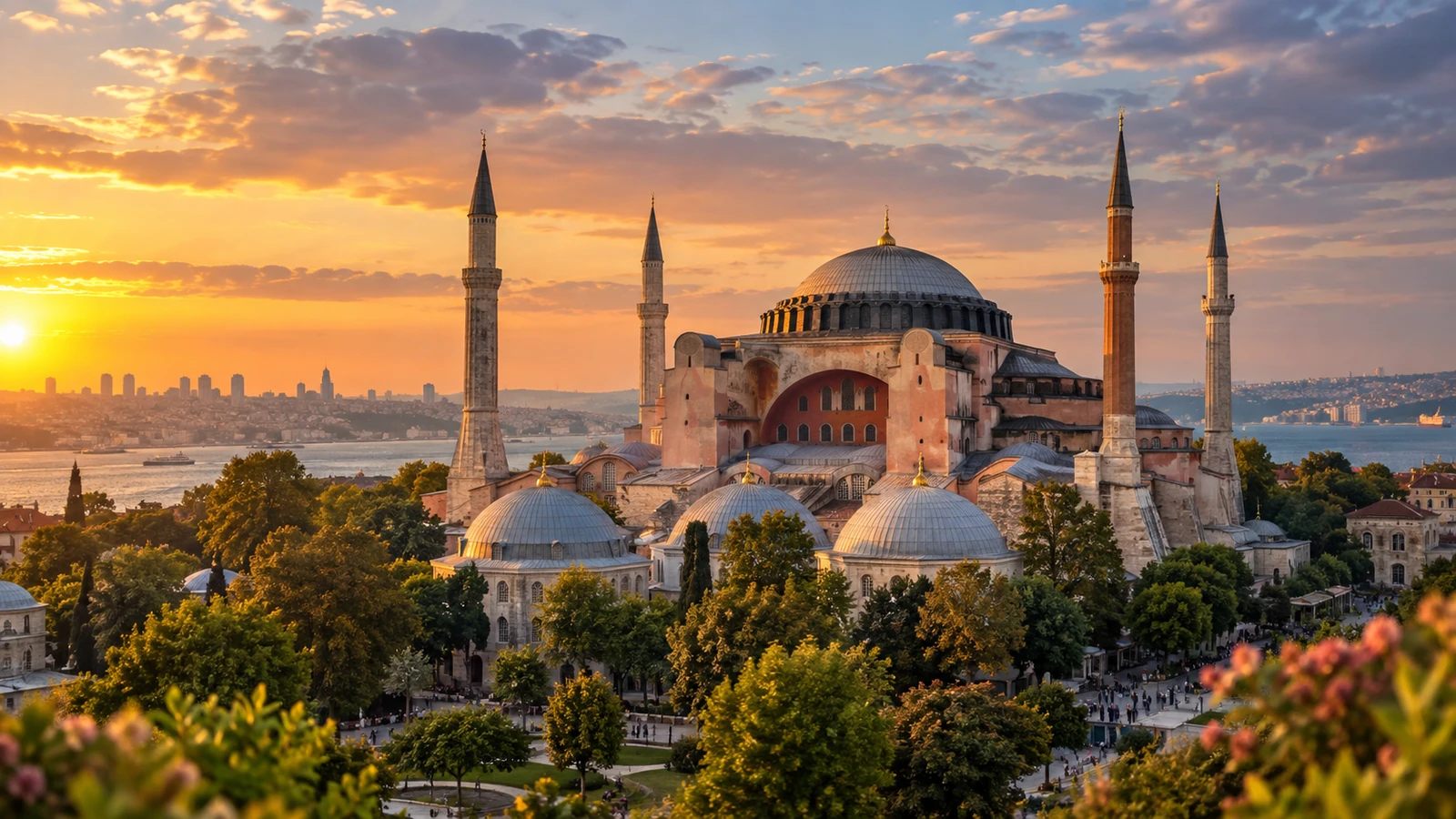
Standing at the crossroads of Europe and Asia, Hagia Sophia has endured for nearly fifteen centuries as a monument to engineering, empire, and religious transformation. First built as the premier cathedral of the Byzantine Empire before becoming an Ottoman imperial mosque and later a museum, this architectural masterpiece has survived earthquakes, conquests, and political upheaval. From secret underground tunnels to ancient Viking graffiti carved into its galleries, Hagia Sophia holds centuries of hidden history beneath its floating golden dome.
1. The Architectural Triumph of the Floating Dome
When Emperor Justinian I commissioned Hagia Sophia in 532 AD, he demanded a structure unlike anything in the ancient world. Architects Isidore of Miletus and Anthemius of Tralles achieved this by pioneering the widespread structural use of pendentives—triangular curved vaulting sections that transition a square room into a circular dome base. This innovative engineering distributed the massive weight downward and outward, eliminating the need for solid supporting walls underneath the dome itself. Combined with forty arched windows encircling the base of the dome, light flooded the interior in a way that made the roof appear suspended by a golden chain from heaven. Contemporary writers noted that the dome seemed to float magically without visible support. This revolutionary design redefined religious architecture across Europe and the Middle East for centuries to come.
2. A Disastrous Earthquake and Subsequent Rebuilding
Building Hagia Sophia took less than six years, an extraordinarily rapid pace for a monument of its scale, but the haste took a toll on structural integrity. In 558 AD, just twenty-one years after its grand opening, a severe earthquake caused the original main dome to collapse entirely. Justinian tasked Isidore the Younger, nephew of the original architect, with rebuilding the sacred structure. Recognizing that the original dome had been too shallow, Isidore raised its height by over six meters to reduce horizontal side-thrust against the walls. He also utilized lighter brick materials imported from Rhodes to lighten the physical load on the supporting arches. Reopened in 562 AD, this revised dome profile gave Istanbul the iconic silhouette that defines its skyline today.
3. Nearly One Thousand Years as the World's Largest Cathedral
For almost a millennium, Hagia Sophia held the undisputed record as the largest cathedral in Christendom. From its consecration in 537 AD until the completion of Seville Cathedral in Spain in 1520, no Christian church on Earth exceeded its sheer internal volume. The cavernous central nave rises to a height of fifty-five meters, creating an immense open indoor space that overwhelmed visiting foreign dignitaries. Its vast dimensions were meant to project the supreme power and divine authority of the Byzantine Empire. Even after its conversion into an imperial mosque in 1453, it remained one of the largest houses of worship in the world. Its vast interior scale continues to mesmerize millions of global visitors every year.
4. Ancient Viking Graffiti Scratched Into Marble Balustrades
Deep within the upper gallery of Hagia Sophia lies unexpected evidence of Scandinavian mercenaries from the Middle Ages. During the ninth and tenth centuries, elite Norse warriors served as the personal bodyguards of the Byzantine Emperor, a unit known as the Varangian Guard. Bored during long religious services, at least two of these Norsemen carved their names into the marble parapets. One famous inscription, discovered in 1964, reads "Halfdan," written using authentic Scandinavian runes. Another nearby inscription translates roughly to "Are made these runes." These subtle carvings serve as tangible proof of the vast cultural connections that converged in Byzantine Constantinople.
5. Built From the Recycled Ruins of Pagan Temples
To construct Hagia Sophia in record time, Emperor Justinian ordered classical monuments throughout the Roman Empire to be stripped for building materials. This practice, known as spolia, physically integrated the ancient pagan world into the new Christian empire. Eight massive dark green marble columns were transported from the Temple of Artemis at Ephesus, one of the Seven Wonders of the Ancient World. Eight giant red porphyry columns were shipped from the Temple of the Sun at Baalbek in modern-day Lebanon. Additional stone, granite, and marble were harvested from quarries in Greece, Egypt, and Syria. This grand recycling project not only sped up construction but also symbolized the complete triumph of Christianity over ancient pagan traditions.
6. The Imperial Gate Legend and Massive Bronze Doors
The largest entrance into Hagia Sophia is the Imperial Gate, reserved historically for the Byzantine Emperor and his ceremonial procession. According to popular medieval legend, the massive timber doors of this entryway were constructed using original wooden planks salvaged from Noah's Ark. Above the entryway, a stunning tenth-century mosaic depicts Emperor Leo VI kneeling humbly before Jesus Christ seated on a throne. The heavy doors flanking the surrounding portals are framed in solid cast bronze and weigh several tons each. Despite their colossal weight, ancient engineers balanced them so precisely that a single person could push them open with minimal effort. Today, these ancient portals remain among the best-preserved architectural elements of the original sixth-century structure.
7. Engineered Marble Echoes and Acoustic Dynamics
The interior of Hagia Sophia was intentionally crafted to create a unique sensory environment for litanies and sacred chanting. Because the lower walls are clad in polished marble and the soaring vaulting features smooth plaster and glass mosaics, sound reflects in an extraordinary manner. Acoustic testing shows that a single sound produced inside the nave reverberates for up to eleven seconds. This creates a lingering, ethereal wash of sound where musical notes blend into a continuous atmospheric hum. Byzantine choirs composed music specifically tailored to take advantage of these unique temporal echoes. Centuries later, Islamic calls to prayer and recitation utilized these same acoustic qualities to fill the vast cavern with resonance.
8. Hidden Subterranean Tunnels and Unexplored Vaults
Beneath the grand marble floors of Hagia Sophia lies an intricate network of underground tunnels, crypts, and water cisterns. For centuries, rumors persisted that secret passages connected the cathedral directly to the Great Palace of Constantinople and distant parts of the city. In recent decades, speleologists and divers equipped with specialized cameras have explored portions of these flooded subterranean passages. They discovered submerged stone corridors, centuries-old burial vaults, and lost artifacts dropped by medieval workmen. Much of this underground realm remains uncharted due to structural risks and water levels. Researchers continue to map these dark subterranean corridors to unlock the building's final hidden structural secrets.
9. Ottoman Plaster Unwittingly Saved Priceless Mosaics
When Sultan Mehmed II conquered Constantinople in 1453 and converted Hagia Sophia into a mosque, Islamic law prohibited figurative depictions of human forms in prayer spaces. However, rather than chiseling away or destroying the magnificent Christian mosaics, Ottoman restorers covered them with fine plaster and whitewash. Intricate geometric patterns and Islamic calligraphy were then painted over the plastered surfaces to suit Muslim worship. This protective plaster coating shielded delicate gold-leaf tiles from environmental exposure, moisture, and soot for nearly four centuries. When Swiss architects Gaspare and Giuseppe Fossati restored the building in the 1840s, they uncovered the pristine mosaics beneath. This careful historical layering allowed modern conservators to restore some of the finest surviving Byzantine artworks in existence.
10. Mirror-Matched Marble Slabs That Resemble Water
The wall coverings in Hagia Sophia showcase one of the most stunning decorative techniques of the ancient world: marble book-matching. Byzantine stonemasons took thick blocks of veined Proconnesian marble from the nearby Island of Marmara and sawed them into thin, parallel slices. These matching marble slabs were then unfolded and mounted side by side like pages in an open book. The continuous natural veining produced symmetrical patterns that resemble flowing water, atmospheric clouds, or mysterious mythological figures. Byzantine writers recorded that walking along the nave felt like wading through a frozen ocean of swirling stone waves. This clever artistic manipulation turned raw geological materials into dynamic, moving interior art.
11. The Mystical Powers of the Weeping Column
Located in the northwest section of the building stands the Column of Saint Gregory, commonly known as the Weeping Column or Wishing Column. Covered in protective bronze plates, this marble pillar features a deep thumb-sized hole that continuously secretes moisture. According to ancient local folklore, the column has wept tears ever since Saint Gregory the Miracle Worker performed a divine blessing there in the fourth century. Visitors have flocked to the column for centuries, inserting their thumb into the hole and rotating it in a complete circle while making a wish or seeking healing from ailments. The fluid is actually drawn up from subterranean cisterns via capillary action through the porous stone. Nevertheless, the tradition remains one of the most popular interactive rituals inside the historic structure today.
12. Massive Wooden Calligraphic Medallions
Dominating the upper levels of Hagia Sophia's main hall are eight gigantic circular wooden calligraphic medallions added during nineteenth-century restorations. Crafted by the renowned Ottoman calligrapher Kazasker Mustafa İzzet Efendi, these roundels measure an astounding 7.5 meters in diameter. They feature elegant gold-painted Arabic script displaying the names of Allah, the Prophet Muhammad, the first four Caliphs, and Muhammad’s two grandsons. Constructed from light linden wood, they were assembled directly inside the gallery because their massive size made it impossible to carry them through the entry doors. When Hagia Sophia was converted into a museum in 1935, secular authorities attempted to remove the panels, but could not extract them without damaging the doors. They remain the largest calligraphic works in the Islamic world today.
13. Structural Interventions by Master Architect Mimar Sinan
Over the centuries, the immense weight of Hagia Sophia's central dome placed severe outward pressure on the surrounding walls, threatening total collapse. During the sixteenth century, the legendary Ottoman chief architect Mimar Sinan was tasked with saving the aging monument from inevitable destruction. Sinan engineered massive external stone buttresses around the exterior perimeter, dramatically bracing the main walls against lateral seismic forces. He also constructed two high minarets at the western end of the building, which added essential vertical counterweight to stabilize the structure. Without Sinan's brilliant structural additions, the building likely would have succumbed to one of Istanbul's major destructive earthquakes. His intervention successfully extended the physical lifespan of the ancient masterpiece by centuries.
14. The Blueprint for Classical Ottoman Mosque Architecture
Following the 1453 Ottoman conquest, Hagia Sophia's breathtaking central dome and vast spatial arrangement profoundly altered the course of Islamic architecture. Rather than relying solely on traditional pillared hypostyle mosque designs, Ottoman architects embraced Hagia Sophia's grand central-plan geometry. Generations of master builders studied the monument's proportion, pendentive structures, and light integration to create a new style of imperial worship space. This architectural dialogue directly inspired major Istanbul landmarks, including the Süleymaniye Mosque, the Şehzade Mosque, and the famous Blue Mosque. By blending Byzantine engineering principles with Islamic aesthetics, Ottoman architects developed a distinctive architectural style that defined the skyline of Istanbul.
15. A Complex Modern Journey Across Faiths and Statuses
In 1935, Mustafa Kemal Atatürk, the founder of the modern secular Republic of Turkey, ordered Hagia Sophia to be converted from an active mosque into a public museum. This historic decision transformed the building into a neutral monument celebrating both its Christian Byzantine and Islamic Ottoman heritages simultaneously. UNESCO designated it as a World Heritage Site in 1985, highlighting its unique international importance as a cultural crossroad. In July 2020, following a landmark legal ruling that annulled the 1935 decree, the Turkish government officially reclassified the building back into a functioning mosque. Today, Christian mosaics in the prayer area are shielded by retractable curtains during active Muslim prayer times while remaining accessible to global tourists outside of service hours. This continuous evolution reflects Hagia Sophia's enduring role as a living symbol of spiritual and political history.
Sources & References
This AI-assisted post was rigorously curated and fact-checked for accuracy by:
 Martin Roháček
How fun was this article? 🤔
Tap a star to rate it
🧠 Quiz: How closely were you paying attention?
10 questions — all answers are in the article above!
Enjoyed these facts? There's more! 💌
Fresh fun facts in your inbox. No spam, ever.