The Clowns of the Sea: 15 Fascinating Facts About Puffins
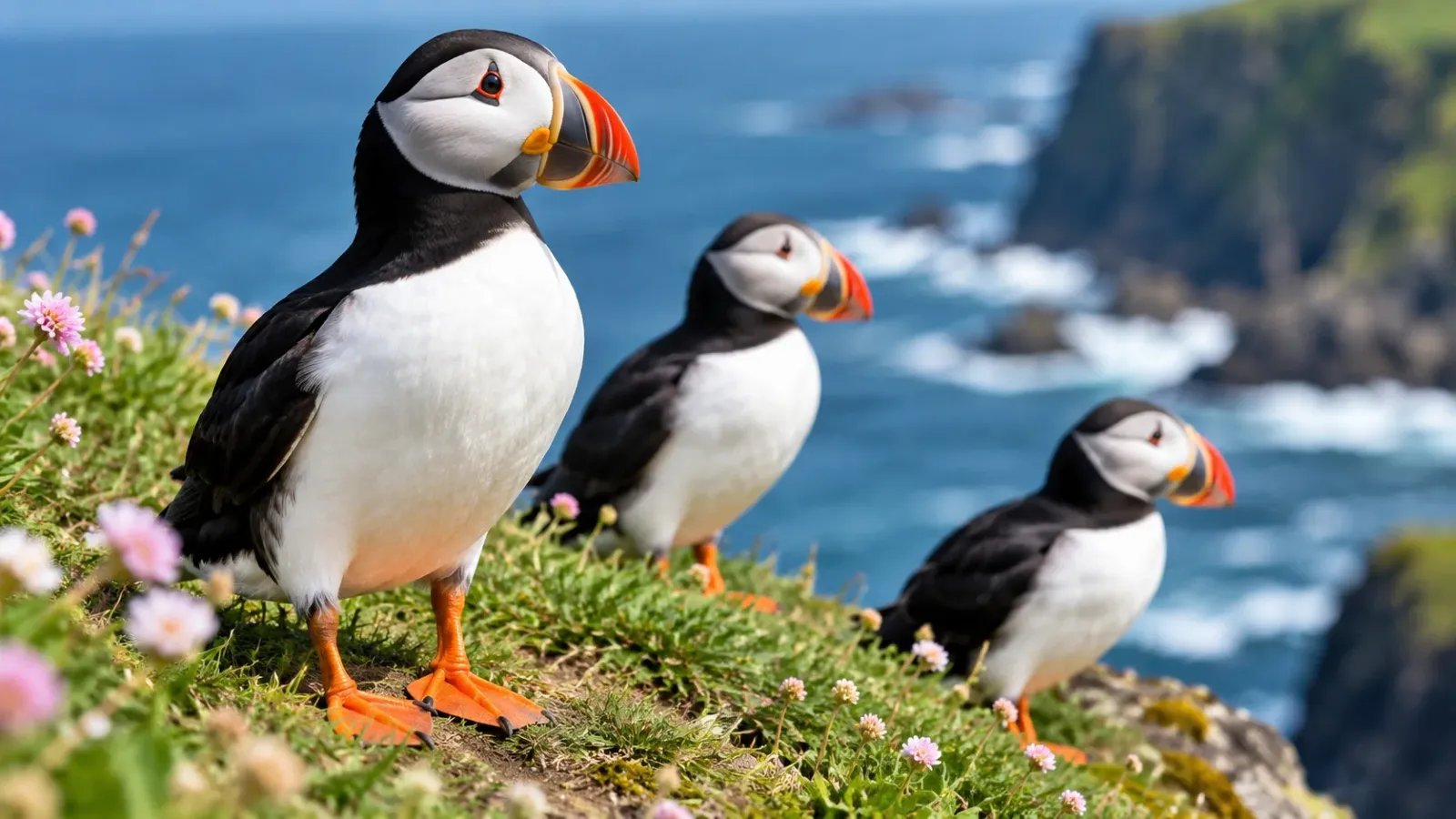
With their colourful beaks and comical waddle, puffins are often called the clowns of the sea. But these little seabirds are also expert divers, tireless flyers and devoted parents whose chicks are sometimes rescued by children carrying cardboard boxes. Here are the surprising facts about the puffin.
1. A puffin's colourful beak is only for the breeding season.
The Atlantic puffin's famous red, yellow and blue-grey beak is at its brightest in spring and summer, when the birds gather to breed. In winter, out at sea, puffins shed the colourful outer plates of their beaks and their faces turn greyer. The bright colours return the following spring, when they need to impress a partner again.
2. They can carry a whole row of fish at once.
Puffins can catch several small fish in a single dive without letting the first ones go. Their tongue is muscular and grooved, and spines on the roof of the mouth help to hold each fish in place while the bird opens its beak to catch the next. Puffins regularly return to their chicks with a beak full of a dozen or more sand eels lined up neatly side by side.
3. They fly with their wings underwater.
Puffins are excellent swimmers that use their wings to "fly" underwater, steering with their feet. They usually dive to depths of a few dozen metres in search of sand eels, herring, capelin and sprats. An adult needs to eat dozens of small fish every day to stay healthy.
4. Their wings beat incredibly fast.
Because their small wings are built for both swimming and flying, puffins have to flap extremely quickly to stay in the air, up to around 400 times a minute. They can reach speeds of about 80 kilometres per hour. Taking off is not always graceful: they often patter across the surface of the water, wings whirring, before finally lifting off.
5. Their burrows sound like chainsaws.
Puffins are almost silent at sea and fairly quiet on land. Inside their burrows, however, they make a deep, growling call that has been compared to the sound of a chainsaw being revved. This strange noise is used to communicate with their partners and defend their nesting sites.
6. They dig their own homes.
Puffins nest in colonies on grassy clifftops and islands. Each pair digs a burrow in the soil using its beak and feet, or takes over an existing hole, sometimes one made by a rabbit. Many pairs return to the same burrow year after year and stay together for many breeding seasons.
 Birds of the World
From record-breaking aerial plunge-divers to massive flightless icons, the avian world is a marvel of evolutionary engineering. Discover the extraordinary intellects, specialized survival skills, and hidden superpowers of the planet's most fascinating birds.
See All Facts
7. Each pair raises just one chick a year.
A female puffin lays a single white egg, which soon becomes covered with mud. Both parents take turns keeping it warm. The chick, called a puffling, hatches after about six weeks and is fed whole fish by both parents until it is ready to leave the nest.
8. Children in Iceland rescue lost pufflings.
When pufflings leave their burrows, they head for the sea at night, possibly guided by moonlight. On the Icelandic island of Heimaey, many young birds become confused by street lights and crash-land in the town. Every year, local children patrol the streets with cardboard boxes, collect the stranded pufflings and release them safely at the sea the next morning.
9. Young puffins stay at sea for years.
After leaving their burrow, young puffins swim out to sea and do not return to land for several years. They spend that time roaming the North Atlantic, far from shore. They only begin breeding when they are around four or five years old.
10. Most of the world's Atlantic puffins live in Iceland.
The Atlantic puffin breeds on coasts and islands from Russia and Norway to Britain, Ireland, Iceland, Greenland and eastern Canada. Iceland alone is home to around 60 percent of the world's population. The Westman Islands, off Iceland's south coast, hold one of the largest colonies of all.
11. They are known by many nicknames.
The puffin's bright beak, waddling walk and upright posture have earned it nicknames such as "clown of the sea" and "sea parrot". The British island of Lundy is thought to take its name from the Old Norse for "puffin island". The Atlantic puffin is also the official bird of the Canadian province of Newfoundland and Labrador.
12. Decoys brought puffins back to Maine.
By the early 20th century, hunting had wiped out puffins on most islands off the coast of Maine. In 1973, ornithologist Stephen Kress launched Project Puffin, bringing puffin chicks from Newfoundland to Eastern Egg Rock and using wooden decoys and mirrors to make the island look like a busy colony. The trick worked, and puffins returned to breed there for the first time in nearly a century.
13. Their beaks glow under ultraviolet light.
In 2018, researchers discovered that the yellow ridges on a puffin's beak glow when exposed to ultraviolet light. Puffins can see ultraviolet light, which humans cannot, so the glow may make their beaks look even more striking to one another. Scientists are still investigating what role it plays in puffin life.
14. Puffins have become a vulnerable species.
Although there are still millions of Atlantic puffins, their numbers have fallen sharply in parts of Europe. In 2015, the IUCN reclassified the species as Vulnerable. Scientists link the decline to changes in the sea, including warming waters that affect the small fish puffins depend on to feed their chicks.
15. There are three other kinds of puffin.
The Atlantic puffin is the only puffin of the Atlantic Ocean, but the Pacific is home to three relatives: the horned puffin, the tufted puffin and the rhinoceros auklet. The tufted puffin has dramatic golden head plumes during the breeding season. All of them belong to the auk family, which also includes guillemots and razorbills.
Sources & References
This AI-assisted post was rigorously curated and fact-checked for accuracy by:
 Martin Roháček
How fun was this article? 🤔
Tap a star to rate it
🧠 Quiz: How closely were you paying attention?
10 questions — all answers are in the article above!
Enjoyed these facts? There's more! 💌
Fresh fun facts in your inbox. No spam, ever.