The Ocean Giant: 15 Fascinating Facts About Sperm Whales
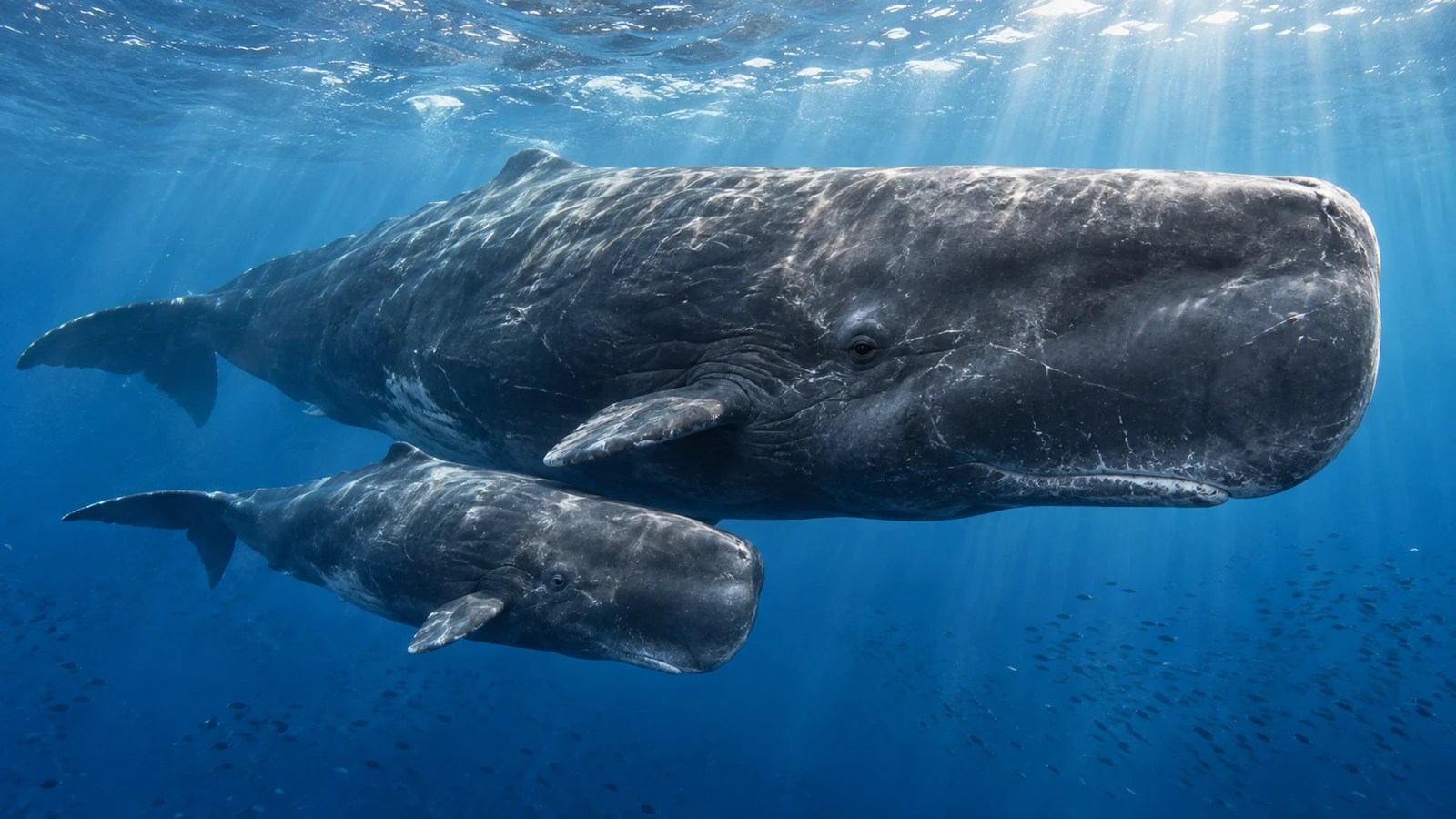
Sperm whales are among the ocean's most enigmatic leviathans, holding records for the largest brain on Earth and producing the loudest sound in the animal kingdom. From hunting giant squid in the pitch-black abyss to sleeping vertically in floating pods, these massive deep-divers possess extraordinary physiological adaptations. Discover the surprising history behind their name, their role in fighting climate change, and the real-life encounter that inspired Moby-Dick.
1. They Produce the Loudest Sound of Any Animal on Earth
Sperm whales produce the loudest acoustic sounds of any living organism on Earth. Their brief echolocation clicks can reach an astonishing 230 decibels under water, which easily surpasses the sound level of a jet engine taking off at close range. These powerful sound waves pass through the whale's massive spermaceti organ, acting like a concentrated acoustic lens to pinpoint prey in pitch-black depths. The intense pressure waves of these clicks are strong enough to stun giant squid or potentially vibrate a human body to death if experienced at close range in water. Because sound travels far more efficiently in water than in air, sperm whales can communicate with pod members across hundreds of miles of open ocean using distinct clicking patterns called codas.
2. Entire Pods Sleep Vertically Floating Like Logs
Unlike most marine mammals that drift horizontally, sperm whales engage in a surreal behavioral phenomenon known as vertical sleeping. Entire pods will suspend themselves upright in the ocean column, floating like gigantic submerged logs just below the water's surface. These synchronized power naps are surprisingly brief, usually lasting between 10 and 30 minutes at a time. During these restorative periods, the whales do not breathe or react to gentle surrounding stimuli, entering one of the deepest sleep states documented in marine life. Researchers discovered this striking behavior in 2008 when a research vessel accidentally drifted into a group of motionless, standing whales floating together off the coast of Chile.
3. They Possess the Largest Brain in Earth's History
The sperm whale possesses the largest single brain of any creature to ever exist on Earth, modern or prehistoric. Tipping the scales at roughly 18 pounds (8 kilograms), a sperm whale's brain is approximately five times heavier than a mature human brain. Despite its immense size, the whale's brain yields a lower brain-to-body mass ratio compared to humans or bottlenose dolphins. However, their vast cerebral structures possess a highly complex neocortex and specialized spindle neurons associated with complex social bonding, emotional processing, and communication. This sophisticated neural architecture allows sperm whale pods to maintain intricate cultural traditions and regional dialects passed down through generations.
4. Early Whalers Mistook Waxy Head Oil for Semen
The sperm whale owes its unusual common name to early 18th-century whalers who misunderstood the animal's complex anatomy. Inside the whale's enormous head lies a vast cavity filled with a clear, waxy fluid known as spermaceti. Sailors mistakenly believed this yellowish fluid was stored reproductive semen, leading to the misleading moniker that persists today. In reality, the spermaceti organ plays a critical physiological role by regulating buoyancy during deep dives and amplifying echolocation clicks. Whalers aggressively targeted sperm whales specifically for this valuable oil, which burned cleanly without smoke in lamps and served as a high-grade industrial lubricant.
5. They Battle Giant Squid in the Deep Abyss
Sperm whales are the ocean's ultimate deep-sea hunters, frequently descending thousands of feet to do battle with giant squid (Architeuthis dux). Because these titanic battles take place in the pitch-black abyss, human eyes have never directly observed a live combat encounter between the two ocean giants. However, clear evidence of these epic struggles is written directly onto the whales' bodies. Adult sperm whales routinely bear prominent circular scars around their heads and flanks, left by the hooked serrated suckers of desperate squid fighting for their lives. Furthermore, indigestible squid beaks are routinely found inside the stomachs of harvested or stranded sperm whales, proving these cephalopods form the core of their diet.
6. Their Digestive Waste Can Be Worth Millions
One of the most valuable animal products in the world originates as a protective digestive response inside the sperm whale's intestines. Sharp squid beaks can irritate the whale's internal organ lining, prompting their gut to secrete a fatty, resinous substance that encapsulates the hard beaks. Eventually excreted or vomited into the sea, this foul-smelling mass hardens upon exposure to sunlight and salt water, transforming into a fragrant material called ambergris. High-end perfumers prize raw ambergris immensely because it acts as a fixative, allowing luxury scents to remain on human skin for days. Single boulders of high-quality ocean ambergris found washed ashore can command market prices reaching hundreds of thousands of dollars.
 Marine and Freshwater Animals
See All Facts
Marine and Freshwater Animals
See All Facts
7. They Can Hold Their Breath for Up to 90 Minutes
To hunt deep-dwelling cephalopods, sperm whales must perform some of the most extreme deep dives of any air-breathing mammal. A single dive can routinely extend up to 90 minutes, with some recorded dives stretching beyond two hours in length. To survive these prolonged trips into the ocean depths, sperm whales store vast quantities of oxygen in their muscles and blood rather than relying on their lungs. Their muscle tissues contain extremely high concentrations of myoglobin, a specialized protein that binds and stores oxygen far more efficiently than human muscle tissue. This unique biochemical adaptation allows them to plunge over 10,000 feet deep where water pressure is completely unlivable for most air-breathers.
8. Their Blowhole Sits Asymmetrically on the Left Side
Unlike most baleen whales that possess two symmetrical blowholes on top of their head, the sperm whale features an asymmetrical single blowhole situated on the far left side of its snout. This off-center anatomical placement produces a distinctively slanted bushy blowhole spray that shoots forward and to the left at a 45-degree angle. Experienced mariners and whale watchers can identify a sperm whale miles away solely by observing this characteristic diagonal vapor cloud rising above the water line. Internally, this evolutionary asymmetry reflects the specialized acoustic structures inside the head, where the right nasal passage has evolved almost entirely to generate intense sonic clicks rather than handle respiration.
9. They Only Have Functional Teeth on Their Lower Jaw
The dental anatomy of the sperm whale is strikingly unusual compared to other predatory marine mammals. They possess up to 50 thick, cone-shaped teeth exclusively along their narrow lower jaw, while the upper jaw contains matching hollow sockets with virtually no visible teeth. Individual teeth can grow up to eight inches long and weigh over two pounds each, yet they are not primarily used for chewing prey. Sperm whales typically swallow giant squid and large deep-water fish completely whole using powerful suction created by their throat muscles. Marine biologists believe these heavy teeth may serve primarily as weapons during competitive battles between rival males fighting for breeding dominance.
10. Their Skin Features a Wrinkled Prune-Like Texture
While dolphins and killer whales boast sleek, smooth skin designed for high-speed swimming, sperm whales display a surprisingly wrinkled, prune-like exterior. This corrugated skin texture features long parallel ridges running along the animal's back and sides behind its blunt head. Scientists hypothesize that this unique surface texture creates micro-turbulences in the water, which paradoxically reduces overall hydrodynamic drag as the whale travels through deep water. Additionally, this corrugated epidermal structure provides extra flexibility, allowing the whale's massive body to expand and contract under severe hydrostatic pressure during extreme vertical dives.
11. A Real-Life Albino Whale Inspired the Legend of Moby-Dick
Herman Melville's classic 1851 novel Moby-Dick was directly inspired by real historical encounters with a notorious albino bull sperm whale named Mocha Dick. Operating near Mocha Island off the coast of central Chile, this massive white whale survived dozens of attacks by whalers, destroying multiple boats and killing numerous crew members in self-defense. In 1820, another angry sperm whale rammed and sank the Nantucket whaleship Essex in the remote Pacific ocean, an harrowing disaster that stranded the crew for months. Melville combined these dramatic maritime accounts into his famous literary masterpiece, immortalizing the sperm whale as an unstoppable symbol of nature's formidable power.
12. Their Ribs and Lungs Deliberately Collapse Under Pressure
Surviving at depths exceeding 3,000 feet requires incredible physiological adaptations to withstand crushing water pressures that exceed 100 times atmospheric pressure at the surface. Sperm whales accomplish this impossible feat thanks to a highly flexible, collapsible ribcage attached to pliable cartilage connections. As the whale plunges into the abyss, hydrostatic pressure forces the lungs to completely collapse, pushing remaining air into non-absorptive nasal passages. This deliberate collapse prevents harmful nitrogen gas from dissolving into the bloodstream under high pressure, protecting the whale from decompression sickness, commonly known as the bends. Once returning to the surface, their resilient pulmonary system instantly reinflates without structural damage.
13. Grandmothers Babysit Calves While Mothers Dive Deep
Sperm whale society operates within tightly knit, matriarchal pods composed of related females and their dependent offspring. Because young calves lack the oxygen capacity to follow their mothers into deep feeding dives, pods employ a system of communal care and alloparenting. Older females, particularly grandmothers who are no longer raising their own calves, remain near the ocean surface to babysit and protect young calves from predators like killer whales. This division of labor allows foraging mothers to spend hours hunting deep below without risking the safety of their vulnerable young. These female family units remain together for decades, maintaining lifelong bonds that form the bedrock of sperm whale culture.
14. Males Can Weigh Three Times More Than Females
Sperm whales display one of the most pronounced cases of sexual dimorphism among all living mammals. Mature males, known as bulls, grow significantly larger than adult females, reaching lengths of up to 60 feet and weighing up to 50 tons. In stark contrast, female cows rarely exceed 36 feet in length and weigh approximately 15 tons, meaning a fully grown bull can weigh up to three times more than a female. Beyond body size, mature males leave their tropical birth pods in early adulthood to live solitary lives near freezing polar waters, only returning to warmer equatorial waters to breed. This dramatic physical and geographical divergence minimizes resource competition between males and nursing female pods.
15. Their Poop Helps Combat Global Climate Change
Despite their predatory nature, sperm whales play a surprisingly crucial role in regulating global climate patterns through their biological waste. Because sperm whales feed on deep-sea prey but defecate near the sunlit surface, they transport massive quantities of vital nutrients like iron back to upper ocean layers. This iron-rich whale poop acts as a natural fertilizer that sparks massive blooms of microscopic marine algae known as phytoplankton. Phytoplankton absorb vast amounts of atmospheric carbon dioxide through photosynthesis, trapping carbon when they eventually die and sink to the ocean floor. Scientists estimate that Southern Ocean sperm whales alone help remove tens of thousands of tons of carbon from the atmosphere every year.
Sources & References
This AI-assisted post was rigorously curated and fact-checked for accuracy by:
 Martin Roháček
How fun was this article? 🤔
Tap a star to rate it
🧠 Quiz: How closely were you paying attention?
10 questions — all answers are in the article above!
Enjoyed these facts? There's more! 💌
Fresh fun facts in your inbox. No spam, ever.