The Night Martians Invaded: 15 Fascinating Facts About the War of the Worlds Broadcast
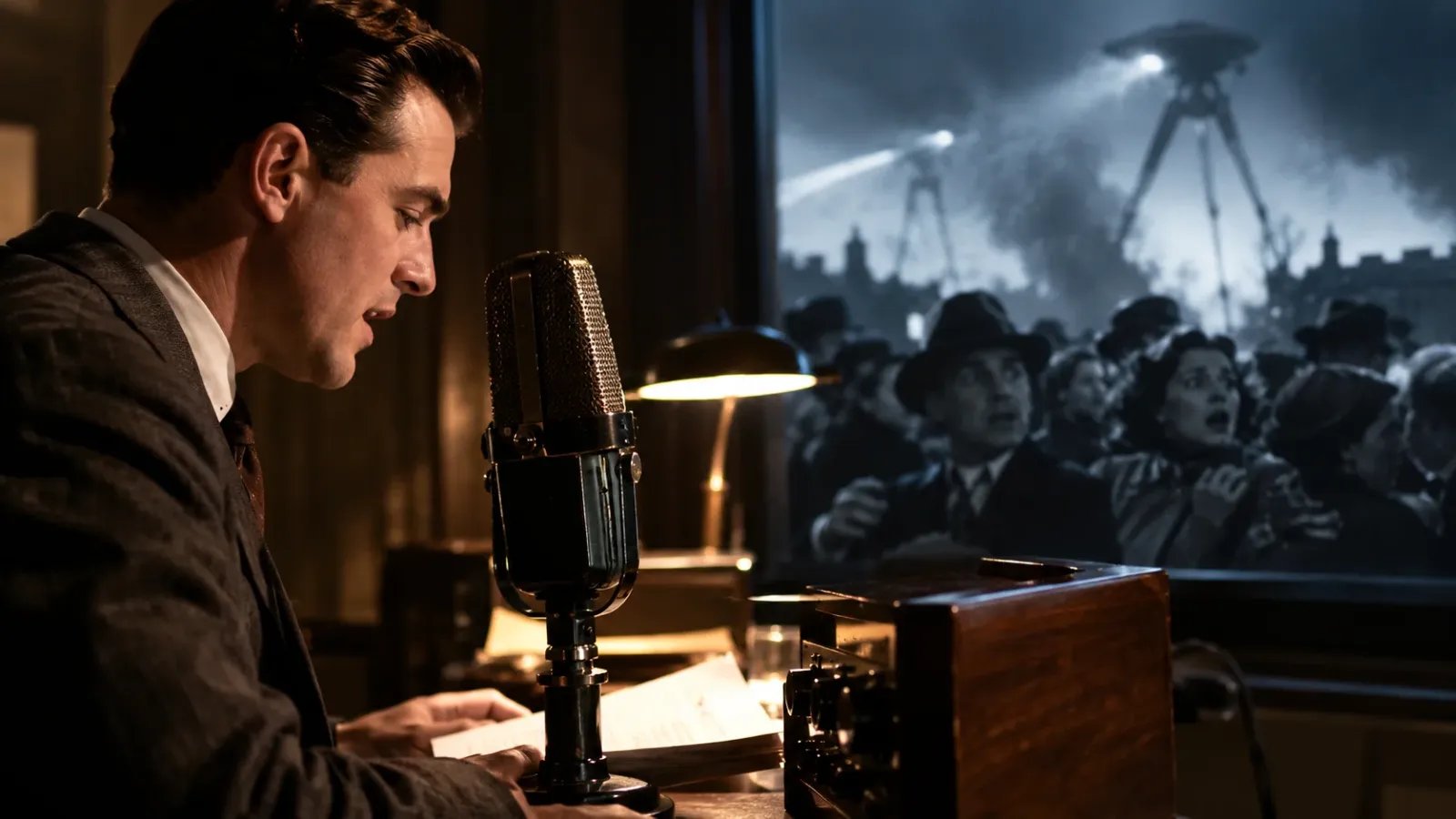
On the night before Halloween in 1938, a 23-year-old Orson Welles told radio listeners that Martians had landed in New Jersey. The broadcast became one of the most famous moments in media history, but the legendary nationwide panic was far smaller than the newspapers claimed. Here is what really happened on the night America was "invaded."
1. It aired on the night before Halloween.
On Sunday, October 30, 1938, the CBS radio series The Mercury Theatre on the Air broadcast a Halloween special: an adaptation of H. G. Wells's 1898 novel The War of the Worlds. The show was directed and narrated by Orson Welles, who was just 23 years old at the time.
2. It was told as a series of breaking news bulletins.
Instead of telling the story as an ordinary drama, the broadcast began like a typical evening of dance music, which was repeatedly interrupted by increasingly alarming news bulletins. Listeners heard reports of explosions on Mars, a strange object landing on a farm, eyewitness accounts and the voices of officials, all played by actors.
3. The landing site was picked almost at random.
Screenwriter Howard Koch moved the story from England to New Jersey. He later said he chose the tiny village of Grover's Mill by dropping a pencil on a map. Overnight, the community near Princeton became the most famous landing site in science fiction.
4. Listeners were told it was fiction, more than once.
The program opened with an announcement that it was a dramatization of Wells's novel. A similar announcement was made at the station break about 40 minutes in, and again at the end. Welles closed the show by explaining that it was simply the Mercury Theatre's way of shouting "Boo!" for Halloween.
5. Very few people were actually listening.
The Mercury Theatre was a relatively small show competing against one of the most popular programs on radio, NBC's Chase and Sanborn Hour, starring ventriloquist Edgar Bergen and his dummy Charlie McCarthy. A ratings survey conducted that night found that only about 2% of respondents were listening to Welles.
6. Newspapers greatly exaggerated the panic.
The next morning, newspapers across the country ran dramatic stories about hysterical crowds and mass flight from cities. Media historians now believe the panic was much smaller than reported. Newspapers were losing advertising money to radio, and a story showing the new medium as dangerous and irresponsible suited them perfectly.
7. A famous study helped create the legend.
In 1940, Princeton researcher Hadley Cantril published The Invasion from Mars, which estimated that about 6 million people had heard the broadcast and more than a million had been frightened. Later scholars criticized his methods, but the study helped cement the idea that the broadcast had terrified America.
8. Some people really were scared.
The panic may have been exaggerated, but it was not invented. Police stations, newspaper offices and radio stations received a flood of phone calls from worried listeners. One theory is that people who tuned in late, after flipping away from the Chase and Sanborn Hour, missed the opening announcement and believed what they heard.
9. A Grover's Mill water tower supposedly came under fire.
According to a local legend, armed residents of Grover's Mill mistook a wooden water tower for a Martian war machine and shot at it. The story is impossible to verify, but it remains a favorite part of local lore.
10. Welles apologized the next morning.
On October 31, Welles faced reporters at a press conference in New York. Looking tired and contrite, he said he was deeply shocked that anyone had taken the broadcast seriously. Many people suspected he was secretly delighted with the attention.
11. The scandal made Welles famous.
Instead of ending his career, the broadcast turned Welles into a national celebrity. Campbell's Soup soon agreed to sponsor his radio show, and in 1939 he signed a contract with RKO Pictures that gave him unprecedented creative control. The result was his first feature film, Citizen Kane (1941), often ranked among the greatest movies ever made.
12. The government took no action.
The Federal Communications Commission investigated the broadcast after receiving complaints, but it decided not to punish CBS or Welles. Networks, however, became more careful about using realistic news bulletins in fictional programs. Several lawsuits were filed against CBS, but none of them succeeded.
13. H. G. Wells and Orson Welles later met on the radio.
H. G. Wells was initially unhappy that his novel had been adapted so freely. In October 1940, the two men met and appeared together on a radio station in San Antonio, Texas. They joked about the broadcast and their similar names, and Wells teased Welles about the panic he had caused.
14. A later version in Ecuador ended in tragedy.
In February 1949, Radio Quito in Ecuador aired a Spanish-language adaptation set in the local area. When listeners realized they had been fooled, an angry mob attacked and set fire to the building housing the station. At least six people were killed, making it far deadlier than the original broadcast.
15. The script's writer went on to win an Oscar.
Howard Koch, who wrote the radio script, later moved to Hollywood and co-wrote the screenplay for Casablanca (1942), which won him an Academy Award. In 1988, Grover's Mill unveiled a monument marking the 50th anniversary of the broadcast, showing Welles at the microphone, a family listening to the radio and a Martian ship.
Sources & References
This AI-assisted post was rigorously curated and fact-checked for accuracy by:
 Martin Roháček
How fun was this article? 🤔
Tap a star to rate it
🧠 Quiz: How closely were you paying attention?
10 questions — all answers are in the article above!
Enjoyed these facts? There's more! 💌
Fresh fun facts in your inbox. No spam, ever.