The Dream Factory: 15 Fascinating Facts About Hollywood
Long before it became the glittering capital of global cinema, Hollywood was a quiet, alcohol-free agricultural community founded by prohibitionists. From rogue filmmakers escaping Thomas Edison's patent monopolies to iconic real estate billboards that accidentally became historic monuments, the story of Tinseltown is full of unexpected twists. Explore the hidden history, grueling early studio conditions, and industry-shaking court rulings that transformed a dusty orange grove into the epicenter of worldwide entertainment.
1. Hollywood Was Originally Founded as a Strict Temperance Town
Before it became the global epicenter of show business, Hollywood was established in 1887 as a strictly temperance-focused utopian settlement. Founded by Harvey and Daeida Wilcox, the town enforced rigid moral laws that prohibited the sale or consumption of alcohol. Early local ordinances even banned pool halls, bowling alleys, and nickelodeon theaters to preserve a quiet, pious atmosphere. Property deeds explicitly restricted undesirable businesses, ensuring that early residents lived in a sober agricultural enclave surrounded by citrus groves. It was only when eastern film companies migrated west that the town's quiet, prohibitionist character was irreversibly transformed.
2. A Real Estate Developer Opened the District's First Luxury Hotel
Real estate developer H.J. Whitley is widely remembered as the "Father of Hollywood" for transforming a sleepy rural outpost into an attractive residential community. In 1902, Whitley opened the luxurious Hollywood Hotel on Hollywood Boulevard, creating an elegant destination for wealthy easterners and prospective land buyers. He established essential infrastructure, laid out grid streets, and installed electric lighting to attract high-society residents long before the arrival of the movie industry. Whitley also helped popularize the name "Hollywood," which legendary lore claims came from a chance conversation with a local worker hauling wood. His early developments established the geographic foundation that eventually lured pioneering filmmakers to the area.
3. Filmmakers Migrated West to Escape Thomas Edison's Patent Monopoly
In the early 1900s, legendary inventor Thomas Edison dominated the film industry through the Motion Picture Patents Company, which held aggressive monopolies on camera technology and projector patents. Independent filmmakers faced constant lawsuits, extortionate licensing fees, and physical intimidation by Edison's hired enforcers on the East Coast. To escape this legal stranglehold, rogue directors moved 3,000 miles across the country to Southern California. Federal marshals struggled to enforce patent injunctions across such a vast distance, giving directors room to operate. Furthermore, Hollywood's close proximity to the Mexican border allowed filmmakers to easily haul their equipment out of the country if process servers drew near.
4. Southern California's Climate Was the Ultimate Early Production Tool
The primitive film emulsion used in early cinema required immense amounts of illumination to capture sharp images on camera. Southern California offered an unmatched operational advantage by boasting over 300 days of reliable annual sunshine and virtually no rain for months at a time. This allowed early production crews to shoot outdoors year-round without wasting expensive capital on unreliable artificial lighting. Additionally, the surrounding landscape featured mountains, deserts, forests, and oceans all located within a short driving distance. This extraordinary geographic diversity enabled studios to double the local terrain for almost any location in the world.
5. Hollywood's First Permanent Studio Was Housed in a Former Tavern
The very first permanent movie studio in Hollywood was established in October 1911 by the New Jersey-based Nestor Motion Picture Company. Founders David and William Horsley rented an abandoned roadhouse known as the Blondeau Tavern on the corner of Sunset Boulevard and Gower Street. They converted the former drinking establishment's backyard into an open-air wooden stage with canvas tarps to filter natural sunlight. Within months, rival production companies flooded the surrounding neighborhood, turning Gower Street into an area famously known as "Gower Gulch." This humble conversion marked the official birth of Hollywood as the permanent capital of American filmmaking.
6. The Iconic Sign Was Originally an Illuminated Real Estate Billboard
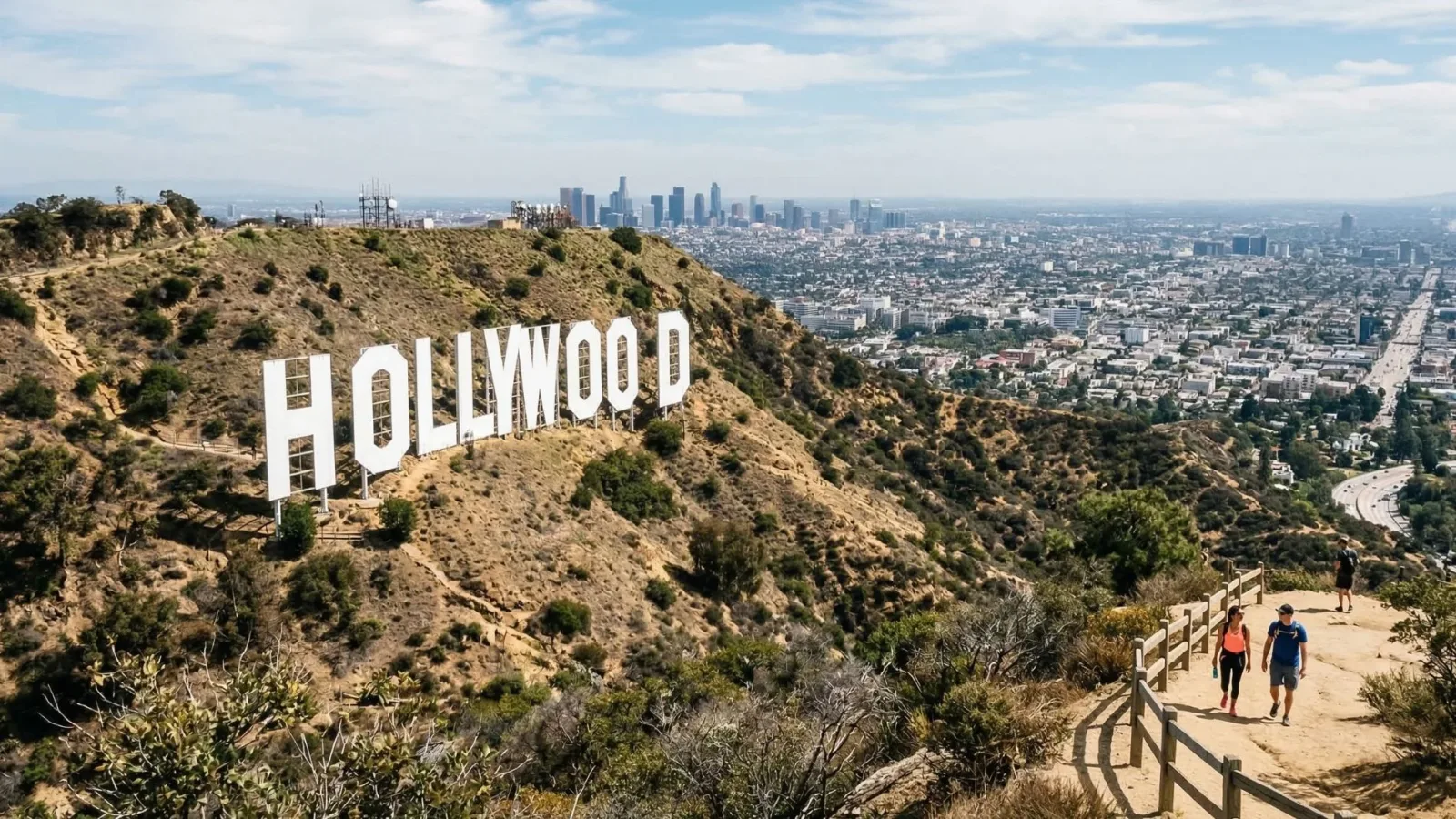
The famous landmark overlooking the district was never created to promote the film industry or celebrate cinematic history. Erected in 1923, the sign originally spelled out "HOLLYWOODLAND" as a giant billboard for a high-end real estate development in Beachwood Canyon. Real estate developers spent over $21,000 to construct fifty-foot-high metal letters attached to telephone poles and scaffolding. The entire structure was illuminated by 4,000 flashing lightbulbs, requiring a live-in caretaker to regularly replace burnt-out bulbs in the hills. What began as a temporary suburban advertisement eventually grew into an international symbol of cinematic glamour.
7. The Hollywood Sign Was Only Intended to Last for Eighteen Months
When the real estate developers erected the "HOLLYWOODLAND" sign in 1923, it was designed to stand for only eighteen months until the residential housing plots were sold. However, as the silent film era exploded into a global phenomenon, the giant letters became a universally recognized landmark associated with the movie business. Left largely unmaintained through the Great Depression, the sign suffered severe decay, with the letter "H" even collapsing in the 1940s. Local residents debated tearing the eyesore down completely, but its famous image had already been etched into global popular culture. The community ultimately chose to preserve the iconic structure rather than demolish it.
8. Hollywood Surrendered Its Independence to Secure Access to Water
Despite its present status as a world-famous neighborhood, Hollywood was once an independent incorporated municipality with its own local government. However, as the population expanded rapidly during the early 1900s, the small town faced a devastating shortage of municipal water reserves. In 1910, residents voted overwhelmingly to surrender their independence and annex the town to the rapidly expanding city of Los Angeles. This crucial vote granted Hollywood direct access to the massive Los Angeles Aqueduct system engineered by William Mulholland. The merger secured the reliable water grid required to support heavy industrial studio operations and a skyrocketing population.
9. Golden Age Studios Operated Like Industrial Assembly Lines
During the Golden Age of cinema in the 1930s and 1940s, major film production was organized around a rigid factory model known as the studio system. Powerful executives at companies like Metro-Goldwyn-Mayer, Warner Bros., and Paramount controlled every stage of filmmaking on sprawling gated lots. Directors, writers, and actors signed strict seven-year exclusive contracts that gave studios complete control over their careers, personal lives, and public screen personas. Stars were routinely rebranded with new names, forced into studio-arranged romances, and assigned to specific genre films without creative input. This assembly-line approach produced hundreds of feature films each year with remarkable efficiency.
10. A Supreme Court Ruling Shattered the Studio Monopoly on Movie Theaters
For decades, Hollywood's major studios held a complete monopoly over the film industry through an anti-competitive practice known as vertical integration. Production companies owned the distribution networks as well as the actual theater chains where movies were screened for paying audiences. Independent theater owners were forced into "block booking," meaning they had to buy packages of lower-quality B-movies just to secure major blockbuster releases. This anti-competitive control ended abruptly in 1948 with the landmark Supreme Court ruling in United States v. Paramount Pictures, Inc. The decision forced studios to divest from their movie theaters, permanently changing how films were financed and distributed.
11. The Arrival of Synchronized Sound Destroyed Careers Overnight
The release of The Jazz Singer in October 1927 introduced synchronized speech and music, causing a seismic shift that reshaped the motion picture industry overnight. Within two years, silent films were completely obsolete, forcing studios to spend millions soundproofing stages and acquiring expensive audio equipment. The transition proved catastrophic for numerous silent screen icons whose voices were deemed too high-pitched, heavily accented, or unsuited for talking pictures. Studio scripts had to be entirely rewritten, and stage directors with vocal coaching backgrounds were rushed in to replace veteran silent directors. The revolution fundamentally altered cinematic storytelling and destroyed dozens of legendary careers in a matter of months.
12. Early Technicolor Production Required Searing, Unbearable Heat
The introduction of three-strip Technicolor in the 1930s produced breathtaking color visuals, but it subjected actors and crew members to grueling physical conditions on set. Because early color film stock was incredibly insensitive to light, studio soundstages required massive arrays of searing incandescent lamps to expose the film properly. Temperatures on set frequently topped 100 degrees Fahrenheit, causing heavy makeup to melt and forcing actors to change costumes constantly. The blinding brightness of the floodlights often caused permanent eye strain and fainting spells among cast members. Despite these hazardous filming environments, Technicolor became the gold standard for lavish Hollywood musicals and historical epics.
13. The Very First Academy Awards Ceremony Lasted Only Fifteen Minutes
Unlike the televised multi-hour spectacles seen today, the inaugural Academy Awards ceremony was an understated private dinner held on May 16, 1929. Hosted in the Blossom Ballroom of the Hollywood Roosevelt Hotel, the event was attended by just 270 guests who paid five dollars per ticket. The presentation of the bronze Oscar statuettes took a mere fifteen minutes because the winners had already been announced to the press three months prior. Douglas Fairbanks presented the awards in a relaxed, banquet setting without any of the dramatic tension, speeches, or red-carpet fanfare of modern award shows. The entire affair was designed simply as an internal industry banquet to promote goodwill among studios.
14. The Famous Landmark Lost its Last Four Letters in a 1949 Renovation
By the late 1940s, the original real estate sign on Mount Lee had deteriorated into an unsafe, rotting eyesore overlooking the city. In 1949, the Hollywood Chamber of Commerce partnered with the Los Angeles Parks Department to complete a massive restoration project on the landmark. During the renovation, city officials stripped away the last four letters, "LAND," so the sign would represent the entire neighborhood rather than an abandoned housing project. The wooden support structures were reinforced, and the remaining nine giant letters were freshly repainted. This historic overhaul permanently transformed a decaying commercial advertisement into an official civic icon.
15. The Walk of Fame Was Invented as a 1950s Marketing Strategy
The world-famous Hollywood Walk of Fame was originally created in the 1950s as an aggressive marketing strategy to revitalize a declining urban neighborhood. As television ownership skyrocketed, movie theater attendance plummeted, causing Hollywood Boulevard to lose much of its original glamour and foot traffic. Chamber of Commerce president E.M. Stuart conceived the star-studded sidewalk idea in 1953 to give tourists an enduring reason to visit the area. The first permanent stars were installed in 1960, featuring entertainment figures across film, television, audio recording, radio, and live theater. Today, the monument spans over 1.3 miles and draws millions of international visitors to the historic district every year.
Sources & References
This AI-assisted post was rigorously curated and fact-checked for accuracy by:
 Martin Roháček
How fun was this article? 🤔
Tap a star to rate it
🧠 Quiz: How closely were you paying attention?
10 questions — all answers are in the article above!
Enjoyed these facts? There's more! 💌
Fresh fun facts in your inbox. No spam, ever.