Sea Caves, Circus Wagons and a Keyboard: 15 Fascinating Facts About Wisconsin
Wisconsin's stories run from sacred earthworks to the keyboard under your fingers. A lake has carved caves into ancient sandstone, a football club belongs to its supporters, and a university laboratory changed how dairies paid for milk. These fifteen facts explore the state through its landscapes, inventions and communities, with a few familiar myths put back into perspective.
1. The Badger State's nickname has a mining story
In the lead rush of the 1820s and 1830s, some newcomers to southwestern Wisconsin sheltered in holes dug into hillsides. Their underground living quarters earned them the nickname 'badgers.' Lead mining helped shape towns such as Mineral Point long before dairy farming became the state's calling card. The region's Indigenous peoples had already worked accessible lead deposits for centuries before those arriving miners.
2. Some of its most important landmarks are shaped like animals
Wisconsin is a center of the Indigenous effigy-mound tradition. Alongside round and linear earthworks, builders created forms resembling birds and other beings. Many are associated with burials and remain sacred places for descendant communities. Wisconsin's Department of Natural Resources estimates that only about 4,000 of a possible 15,000 precolonial mounds survive, a reminder that an apparently quiet patch of grass can hold irreplaceable cultural history.
3. Statehood took two attempts at a constitution
Wisconsin entered the Union on May 29, 1848, as the thirtieth state, after voters rejected an earlier constitutional draft in April 1847. Arguments over banking, married women's property rights and voting qualifications helped sink the first document. A second convention produced a more moderate version. The familiar statehood date therefore marks the end of a contentious political process, rather than a simple administrative change.
4. A Milwaukee workshop helped put QWERTY on your desk
Christopher Latham Sholes and fellow inventors developed a practical typewriter in Milwaukee before Remington manufactured it in New York. The first Sholes & Glidden machines already carried the recognizable QWERTY arrangement. They typed only capital letters and had no shift key. Modern keyboards preserve a conspicuous piece of that nineteenth-century mechanical inheritance, even though the machines beneath our fingers work very differently.
5. A milk test changed the economics of dairy farming
In 1890, University of Wisconsin scientist Stephen Babcock introduced a practical way to measure butterfat in milk. Creameries could assess quality and pay suppliers on a more meaningful basis than volume alone, while dilution became easier to detect. Babcock declined to patent the method, helping it spread. Wisconsin's dairy reputation owes something to laboratory glassware as well as to cows and pasture.
6. Peshtigo burned on the same night as Chicago
On October 8, 1871, fire devastated Peshtigo and surrounding communities as the much better-known Chicago fire also began. Drought and strong winds helped turn a logging landscape into a catastrophe. More than a thousand people died, but the exact total is uncertain and published estimates vary. Describing it as America's deadliest recorded wildfire conveys its scale without pretending that historians possess a complete list of victims.
 You might also like
The Shadow War: 15 Fascinating Facts About the Cold War
7. Lake Superior has carved caves into ancient sandstone
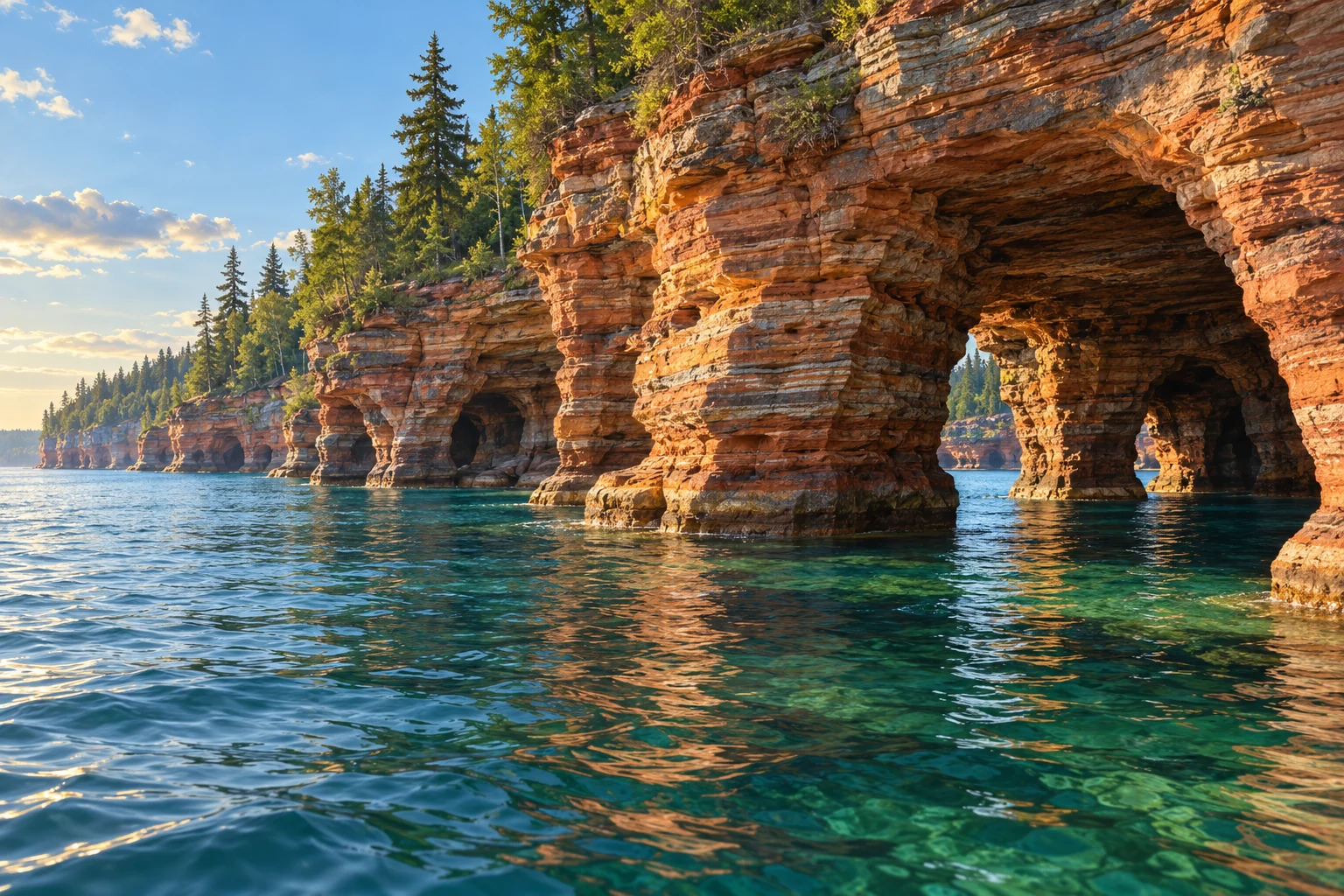
The Apostle Islands' sea caves are a freshwater shoreline phenomenon. Waves exploit thinner, more easily eroded layers within the Devils Island Formation, part of the ancient Bayfield Group sandstones. Glaciers and changing lake levels also helped shape the islands. The result is a coastline of chambers, arches and sculpted cliffs whose long geological history is considerably older than Lake Superior's present outline.

8. An entire trail follows the story of retreating ice
The roughly 1,200-mile Ice Age National Scenic Trail winds through Wisconsin along landscapes shaped near the edge of the last continental glacier. Its subject is visible underfoot in ridges, boulders and other glacial features. The trail is a route through that geological story, rather than a claim that every footstep lies exactly on one ancient ice boundary. It turns a statewide walk into a lesson in landscape formation.
9. The Driftless Area preserves a different landscape
Southwestern Wisconsin's ridges and deeply cut valleys contrast with much of the glaciated Midwest. The Driftless Area lacks the glacial drift that gives it its name, and Wisconsin's geological survey maps it as unglaciated during the Quaternary. That does not mean nearby ice had no effects: windblown sediment and rivers carrying glacial meltwater also influenced the region. 'Driftless' describes a geological distinction, not an untouched landscape.
10. Taliesin was a home that kept being reinvented
Frank Lloyd Wright began Taliesin near Spring Green in 1911, fitting it to the brow of a hill in a valley connected to his Welsh family. Fires destroyed its living quarters in 1914 and again in 1925, and Wright rebuilt both times. The estate also became a place of architectural training. Its surviving spaces represent decades of revision, rather than a single design frozen at completion.
11. Baraboo helped a small wagon show become a circus empire
Five Ringling brothers launched their circus in Baraboo in 1884. Its modest beginnings included neither a menagerie nor wild animals, according to the historic-register account. As the business expanded, its winter quarters became a substantial working complex. Circus World preserves buildings and collections connected with that history, revealing the maintenance, transport and craftsmanship behind an entertainment usually remembered for its performances.
12. Packers shares do not pay dividends
The Green Bay Packers have operated as a publicly owned nonprofit corporation since 1923. Supporters hold shares, but those shares do not provide the financial dividends associated with an ordinary investment. The organization has used stock sales to raise money at important points in its history. Its ownership structure makes the team's relationship with its community an unusually literal one.
13. Cranberries float at harvest, but they do not grow underwater
Those crimson expanses in harvest photographs are temporarily flooded beds. Cranberries grow on low vines, and their internal air spaces let detached berries rise to the surface when growers use the wet-harvest method. Flooding also has other seasonal management uses. Wisconsin's cranberry industry is therefore a story of controlled water, drainage and plant biology, rather than a crop spending its whole growing season submerged.
14. Ultraviolet light helped turn nutrition research into research funding
In the 1920s, Wisconsin biochemist Harry Steenbock developed a way to increase vitamin D activity in certain foods through ultraviolet irradiation. Licensing the process helped establish the Wisconsin Alumni Research Foundation, which supported further university research. The discovery contributed to efforts against vitamin D deficiency and rickets. It was part of a wider scientific and public-health story, not a single experiment that made the disease disappear everywhere.
15. The original territory reached far beyond today's state
Wisconsin Territory, established in 1836, included lands west of the Mississippi that later became separate jurisdictions. Its first legislature met in Belmont, in the lead-mining region, before choosing Madison as the future capital. Subsequent territorial divisions and the 1848 state boundaries reduced that original footprint. Reading an early reference to 'Wisconsin' therefore requires checking the date as well as the map.
How did these facts land?
Know someone who'd love these facts? Share them 👇