15 Fascinating Facts About Aardvarks: Mounds and Melons
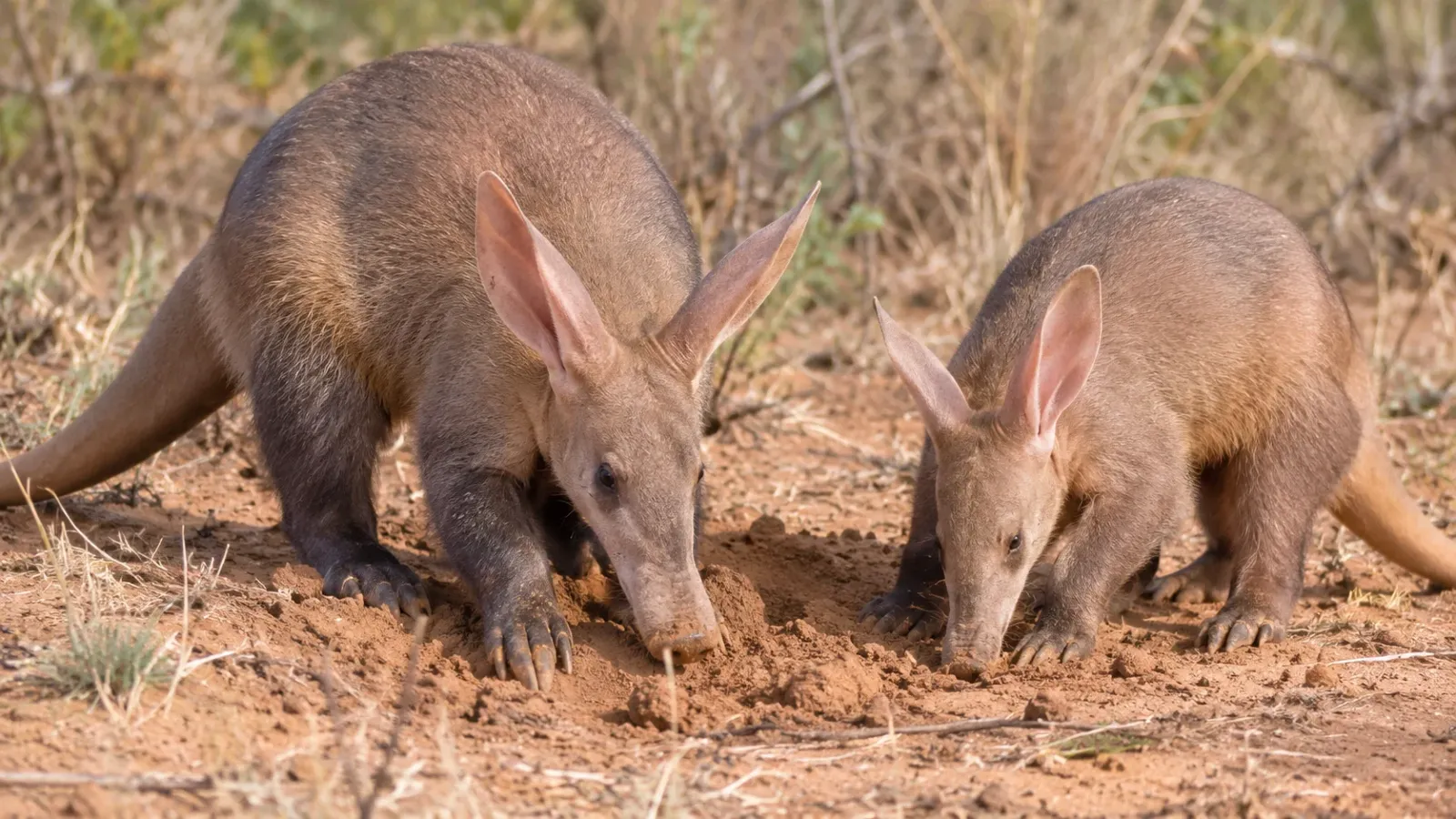
Aardvarks do more than dig for termites: their feeding choices can shape life across a savanna. Discover the surprising links between underground fruit, burrows, and drought.
1. The underground melon relies on an aardvark to spread its seeds
In central Namibia, researchers found that the underground melon Cucumis humifructus depends on aardvarks, also called antbears, to move its seeds. The plant buries its fruit about 20 centimeters below the soil, too deep for seedlings to emerge on their own. Camera traps showed that aardvarks were the only animals to excavate naturally buried fruits. The animals ate the pulp, and intact seeds passed into their droppings, where the researchers found that all examined plants had originated.
2. Aardvarks swallow insects with almost no chewing
An aardvark can feed while digging into an ant or termite nest, sweeping insects into its small mouth with a long, sticky tongue. It swallows them whole or after very little chewing. The prey then reaches a muscular, gizzard-like part of the stomach, where the insects are ground up. This internal processing lets the animal collect tiny, hard-bodied prey quickly instead of stopping to chew each mouthful.
3. Aardvarks use smell to locate food hidden underground
Aardvarks search for ants and termites with an unusually strong sense of smell. A zoo account describes ten thin bones within the snout, while anatomical research summarized by Animal Diversity Web notes expanded scent-detecting surfaces in the nose and a large olfactory region in the brain. In the field, the animal may zigzag with its nose close to the ground and listen for termite columns. Its long snout is therefore part of a searching system, not just a shovel-shaped face.
4. Aardvarks choose larger and more widely spaced termite mounds
A 2026 study in Gonarezhou National Park found that aardvarks did not excavate termite mounds at random. Excavated mounds were larger and farther apart than those left untouched. In the researchers’ model, a one-standard-deviation increase in mound size more than doubled the odds of excavation, while greater distance to the nearest mound modestly increased them. The pattern suggests that aardvarks select particular feeding sites across an already uneven savanna landscape.
5. Granite ground made termite mounds less likely to be excavated
The same Gonarezhou study found a surprising geological pattern: even though larger termite mounds were more common on granite, aardvarks were less likely to excavate mounds there than on basalt. The model associated granite substrate with a 77 percent reduction in excavation odds. The study did not establish why the substrate mattered, so the result is a measured pattern rather than a proven explanation. It shows that mound size alone did not predict where the animals fed.
6. An aardvark can leave a termite colony enough to rebuild
Aardvarks open termite mounds with their powerful claws, but they do not necessarily destroy a colony in one feeding visit. Animal Diversity Web reports that ant and termite colonies are rarely destroyed after an aardvark feeds and can rebuild and reestablish themselves. A San Diego Zoo Wildlife Alliance account likewise says aardvarks leave enough termites behind for a mound to be rebuilt and may return to feed on successive nights. Their hunting routine can therefore exploit a renewable food source.
 You might also like
15 Fascinating Facts About Rhinoceroses
7. A 30-centimeter tongue can collect tens of thousands of insects
Whipsnade Zoo says aardvarks can eat up to 50,000 ants and termites in a single night. The same account gives their tongue a length of 30 centimeters and says it is extra thick, which helps protect it from insect bites. The tongue is sticky, letting the animal sweep small prey from a nest into its mouth. That combination of reach, protection, and speed helps explain how a large mammal can live mainly on tiny insects.
8. The aardvark is the sole living member of its mammal order
Aardvarks belong to the mammalian order Tubulidentata, which Animal Diversity Web identifies as the only mammal order represented by a single living species. The order name refers to their unusual tooth structure, and the animal was historically grouped with other termite eaters such as pangolins and giant anteaters. Anatomical evidence later placed it in its own order, family, and genus. Despite its pig-like name and anteater-like diet, the aardvark has a distinct branch of mammal classification.
9. Aardvarks build several different kinds of burrow
Aardvarks do not use just one standard den. A San Diego Zoo Wildlife Alliance account describes short overnight “camping holes,” long, nearly 10-foot tunnels that may have several entrances, and deeper, multi-chambered burrows suited to raising young. Animal Diversity Web also describes complex burrows with eight or more entrances. The range of designs lets the animals use holes for different purposes, from a temporary refuge during a foraging night to a protected place for a mother and offspring.
 African Wildlife
Venture beyond the safari stereotypes and discover the astonishing biological adaptations, fierce rivalries, and complex societies of Africa's most iconic wildlife. From venom-proof mustelids to deep-rumbling giants, explore the hidden lives of the continent's most remarkable survivors.
See All Facts
10. Abandoned aardvark burrows shelter many other species
Aardvarks create underground spaces that become useful after the digger moves on. Whipsnade Zoo reports that 27 other species were recorded using aardvark burrows in South Africa, where the holes offer protection from heat and predators. Abandoned dens can shelter animals such as African wild dogs, porcupines, and hyenas, and may provide refuge during wildfires. The burrows turn an individual animal’s digging into habitat other species can use.
11. A female usually raises one young after a seven-month pregnancy
Aardvarks typically give birth to one baby after a gestation of about seven months, according to the San Diego Zoo Wildlife Alliance. The young are raised in multi-chambered burrows, and Animal Diversity Web says offspring remain underground for several weeks before the mother takes care of them until they become independent at about six months. Aardvark reproduction is therefore tied closely to the animals’ ability to dig secure dens, not only to their nightly feeding grounds.
12. Drought can turn a nocturnal aardvark into a daytime forager
Aardvarks are usually nocturnal, but a three-year Kalahari study found that some shifted toward daytime activity when food became scarce during drought. Individuals with low body temperatures often emerged from their burrows during daylight, and some became completely diurnal. The researchers interpreted the shift as a way to reduce the energetic cost of staying warm at night when prey was scarce. The change came with risks and did not prevent several study animals from dying, presumably from starvation.
🤔 Quick guess
How did food scarcity affect the tracked aardvarks’ active periods?
13. One aardvark’s body temperature varied by 11.7 degrees in eight hours
During the Kalahari drought study, researchers recorded an 11.7°C difference in one aardvark’s body temperature within eight hours. The study links unusually wide temperature swings to energy shortages, not to a planned hibernation-like state. In non-drought conditions, aardvarks kept their daily temperature rhythm much tighter. That contrast gives researchers a way to see how food availability can affect the physiology of an animal that is usually hidden underground by day.
14. Food scarcity shortened aardvarks’ active periods by 25 percent
When drought reduced food availability in the Kalahari, the tracked aardvarks did not simply extend their nightly search. Researchers found that the animals shortened their active periods by 25 percent, likely reducing the energy costs of foraging. Some also shifted activity into daylight as their body temperatures fell. These changes show the limits of a behavioral workaround: the animals adjusted when and how long they searched, yet the study still recorded deaths that researchers attributed presumably to starvation.
15. Before setting off, an aardvark makes a cautious, jump-filled exit
Animal Diversity Web describes a distinctive routine before an aardvark leaves its den to forage. It pauses at the opening to look for enemies, runs out, then jumps repeatedly and looks around before trotting away. Once it starts foraging, it may cover two to five kilometers in a night. The dramatic exit combines a cautious check of the surroundings with a surprisingly energetic burst, before the animal begins its long search for insects.
How did these facts land?
Know someone who'd love these facts? Share them 👇
🧠 Quiz: How closely were you paying attention?
Think you remember the facts? 10 questions, tap an answer.