The Speeding Dutchman: 15 Fascinating Facts About Arjen Robben
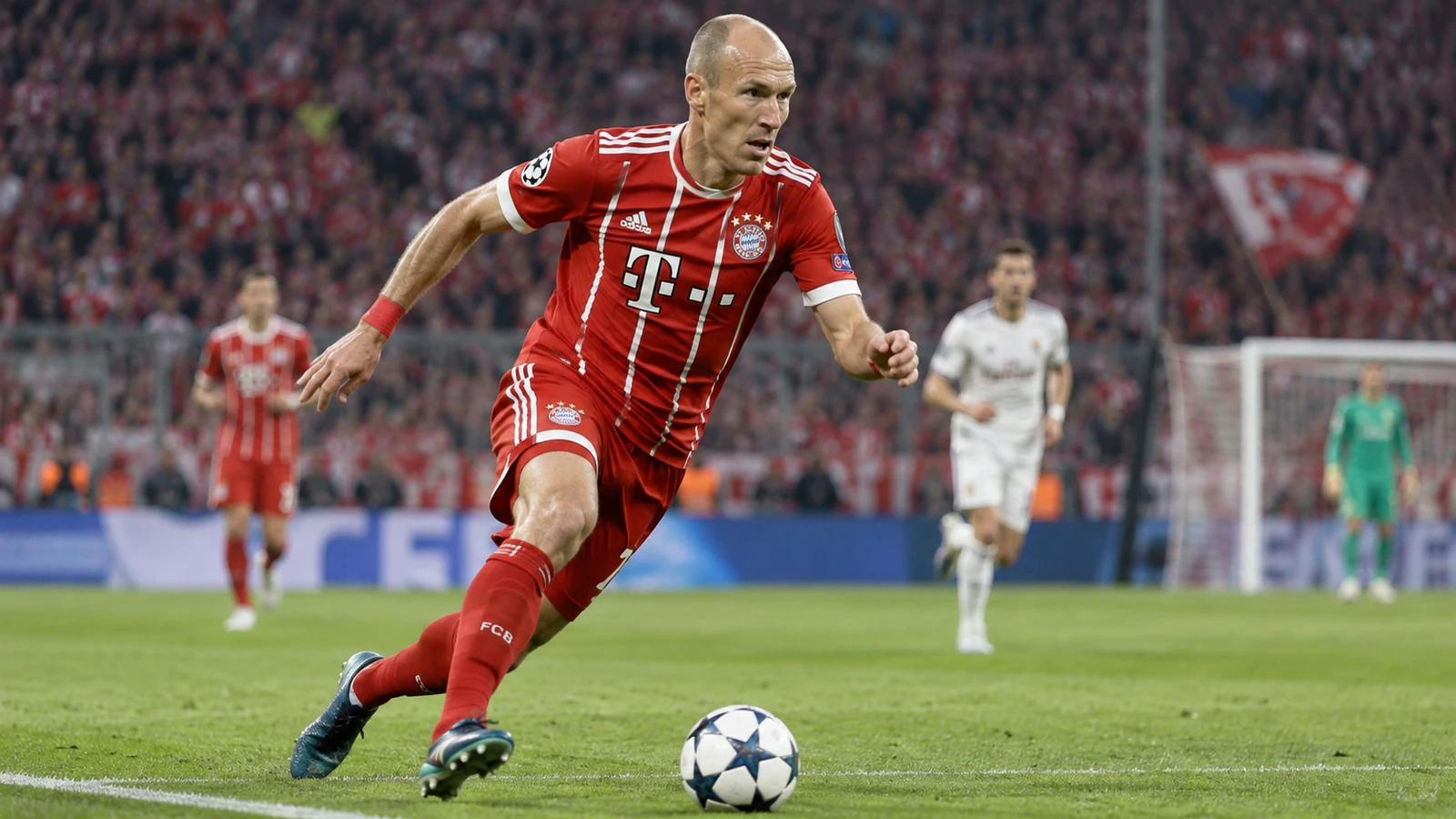
Arjen Robben remains one of football's most iconic and unstoppable wingers, famed for his lethal cut-inside goalscoring signature move and blistering pace. From his dominant European spell winning league titles in four nations to his incredible post-retirement marathon achievements, the Dutch legend's career is packed with remarkable stories. Beyond his trophy-laden cabinet lies a disciplined athlete who excelled at tennis, ran sub-three-hour marathons, and returned to his boyhood club purely out of devotion. Discover the most intriguing facts about one of the most prolific wingers in modern football history.
1. The World's Most Predictable Yet Unstoppable Signature Move
Every opposing defender, manager, and spectator in the stadium knew exactly what Arjen Robben was planning to do whenever he received the ball on the right flank. He would drop his shoulder, accelerate past the left-back, cut inside onto his lethal left foot, and curl a majestic shot into the far top corner. Despite the absolute predictability of this sequence, defenders were almost universally powerless to halt it due to his explosive first step and impeccable timing. Robben honed this specific movement pattern through thousands of repetitive training drills throughout his career. His trademark move yielded over 200 professional goals and became one of the most iconic individual plays in modern football history.
2. He Was Clocked at 37 km/h During the World Cup
During the 2014 FIFA World Cup group stage match between the Netherlands and Spain, Robben recorded one of the most astonishing sprints ever captured on a football pitch. Chasing down a long pass in the 80th minute, he recorded a peak speed of 37 km/h (23 mph) as he surged past Spanish defender Sergio Ramos before scoring. This explosive effort was widely reported as the fastest sprint speed ever registered by a player in an official FIFA World Cup tournament. Robben’s raw acceleration often shocked opponents who underestimated his top-end speed late in matches. His athletic velocity remained a primary weapon well into his thirties.
3. He Ran a Sub-3-Hour Marathon After Retirement
While many retired professional footballers struggle to maintain elite conditioning, Robben tackled long-distance running with the same obsessive discipline he brought to the pitch. In April 2023, at 39 years old, he completed the Rotterdam Marathon in an astounding time of 2 hours, 58 minutes, and 33 seconds. Breaking the elite three-hour barrier in a marathon requires a relentless pace of under six minutes and forty-eight seconds per mile across 26.2 miles. Robben openly admitted that the marathon pushed him to his absolute physical limits, describing the final stretch as a genuine battle against his own body. His feat earned immense praise from professional endurance athletes across the globe.
4. He Was a Highly Skilled Youth Tennis Player
Before committing his future entirely to football, Robben was a formidable tennis player in his youth in the northern province of Groningen. Coaches noted that his fast footwork, sharp hand-eye coordination, and competitive drive made him a standout talent on the tennis court. He regularly competed in local junior tournaments and seriously contemplated pursuing a professional career in tennis. Ultimately, Robben chose football because he preferred the shared camaraderie and collective energy of a team sport over the isolation of individual play. However, he maintained a lifelong love for tennis and frequently played recreational matches during off-seasons.
5. His First Contract Included a Mandatory Schooling Clause
When Robben negotiated his very first professional contract with FC Groningen as a 16-year-old phenom, his parents insisted on an unusual non-negotiable clause. They mandated that the club guarantee him permission to miss training sessions and matches whenever necessary to focus on his high school education. His mother and father were determined that his academic progress at Kamerlingh Onnes high school would not be sidelined by early sporting success. Groningen readily accepted the condition, allowing the young winger to pass his final examinations alongside his early first-team appearances. This grounded upbringing helped Robben navigate the immense pressure of early fame.
6. He Mastered Ball Control via the Coerver Method
Robben’s famously close ball control and ability to weave through tight spaces were largely developed through the Coerver Method during his formative years. Invented by Dutch coach Wiel Coerver, this structured training philosophy emphasizes individual skill, rapid footwork, and one-on-one dominance above rigid tactical positioning. As a young boy playing in Bedum, Robben spent countless hours practicing intricate ball manipulation drills designed to make the ball feel like an extension of his foot. This relentless technical repetition allowed him to maintain full control of the ball even while running at maximum sprint speed. European youth academies later studied his developmental pathway as a benchmark for technical wing play.
7. He Speaks Four Languages Fluently
Throughout his globetrotting career spanning four major European leagues, Robben made a point of immersing himself in the local culture of every club he represented. As a result, he became fluent in four distinct languages: Dutch, English, German, and Spanish. During his tenures at Chelsea, Real Madrid, and Bayern Munich, his language skills made him an invaluable figure in multicultural dressing rooms. He frequently acted as an informal translator during tactical meetings, bridging communication gaps between international players and coaching staff. Teammates often commended his ability to express complex tactical ideas clearly in multiple tongues.
8. He Redeemed Himself in the 2013 Champions League Final
The low point of Robben’s career occurred during the 2012 UEFA Champions League Final in Munich, where he missed a crucial extra-time penalty that contributed to Bayern's painful loss to Chelsea. Devastated by the heartbreak, Robben spent the following season channeling his frustration into motivation for a return to the final. His chance came just twelve months later at Wembley Stadium against arch-rivals Borussia Dortmund in the 2013 final. In the 89th minute of a tense 1-1 match, Robben collected a subtle backheel, slipped through the defense, and rolled a delicate finish past Roman Weidenfeller to seal the European trophy. The goal cemented his status as a legendary figure in Bayern Munich history.
9. He Overcame the "Glass Man" Label Through Biomechanics
During his early career years at Chelsea and Real Madrid, Robben was repeatedly plagued by persistent hamstring injuries and muscle tears, earning him the unwanted German media moniker "Der Mann aus Glas" ("The Man of Glass"). Frustrated by constant setbacks, he sought help outside traditional football medicine and consulted renowned German doctor Hans-Wilhelm Müller-Wohlfahrt and specialized biomechanists. Together, they identified subtle spinal misalignments and muscular imbalances that were triggering his recurring hamstring strains. By committing to customized daily movement routines and altered running mechanics, Robben successfully re-engineered his body. This holistic approach allowed him to enjoy a remarkably durable decade-long peak at Bayern Munich.
10. He Built Explosive Speed by Running Dutch Sand Dunes
The foundation of Robben’s rapid acceleration was laid during his teenage years in the Netherlands through an agonizing training routine. To build extraordinary power in his thighs and calves, he routinely sprinted up steep sand dunes along the Dutch coastline. Running on shifting sand forced his stabilizing muscles to work twice as hard while developing supreme lower-body power and core stability. This natural resistance training enhanced his fast-twitch muscle fibers without the need for heavy weightlifting routines. The unique training method gained legendary status in Dutch sports folklore and was later adopted by regional athletic trainers.
11. He Came Out of Retirement to Play Unpaid for His Boyhood Club
In July 2019, Robben officially announced his retirement from professional football after a glorious final season with Bayern Munich. However, when the COVID-19 pandemic severely threatened the financial stability of his boyhood club FC Groningen in 2020, he felt compelled to take action. He stunned the sporting world by announcing his return to the pitch to help Groningen navigate the crisis, refusing to take a standard player salary. Robben stated that his comeback was driven purely by passion and a desire to help the club that nurtured his early talents. Although injuries limited his playing time, his inspiring presence gave the club a massive morale and financial boost.
12. He Married His High School Sweetheart
Unlike many modern football superstars whose personal lives dominate tabloid headlines, Robben has enjoyed a remarkably stable personal life. He met his wife, Bernadien Eillert, while both were students at Kamerlingh Onnes high school in Groningen long before his international fame. Their romance became famous among local fans after his former youth coach recalled a story of Robben showing up late for a match because he was distracted chatting with Bernadien in a park. The couple married in June 2007 in Groningen and have three children together. Throughout his high-profile career across Europe, Robben repeatedly credited his family stability for his longevity on the pitch.
13. He Kept Detailed Tactical Diaries Throughout His Career
Robben approached his tactical understanding of football with the precision of a scholar, earning him the locker room nickname "The Mathematician." Throughout his ten-year career at Bayern Munich, he kept handwritten notebooks detailing match observations, tactical structures, defender habits, and personal mistakes. After every fixture, he reviewed game film and recorded notes on how opposing full-backs adjusted to his movements. Renowned tacticians like Pep Guardiola praised Robben for his exceptional analytical mind and deep understanding of spatial awareness. This analytical habit allowed him to continually adapt his game even as defenders adjusted to his style.
14. He Played the Violin as a Child
Beneath the fierce, fiery competitor seen charging down the wing was a boy with a surprising artistic background. As a child growing up in the quiet town of Bedum, Robben took formal violin lessons for several years. He performed in small regional youth recitals and local classical concerts in the province of Groningen before football demands dominated his schedule. Friends and family noted that learning the instrument taught him early lessons in patience, rhythmic timing, and intense individual focus. Though he eventually set aside the violin to concentrate on sports, he frequently expressed an appreciation for classical music in later life.
15. He Won League Titles in Four Different Nations
Robben established himself as one of the most decorated players in modern football history by winning domestic league titles in four different European countries. His remarkable championship journey began in the Netherlands, where he lifted the Eredivisie trophy with PSV Eindhoven in 2003. He then moved to England and secured back-to-back Premier League titles with Chelsea under manager José Mourinho. Next came Spain, where he captured the La Liga crown with Real Madrid in 2008, followed by a staggering eight Bundesliga titles during his decade at Bayern Munich. This rare cross-continental success places him in an elite class of European football royalty.
Sources & References
This AI-assisted post was rigorously curated and fact-checked for accuracy by:
 Martin Roháček
How fun was this article? 🤔
Tap a star to rate it
🧠 Quiz: How closely were you paying attention?
10 questions — all answers are in the article above!
Enjoyed these facts? There's more! 💌
Fresh fun facts in your inbox. No spam, ever.