15 Surprising Facts About Delaware
Delaware's small size hides some extraordinary stories: shorebirds refueling on horseshoe-crab eggs, political rivals literally burying a hatchet, and conservators finding arsenic in beautiful bookbindings. A circular border, a giant holding a race car and the chemistry behind nylon and Kevlar add to the surprises.
1. Tiny crab eggs help fuel an enormous bird migration
Each spring, horseshoe crabs come ashore to spawn along Delaware Bay just as hungry migratory shorebirds arrive on their northward journeys. Red knots and other birds feed on the exposed eggs, rapidly rebuilding energy reserves before continuing toward Arctic breeding grounds. Delaware's natural-resources agency reports that red knots can double their body weight in about two weeks. A beach covered in small eggs is therefore an essential refueling station connecting distant parts of the Americas.
2. A courthouse cupola sits at the center of Delaware's circular border
Delaware's curved northern boundary comes from a circle with a twelve-mile radius centered on New Castle. Later surveying fixed its center at the court house cupola, making a small historic building part of the state's geometry. The circle also has a surprising effect on the Delaware River: within it, the state boundary reaches the low-water mark on the New Jersey shore rather than following the middle of the channel. The familiar map outline preserves centuries of boundary negotiation.
3. A Delaware research project found arsenic in beautiful Victorian book covers
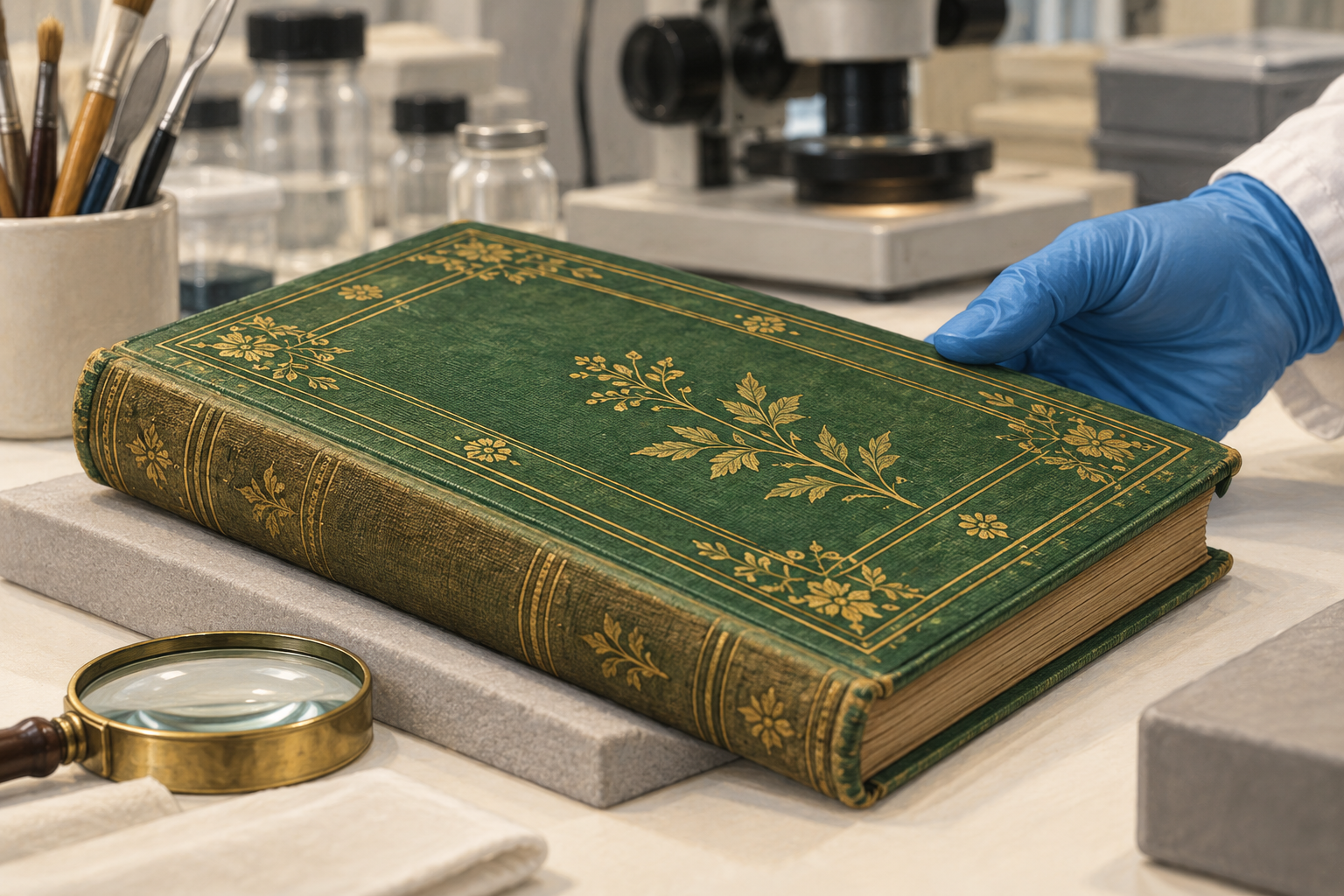
In 2019, analysis at Winterthur Library identified emerald-green pigment containing arsenic in nineteenth-century bookcloth. Conservators investigated more bindings using X-ray fluorescence, with further spectroscopy to identify the pigment. The work grew into the Poison Book Project, a collaboration between Winterthur and the University of Delaware. These books were not sinister props: ordinary decorative materials had put a toxic pigment into handsome commercial bindings. Their appearance alone cannot establish the chemistry, which is why the analytical work matters.
4. Wilmington's first public nylon-stocking sale sold out in three hours
When nylon stockings went on sale to the public in Wilmington in 1939, buyers snapped up 4,000 pairs in three hours. DuPont's new synthetic fiber was about to become a fashion sensation. That December, commercial production began at the company's Seaford plant, built for a manufacturing process that had never operated at that scale before. National sales followed in 1940, but wartime demand soon redirected nylon into parachutes and other military equipment. Delaware stood at the junction of laboratory chemistry, fashion and wartime industry.
5. Kevlar began with a cloudy solution that looked wrong
At DuPont in 1965, Stephanie Kwolek encountered a polymer solution that flowed unusually freely and looked cloudy instead of clear. She recognized that the odd result might be valuable and persuaded colleagues to spin it into fibers. The extraordinary strength and stiffness of the resulting material helped lead to Kevlar. Kwolek had moved with DuPont's research laboratory to Wilmington in 1950; her breakthrough emerged from noticing an unexpected result rather than discarding it as a failed batch.
6. Delaware politicians literally bury the hatchet after an election
Georgetown's Return Day brings former campaign opponents together after the general election. They ride in a parade, traditionally sharing carriages, before the Sussex County results are proclaimed. Party leaders then bury an actual hatchet in sand from Lewes, the former county seat. An ox roast is another part of the occasion. The ritual grew from the time when residents returned to the courthouse to hear election results, giving an old practical gathering a lasting ceremony of political reconciliation.
 You might also like
The Soulful Prophet: 15 Fascinating Facts About Bob Marley
7. A passing school bus helped spark a case within Brown v. Board of Education
In Hockessin, Sarah Bulah sought transportation for her daughter Shirley while a bus carrying white children passed their home without picking her up. The family's legal challenge joined another Delaware school case from Claymont. In 1952, Chancellor Collins J. Seitz ordered the plaintiffs admitted to the white schools because the separate facilities were unequal. Delaware's case later became part of Brown v. Board of Education, carrying a local family's struggle over access and transport into a landmark national decision.
8. Dover honors a recording pioneer whose famous dog changed machines
Wilmington-born Eldridge Reeves Johnson grew up in Dover before building his recording-industry career in Camden, New Jersey. His spring motor helped gramophones maintain a steady speed, and he founded the Victor Talking Machine Company in 1901. Its dog Nipper was a real English animal, but the familiar trademark was altered: the original painting showed a cylinder phonograph, replaced by a disc gramophone for commercial use. Dover's Johnson Victrola Museum preserves the connection between mechanical invention, recorded sound and a remarkably successful image.
9. A 46-foot monster holds a full-size race car in Dover
Miles the Monster stands outside Dover Motor Speedway with a race car in one enormous hand. Installed in 2008, the 46-foot figure gives physical form to the track's Monster Mile nickname. The oval itself is only a mile long, but its steeply banked turns and concrete surface make it a demanding NASCAR venue. Dover switched from asphalt to concrete in 1995, so both the giant mascot and the pale racing surface are later chapters in a speedway history that began in 1969.
10. Wilmington's colonial beginnings included a New Sweden
Swedish and Finnish colonists arrived aboard Kalmar Nyckel and Fogel Grip in 1638, landing at a natural stone wharf on the Christina River in Lenape territory. They established Fort Christina and the colony of New Sweden, trading furs and farming along the river. Dutch forces captured the fort in 1655, ending Swedish rule, but the settlement endured. The surviving rock landing links present-day Wilmington to a Scandinavian chapter of American colonization that lasted only seventeen years.
11. An Underground Railroad organizer kept helping people after ruinous court judgments
Thomas Garrett operated an important Underground Railroad station in Wilmington, collaborating with people including Harriet Tubman and Samuel D. Burris. In 1848, Garrett and fellow abolitionist John Hunn faced federal proceedings at the New Castle Court House for helping an enslaved family escape. Chief Justice Roger B. Taney presided, and the resulting financial penalties cost them dearly. Garrett nevertheless continued aiding freedom seekers. The court house preserves a history of determined resistance to slavery alongside the laws and courts that enforced it.
12. Bombay Hook's name grew out of a Dutch phrase about trees
The name Bombay Hook evolved from the Dutch Bompies Hoeck, meaning little-tree point. The coastal refuge was established in 1937 to protect migratory birds, and its landscape also records New Deal labor. An African American Civilian Conservation Corps company built dikes, water-control structures, roads and other facilities between 1938 and 1942. Freshwater pools within the wider marsh habitat reflect that work. Behind a name that sounds far from Delaware lies a mixture of Dutch language, wetland conservation and labor history.
13. The concrete towers on Delaware's beaches were instruments for aiming guns
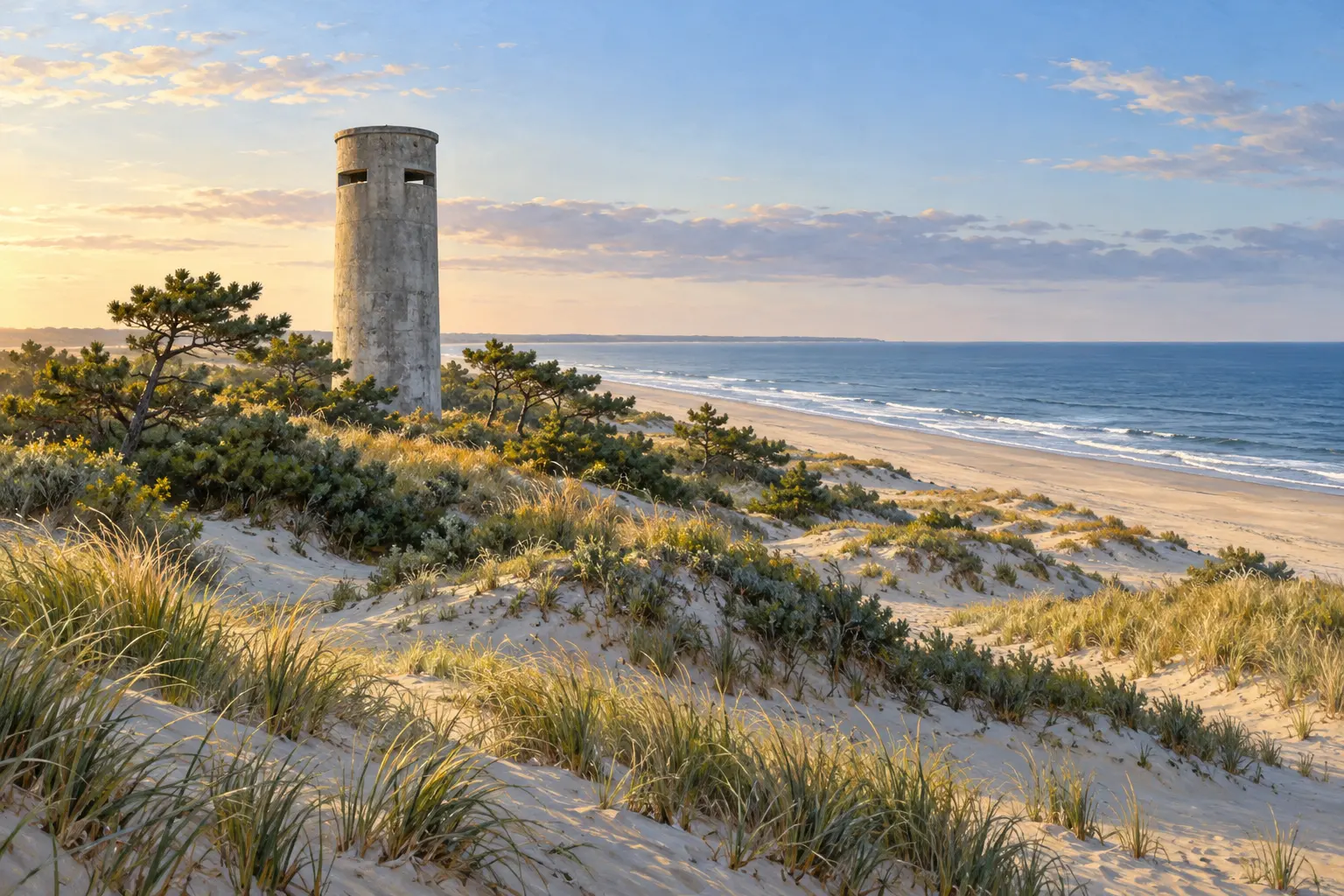
The tall cylindrical towers along Delaware's coast belonged to the World War II defenses around Fort Miles. Observers used their narrow upper windows to locate ships; observations from different positions helped calculate targets for coastal artillery hidden around the dunes. These were working parts of a coordinated fire-control system, rather than gun turrets themselves. Eleven towers were built on the Delaware side of the defense network. Their survival makes the quiet beach landscape a visible record of wartime planning and coastal geometry.
14. A hurried journey broke Delaware's tie on independence
Delaware's delegation to the Continental Congress was divided when Caesar Rodney was summoned to Philadelphia in July 1776. His arrival allowed the colony to vote two to one for independence on July 2. That date matters: Congress voted for independence before adopting the Declaration's text on July 4. The famous ride is often told through dramatic details about weather and distance, but its central consequence was a change in the delegation's vote at a critical political moment.
15. Delaware's registered business entities outnumber its residents by more than two to one
The Division of Corporations reported 2,287,728 business entities for 2025. The Census Bureau estimated Delaware's population at 1,059,952 in July that year, making the legal-entity total more than twice the human population. Most of those entities were limited liability companies, so calling them all corporations would be misleading. Businesses can choose Delaware as their legal home while operating in other places; the comparison captures how unusually large its role in business registration is for such a small state.
How did these facts land?
Know someone who'd love these facts? Share them 👇