The Last Founder: 15 Fascinating Facts About James Monroe
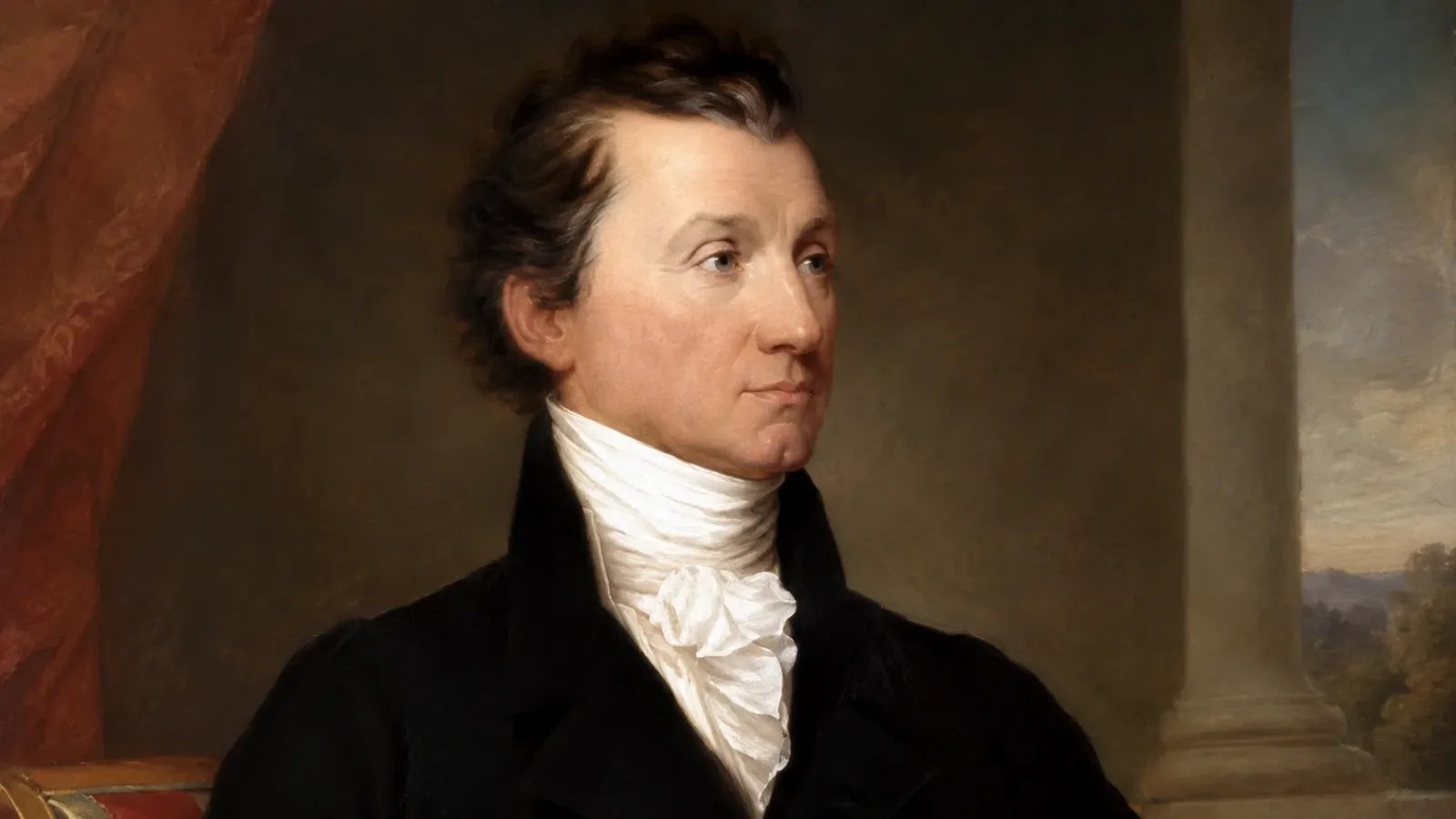
Often dismissed as a mere shadow of Thomas Jefferson or just the namesake of a foreign policy doctrine, James Monroe was actually a daring battlefield hero and a ruthless political operator. Far from a passive executive, he transformed American diplomacy and expanded the nation's borders. Discover the obscure truths behind the last founding father to hold the presidency.
1. The painting Washington Crossing the Delaware features James Monroe holding the flag, even though he was not in that boat.
In Emanuel Leutze's iconic 1851 painting, a young Lieutenant James Monroe is famously depicted standing right behind George Washington, clutching the American flag. Historically, this is a complete myth, as Monroe crossed the icy river in a completely different boat in the vanguard, hours before Washington. The artist included him to symbolize the future of the republic alongside its founder. Despite the historical inaccuracy, the artistic choice correctly underscores Monroe's crucial participation in the Battle of Trenton. He was one of the few Americans severely wounded in the ensuing fight, taking a musket ball to the shoulder that severed an artery.
2. James Monroe single-handedly negotiated the Louisiana Purchase after his initial instructions became obsolete.
While Thomas Jefferson gets the overarching credit for doubling the size of the United States, it was James Monroe and Robert Livingston who actually pulled the trigger in Paris. Monroe was originally dispatched with a maximum budget of ten million dollars to buy just New Orleans and the Floridas to secure trade routes. Upon arriving, he discovered Napoleon Bonaparte was willing to sell the entire Louisiana Territory for fifteen million dollars. Lacking the time to sail back across the Atlantic for presidential approval, Monroe took a massive political and constitutional gamble by agreeing to the deal. His unauthorized audacity ultimately proved to be the most consequential real estate transaction in American history.
3. He is the only president aside from George Washington to run completely unopposed for re-election.
During the 1820 presidential election, the Federalist Party had completely collapsed following their opposition to the War of 1812, leaving Monroe's Democratic-Republican Party as the sole national political force. This period became known as the Era of Good Feelings, characterized by an absence of partisan battles and a strong sense of national unity. Consequently, Monroe faced no formal challenger and was effectively guaranteed a unanimous Electoral College victory. However, a single rogue elector from New Hampshire named William Plumer cast his vote for John Quincy Adams instead. While popular legend claims Plumer did this to protect Washington's unique unanimous record, historical evidence suggests he simply disliked Monroe and believed Adams was better suited for the job.
4. Monroe served simultaneously as both Secretary of State and Secretary of War during the War of 1812.
When the War of 1812 began going disastrously for the United States, culminating in the burning of Washington D.C., President James Madison was forced to reorganize his failing cabinet. He turned to his most trusted ally, James Monroe, who was already serving as Secretary of State. Madison appointed him to take over the War Department as well, making Monroe the only person in American history to hold these two premier cabinet positions at the exact same time. Under his dual leadership, Monroe successfully coordinated both the military logistics necessary to defend cities like New Orleans and the diplomatic negotiations that ultimately led to the Treaty of Ghent. This extraordinary concentration of power effectively made him a wartime prime minister.
5. The capital of the West African nation of Liberia is named Monrovia in his honor.
James Monroe was a prominent supporter of the American Colonization Society, an organization established to send freed African Americans to a colony on the west coast of Africa. The motivations behind this movement were deeply complex and largely rooted in racism, as many white leaders, including Monroe, feared the social implications of a growing free Black population in the United States. During his presidency, he secured federal funding and naval support to help the society establish its African settlement. In gratitude for his crucial backing, the organization named the colony's capital Monrovia in 1824. Today, it stands as the only foreign capital city in the world named after a United States president.
6. He physically chased his own Secretary of the Treasury out of the White House with a pair of fire tongs.
Monroe was generally known for his dignified and amiable demeanor, but he possessed a fierce temper when pushed past his breaking point. During a heated cabinet meeting in 1825, Secretary of the Treasury William Crawford aggressively demanded patronage appointments that the president refused to grant. The argument escalated until Crawford raised his cane and called the president a scoundrel. Enraged by the blatant disrespect, Monroe grabbed a pair of heavy iron fire tongs from the White House fireplace and charged at his cabinet member. Crawford was forced to quickly retreat and apologize, demonstrating that the aging battlefield veteran still retained his fighting spirit.
 US Presidents
Discover the eccentricities, secret talents, and surprising hidden lives of America's most influential presidents, from frontier wrestlers to covert strategists.
See All Facts
US Presidents
Discover the eccentricities, secret talents, and surprising hidden lives of America's most influential presidents, from frontier wrestlers to covert strategists.
See All Facts
7. The Monroe Doctrine was actually written by his Secretary of State, John Quincy Adams.
The famous 1823 foreign policy declaration that warned European powers against recolonizing the Western Hemisphere is universally associated with James Monroe. However, the core principles and the specific language of the doctrine were meticulously drafted by John Quincy Adams. While Monroe initially wanted to issue a joint declaration alongside Great Britain to deter Spanish aggression in the Americas, Adams convinced him that the United States should make a unilateral statement. Adams famously argued that America should not look like a cock-boat in the wake of the British man-of-war, which persuaded the president. Ultimately, Monroe deserves credit for having the political courage to adopt Adams's aggressive stance and declare it to Congress.
8. He was the first president to ride on a steamboat.
Recognizing the vital need for national unity after the divisive War of 1812, Monroe embarked on a massive, multi-year goodwill tour across the United States. It was during these extensive travels that he embraced new technologies that were beginning to revolutionize American transportation. In 1817, he boarded a pioneering vessel, becoming the first sitting executive to travel by steamboat. This was not merely a personal curiosity but a highly calculated political move to demonstrate the federal government's support for internal improvements and interstate commerce. By showcasing his willingness to utilize modern maritime technology, Monroe helped popularize a mode of travel that would soon dominate the American economy.
9. Monroe died on exactly the same date as Thomas Jefferson and John Adams.
One of the most bizarre statistical anomalies in American political history is the death date of James Monroe. He passed away on July 4, 1831, from heart failure and tuberculosis at the age of 73. This occurred exactly five years after Thomas Jefferson and John Adams famously died on the same day in 1826, which was the fiftieth anniversary of the Declaration of Independence. Consequently, three of the first five presidents of the United States died on the Fourth of July. This incredible coincidence cemented a powerful nineteenth-century myth that the nation's founding generation was divinely blessed and inextricably tied to the birth of the republic.
10. He actively covered up a major international scandal involving his wife's daring rescue of Madame de Lafayette.
While serving as the American minister to France during the Reign of Terror, Monroe learned that the Marquis de Lafayette's wife, Adrienne, was scheduled to be executed by the guillotine. Knowing that formal diplomatic protests would be ignored or even endanger her further, he devised a theatrical plan involving his wife, Elizabeth Monroe. She rode an official carriage directly to the prison where Adrienne was held, demanding to see her in a highly public display of American solidarity. The French authorities, terrified of severing their fragile alliance with the United States, canceled the execution and quietly released Adrienne. Monroe kept the details of this rogue diplomatic operation out of his official dispatches to avoid angering both the radical French government and his superiors back home.
11. He was the last United States president to dress like a traditional founding father.
By the time Monroe took office in 1817, men's fashion had dramatically shifted toward modern trousers, shorter hair, and more subdued clothing. Monroe, however, stubbornly refused to adapt, insisting on wearing the knee breeches, silk stockings, and powdered wigs of the revolutionary era. This sartorial choice earned him the affectionate nickname of the Last Cocked Hat among the younger generation of politicians. His archaic wardrobe was actually a deliberate political strategy designed to visually remind the public of his sacrifices during the Revolutionary War. By dressing as a living artifact of the 1770s, he continuously invoked the spirit and unquestionable patriotism of the founding generation.
12. A medical doctor literally saved his life on the battlefield by packing his severed artery with his finger.
During the daring raid at the Battle of Trenton, a Hessian musket ball struck Monroe in the left shoulder, severing a major artery and causing massive blood loss. In the chaos of the eighteenth-century battlefield, such an injury was almost always an automatic death sentence. Fortunately, a volunteer physician named John Riker had joined Monroe's squad just hours before the skirmish began. Riker clamped the bleeding vessel by physically shoving his index finger directly into the wound and holding it there until a surgeon could properly tie off the artery. Had Riker not been present and acted with such immediate, gruesome precision, the future fifth president would have bled to death in the snow.
13. He sparked a major diplomatic incident with Spain by illegally occupying Florida without presidential permission.
It is a common misconception that Andrew Jackson was the only rogue actor during the acquisition of Florida, but Monroe had set the precedent years earlier. In 1811, while serving as James Madison's Secretary of State, Monroe secretly coordinated with American expansionists to foment a rebellion in Spanish-held East Florida. He essentially authorized military force to occupy the territory before Congress or the President had officially sanctioned any invasion. When the Spanish government furiously protested this blatant violation of international law, Monroe feigned ignorance while simultaneously refusing to withdraw American troops. This aggressive, under-the-table maneuvering ultimately destabilized Spanish control and paved the way for the formal annexation of Florida in 1819.
14. Monroe spoke fluent French and used it to gain exclusive intelligence from Napoleon's court.
Unlike many of his contemporaries who relied heavily on official translators, Monroe was highly proficient in French, the international language of diplomacy. This linguistic skill proved to be an invaluable asset during his multiple diplomatic missions to Paris in the 1790s and 1800s. Because he could converse smoothly at social gatherings without an intermediary, he cultivated close personal relationships with key French ministers and even Napoleon's family. He routinely bypassed official diplomatic channels, gathering critical intelligence during casual dinners and private salon conversations. This direct line of communication was highly instrumental in maneuvering the French government toward the sudden sale of the Louisiana Territory.
15. He was forced to sell his family estate and died virtually penniless despite his decades of public service.
Despite holding nearly every major office in the American government, Monroe's lifelong dedication to public service completely ruined him financially. In the early nineteenth century, diplomats were expected to pay for their own travel, entertainment, and staff out of pocket, which forced Monroe into massive debt during his years in Europe. Furthermore, his absence from his Virginia plantations meant they were frequently mismanaged and yielded terrible crop returns. After leaving the presidency, he spent years begging Congress to reimburse him for his diplomatic expenses, which they only partially did just before his death. Ultimately, the last founding father was forced to sell his beloved Highland estate and move into a spare room in his daughter's New York City apartment.
Sources & References
This AI-assisted post was rigorously curated and fact-checked for accuracy by:
 Martin Roháček
How fun was this article? 🤔
Tap a star to rate it
🧠 Quiz: How closely were you paying attention?
10 questions — all answers are in the article above!
Enjoyed these facts? There's more! 💌
Fresh fun facts in your inbox. No spam, ever.