The Devastating Inferno: 15 Fascinating Facts About The Great Fire of London
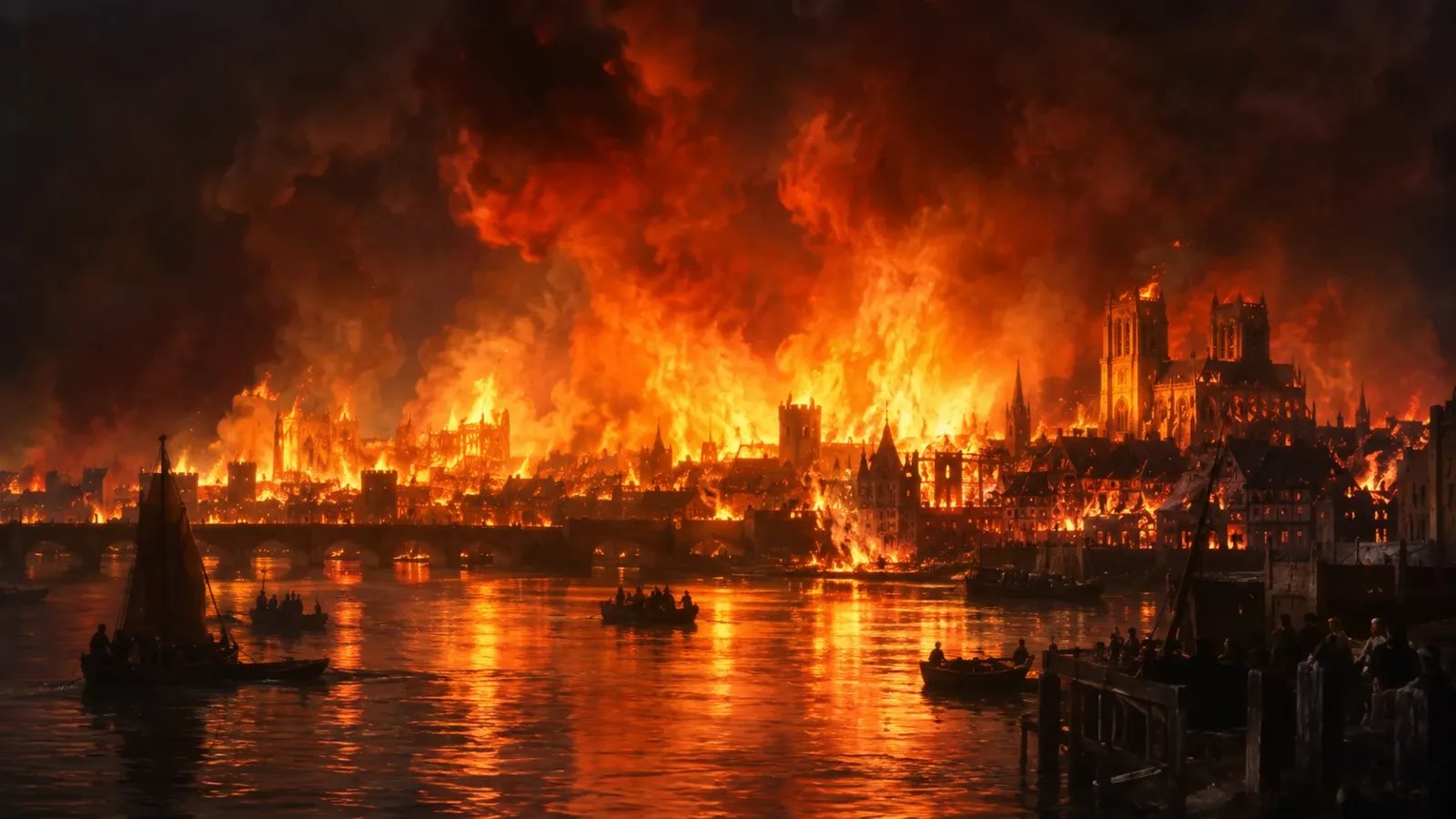
We often picture the Great Fire of London killing thousands and ending the plague. Both are myths. This 1666 inferno claimed fewer than ten official lives and barely touched plague-ridden slums. Let us look beyond the tale of a clumsy baker in Pudding Lane to uncover the political paranoia, strange science, and architectural rebirth of a sprawling city that rose from ashes.
1. The official death toll for the entire disaster was remarkably recorded as only six people.
While it seems impossible for a fire that destroyed over thirteen thousand homes to cause so few casualties, the recorded death toll stood at just six. Historians debate whether this figure is accurate, suggesting that deaths among the poor and middle class simply went unrecorded, or that the intense heat of the fire completely cremated victims, leaving no remains for officials to count.
2. The fire did not actually cure or eradicate the Great Plague of London.
A persistent historical myth claims the fire cleansed the city of the bubonic plague by killing off infected rats and fleas. In reality, the fire primarily destroyed the affluent center of the city, largely missing the unsanitary, poverty-stricken suburbs where the plague thrived. The epidemic was already naturally declining by September 1666, and plague deaths continued in the outskirts well into the following year.
3. The Lord Mayor of London famously dismissed the initial blaze as so trivial that a woman could extinguish it by urinating on it.
When woken to inspect the fire at Thomas Farriner's bakery on Pudding Lane, Lord Mayor Sir Thomas Bloodworth was unimpressed. Annoyed at being disturbed, he allegedly remarked that a woman could piss it out and went back to sleep. His fatal lack of leadership and refusal to immediately demolish surrounding buildings allowed the flames to spread uncontrollably through the tightly packed wooden structures.
4. A completely innocent French watchmaker was hanged after falsely confessing to starting the fire.
Amidst rampant anti-Catholic and anti-foreigner paranoia, a troubled Frenchman named Robert Hubert confessed to throwing a firebomb into the Pudding Lane bakery. Despite overwhelming evidence that his confession was fabricated, including the fact that he did not even arrive in London until two days after the fire began, the desperate public and legal system demanded a scapegoat. He was hanged at Tyburn, a victim of mass hysteria.
5. The old St Paul's Cathedral burned down largely because it was wrapped in highly combustible wooden scaffolding.
Citizens believed the massive stone structure of St Paul's Cathedral would be a safe haven, packing its crypts with books and valuables. However, the building was undergoing renovations led by Christopher Wren and was surrounded by heavy wooden scaffolding. When sparks ignited the timber, the fire breached the cathedral's roof, melting the lead and incinerating the thousands of books stored below, turning the supposed sanctuary into a giant furnace.
6. The temperature of the inferno reached such extremes that it melted imported steel and iron chains.
Modern analysis of pottery and melted materials recovered from the seventeenth-century ruins indicates that the core temperature of the fire reached at least 1,250 degrees Celsius. This astonishing heat was enough to melt iron chains along the riverfront, turn the lead roof of St Paul's into a rushing river of liquid metal that flowed down the streets, and fuse pieces of glass and ceramics into solid masses.
7. The Monument built to commemorate the tragedy stands exactly 202 feet tall because it is 202 feet away from where the fire started.
Designed by Christopher Wren and Robert Hooke, the Doric column simply known as The Monument is an architectural marvel embedded with historical precision. Its height of 202 feet was mathematically chosen so that if the column were to fall over in the right direction, its flaming urn apex would land squarely on the exact spot of Thomas Farriner's bakery on Pudding Lane where the blaze originated.
8. The famous Monument was secretly designed to double as a gigantic zenith telescope for scientific experiments.
Robert Hooke and Christopher Wren, both prominent members of the Royal Society, built a secret laboratory beneath The Monument. The central shaft of the column was intentionally left hollow to serve as a massive zenith telescope, allowing researchers to observe the transit of stars directly overhead to prove the Earth orbits the sun. Unfortunately, the vibrations from heavy London traffic made accurate measurements impossible, ruining the experiment.
9. The relentless spread of the flames was only halted when the military used gunpowder to blow up hundreds of homes.
Early attempts to pull down houses with fire hooks to create firebreaks proved too slow against the wind-driven inferno. It was only when King Charles II ordered the Navy to bring in barrels of gunpowder that authorities could destroy buildings fast enough to starve the fire of fuel. These controlled explosions created massive gaps in the city's architecture that the encroaching flames could not leap across.
10. A small gilded statue of a cherub marks the exact spot where the Great Fire finally stopped.
While Pudding Lane is famous for the fire's start, it ended miles away at Giltspur Street in Smithfield, at a location known as Pye Corner. A small wooden statue called the Golden Boy of Pye Corner was erected there. The inscription on the statue blames the fire on the sin of gluttony, pointing out the dark irony that the fire started at Pudding Lane and ended at Pye Corner, suggesting divine punishment for eating too much.
11. The famous diarist Samuel Pepys buried a wheel of Parmesan cheese in his garden to save it from the flames.
Much of our firsthand knowledge of the fire comes from the diary of Samuel Pepys, a naval administrator. As the fire closed in on his home, Pepys focused on saving his most prized and expensive possessions. Among his wine and important documents, he specifically mentions digging a hole in his garden to safely bury a large wheel of imported Parmesan cheese, a luxury item at the time that was too valuable to lose.
12. A special Fire Court was established solely to handle the chaotic legal disputes between landlords and tenants over burned properties.
Because the fire devastated so many leased buildings, it created a legal nightmare regarding who was responsible for paying rent on a pile of ashes or covering the cost of rebuilding. The government established the Fire Court, which operated until 1672, to bypass traditional, slow legal proceedings. The judges were granted extraordinary powers to cancel leases, mandate rebuilding, and distribute costs fairly, preventing the complete economic collapse of the city.
13. The baker whose oven started the fire survived the disaster by escaping across the rooftops.
Thomas Farriner and his family awoke to a house filled with smoke in the early hours of September 2. They were unable to use the stairs, as the ground floor of the bakery was completely engulfed. Farriner, his daughter, and his son managed to survive by climbing out of an upstairs window and crawling along the interconnected rooftops of neighboring houses. Tragically, their maid was too frightened to climb the roof and became the fire's first official victim.
14. Radical plans to rebuild London as a geometric utopia were completely abandoned due to property lines.
Immediately after the fire, visionaries like Christopher Wren and John Evelyn submitted gorgeous, sweeping grid plans for a new London, featuring grand piazzas and wide boulevards reminiscent of Paris. However, these utopian designs were swiftly rejected. Tracing the old property lines to compensate owners would have taken decades of surveying and litigation, so the city was hastily rebuilt on its original medieval, winding street plan, just utilizing brick instead of wood.
15. The man responsible for the fire was never prosecuted and continued to bake for the King.
Despite causing one of the greatest disasters in British history, Thomas Farriner faced no formal legal punishment, primarily because the execution of the innocent Robert Hubert legally closed the case of arson. Farriner even rebuilt his bakery and continued to hold his prestigious position as the baker to King Charles II. However, the guilt and social stigma haunted him, and he died only a few years later in 1670.
Sources & References
This AI-assisted post was rigorously curated and fact-checked for accuracy by:
 Martin Roháček
How fun was this article? 🤔
Tap a star to rate it
Enjoyed these facts? There's more! 💌
Fresh fun facts in your inbox. No spam, ever.