15 Fascinating Facts About Benjamin Franklin: The Electrifying Polymath
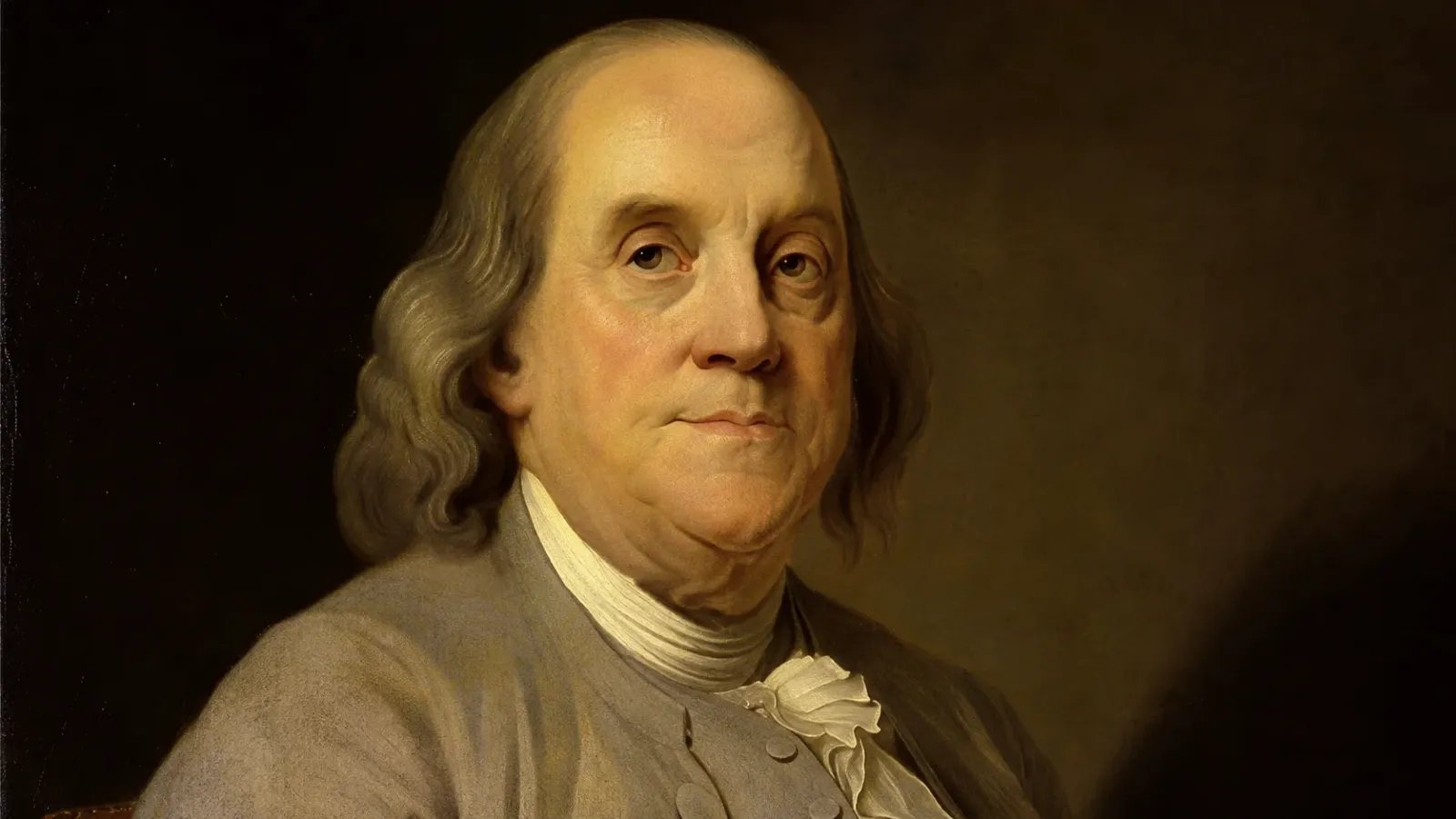
Popular mythology reduces Benjamin Franklin to a cozy folk hero flying a kite in a thunderstorm, but the real man was a radical scientist, master spy, and iconoclastic genius. Beyond his familiar portrait on the hundred-dollar bill lies a cunning strategist whose scientific breakthroughs and eccentric lifestyle redefined the Western world.
1. Benjamin Franklin never actually stood in an open field holding a kite string waiting to be struck directly by lightning.
If lightning had directly struck the metal key on Franklin’s kite as folklore suggests, the massive electric surge would have killed him instantly. Instead, during his famous June 1752 experiment in Philadelphia, Franklin flew the kite beneath a dark storm cloud to draw ambient electrical charge from the atmosphere. The ambient charge traveled down the wet hemp string and collected in a Leyden jar—a primitive capacitor—proving that lightning was a form of static electricity rather than a supernatural phenomenon.
2. He invented a mesmerizing musical instrument called the glass armonica that Mozart and Beethoven later composed music for.
In 1761, after watching a performer play water-filled wine glasses in London, Franklin sought to build a cleaner, self-contained instrument. He mounted nested glass bowls of varying sizes onto a central iron spindle rotated by a foot treadle. By touching wet fingers to the spinning glass rims, musicians could produce eerie, sustained chords. The instrument became a sensation across Europe, though rumors eventually arose that its haunting frequencies drove both players and listeners insane—a belief modern historians attribute to lead poisoning from the 18th-century crystal glass.
3. Franklin charted and named the Gulf Stream after investigating why British mail packets took weeks longer to cross the Atlantic than American merchant ships.
While serving as Deputy Postmaster General for the American colonies, Franklin noticed that merchant captains consistently beat official British mail ships across the Atlantic by several days. Questioning Nantucket whaling captains, he learned of a massive warm water current flowing northeast off the American coast. Franklin systematically measured water temperatures and current speeds with a thermometer during his transatlantic voyages, publishing the very first official nautical chart of the Gulf Stream to help ships speed up their travel by riding or avoiding the current.
4. He coined fundamental electrical terms still used today, including "battery," "charge," "conductor," and "plus" and "minus."
Before Franklin turned his focus to electricity, scientists viewed electrical phenomena as two opposing fluids. Franklin proposed a revolutionary single-fluid theory, arguing that all matter contained an electric fluid that could exist in excess or deficit. To describe this mechanism, he borrowed terms from military and general vernacular, introducing terms like positive, negative, charge, discharge, armature, and battery—the latter named after a battery of military cannon because his linked electrical Leyden jars discharged their energy together in a single powerful blast.
5. Franklin authored an entire humorous scientific essay arguing that researchers should invent a chemical compound to make human flatulence smell like perfume.
In 1781, while serving as the U.S. Minister to France, Franklin wrote a satirical letter titled "Fart Proudly" (originally addressed to the Royal Academy of Brussels). Frustrated by the overly dense, impractical academic papers submitted to European scientific institutions, Franklin argued that scientists should focus on solving everyday human problems. He proposed that chemists develop a drug or dietary supplement that would alter the chemistry of digestion, rendering human intestinal gas harmlessly aromatic.
6. He established the first successful volunteer fire company and the first fire insurance company in North America.
Recognizing that colonial Philadelphia was built largely of wood and extremely vulnerable to citywide blazes, Franklin published essays advocating for organized fire prevention. In 1736, he organized the Union Fire Company, where members pledged to rush to fires equipped with leather buckets and linen bags to save goods. Realizing that fighting blazes wasn't enough to prevent financial ruin, he co-founded the Philadelphia Contributionship in 1752, establishing the first fire insurance company in the colonies to help homeowners rebuild after disaster.
7. Franklin authored published letters under the pseudonym "Silence Dogood" when he was just 16 years old after his brother refused to print his work.
Apprenticed to his strict older brother James at The New-England Courant, young Benjamin wanted to contribute articles to the paper, but his brother repeatedly dismissed him. Undeterred, Franklin adopted the persona of "Silence Dogood," a sharp-tongued middle-aged widow living in the countryside. He slipped the essays under the door of the print shop at night. The satirical letters became an instant hit with readers across Boston until Franklin finally confessed his identity, igniting a fierce sibling rivalry that eventually led him to run away to Philadelphia.
8. He invented bifocal spectacles by cutting two pairs of lenses in half and mounting them into a single frame.
As Franklin aged, he suffered from both presbyopia and myopia, forcing him to constantly switch between two pairs of glasses—one for reading up close and another for seeing at a distance. Annoyed by the constant swapping during his diplomatic travels in France, he took matters into his own hands around 1784. He instructed an optician to slice the lenses of both pairs horizontally and fuse them into a single frame, creating the world's first bifocals so he could read a book and instantly look up to examine a person's face.
9. Franklin deliberately chose not to patent any of his famous inventions, insisting they should belong to the public free of charge.
Despite inventing the Franklin stove, the lightning rod, bifocals, and the glass armonica—all of which could have made him astronomically wealthy—Franklin steadfastly refused to secure patents on any of them. In his famous autobiography, he articulated his philosophy on intellectual property: "As we enjoy great advantages from the inventions of others, we should be glad of an opportunity to serve others by any invention of ours; and this we should do freely and generously."
10. He spent almost two decades living in London as a colonial agent and initially tried to prevent the American Revolution by preserving the British Empire.
Though celebrated as an iconic Founding Father, Franklin spent 1757 to 1775 living in London, where he fell in love with British culture and society. He initially viewed himself as a proud British subject attempting to reconcile the crown with the colonies. It was only after he was publicly humiliated in 1774 by the British Privy Council at the "Cockpit" in London—where he was falsely accused of treason over leaked political letters—that Franklin abandoned his dream of an undivided empire and returned home an ardent revolutionary.
11. Franklin started his famous career by printing paper currency designed with secret leaf patterns to thwart counterfeiters.
Long before he served as a statesman, Franklin built his fortune as a master printer. Counterfeiting was a massive problem in the colonies, as forged bills threatened to crash local economies. Franklin pioneered an ingenious anti-counterfeiting technique using a copperplate press to print accurate leaf skeleton patterns on paper money. Because nature never creates two identical leaves, and duplicating the delicate, complex vein structure of a real leaf was nearly impossible for 18th-century engravers, his currency remained uniquely secure.
12. He was an avid, lifelong open-water swimmer who invented hand-paddles for swimming at age eleven and was inducted into the International Swimming Hall of Fame.
Long before swimming was recognized as an organized sport, Franklin was a passionate aquatic athlete. As a boy in Boston, he crafted oval wooden paddles with thumb holes to propel himself faster through the water, creating an early prototype of modern swim fins. During a diplomatic stay in London in 1726, he performed impressive acrobatic swimming feats in the Thames River for a crowd of onlookers, demonstrating techniques that earned him posthumous induction into the International Swimming Hall of Fame in 1968.
13. Franklin spent his final years as an outspoken abolitionist and served as the president of Pennsylvania's anti-slavery society.
While Franklin had owned household slaves in his youth and printed slave-sale advertisements in his newspaper, his moral perspective evolved dramatically over his long life. By the 1780s, he had freed his slaves and joined the Pennsylvania Society for Promoting the Abolition of Slavery, becoming its president in 1787. Just two months before his death in 1790, Franklin presented a formal petition to the United States Congress demanding the immediate abolition of the slave trade and the emancipation of all enslaved people.
14. He designed a highly popular, energy-efficient heating appliance known as the "Franklin Stove" that warmed homes using far less wood.
In the 18th century, homes were heated by open fireplaces that consumed vast quantities of wood while venting most of their heat directly up the chimney. In 1741, Franklin designed a freestanding cast-iron stove with an inverted siphon system designed to draw heat into the room while pulling smoke out. Though his original air-duct design suffered from draft issues and required later modifications by David Rittenhouse, the iron stove concept revolutionized domestic heating across cold North American winters.
15. Franklin famously preferred the American turkey over the bald eagle as a national symbol, calling the eagle a bird of "bad moral character."
Although popular myth claims Franklin formally proposed the turkey as the official national bird, he actually expressed this opinion in a private letter to his daughter, Sarah, in 1784. Criticizing the newly chosen Great Seal of the United States, Franklin argued that the bald eagle was a dishonest scavenger that stole fish from hawks. In contrast, he praised the wild turkey as a courageously native American bird that wouldn't hesitate to attack British soldiers invading its farmyard.
Sources & References
This AI-assisted post was rigorously curated and fact-checked for accuracy by:
 Martin Roháček
How fun was this article? 🤔
Tap a star to rate it
Enjoyed these facts? There's more! 💌
Fresh fun facts in your inbox. No spam, ever.