The Contradictory King: 15 Cool Facts About Henry VIII
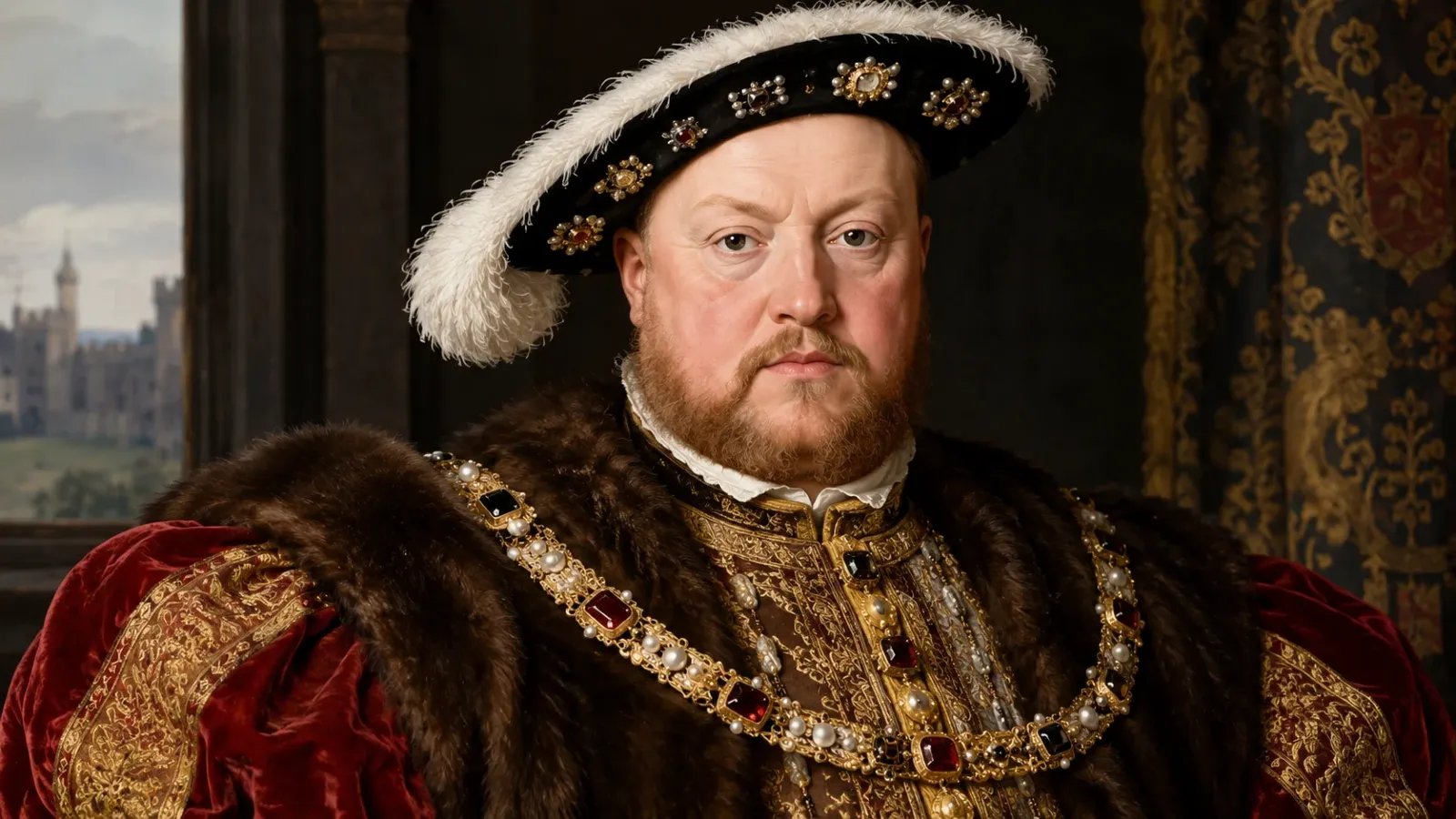
Often reduced to a gluttonous caricature who carelessly beheaded wives, Henry VIII was actually a sophisticated intellectual and hypochondriac whose reign revolutionized England. Far from starting as an obese tyrant, he was a handsome, athletic scholar who composed music and studied theology. Discover the startling medical, political, and personal truths behind this infamous Tudor king.
1. Henry VIII was originally destined for a high-ranking career in the Catholic Church, not the throne of England.
As the second son of Henry VII, Henry was not the heir apparent and was instead provided with a rigorous theological education to prepare him for the clergy. It was only the sudden death of his older brother, Arthur, in 1502 that pushed a young, religiously devout Henry into the direct line of succession. This deep theological background explains his lifelong obsession with scripture and his later ability to personally debate religious doctrine with the Pope's envoys.
2. He published a bestselling book aggressively defending the Catholic faith against the Protestant Reformation.
In 1521, a decade before he broke away from Rome, Henry authored a treatise called The Defense of the Seven Sacraments, which fiercely condemned Martin Luther. Pope Leo X was so impressed by the work that he bestowed upon Henry the title Defender of the Faith. Ironically, the British monarchy retained the title even after Henry's excommunication, and it remains a part of the British monarch's official styling to this day.
3. The king did not compose the famous English folk song Greensleeves for Anne Boleyn.
Despite a pervasive historical myth that Henry wrote the tune to woo his future second wife, musicologists have debunked this claim. The song is based on an Italian style of musical composition known as the romanesca, which did not reach England until well after Henry's death. However, he was an accomplished songwriter and did compose the popular Tudor secular song Pastime with Good Company.
4. A severe jousting accident in 1536 likely caused a traumatic brain injury that fundamentally altered his personality.
During a tournament, Henry was thrown from his armored horse, which then fell directly on top of him, leaving the king unconscious for two hours. Modern medical historians hypothesize that he suffered damage to his frontal lobe during this incident. This brain injury would explain the sudden, drastic shift in his temperament from a relatively jovial and generous Renaissance ruler to an erratic, paranoid, and explosive tyrant.
5. There is absolutely no historical evidence that Henry VIII ever instituted a tax on beards.
A popular piece of internet trivia claims that the king introduced a tax on facial hair in 1535, adjusting the fee based on the wearer's social status. In reality, historians have found zero primary sources, tax records, or contemporary accounts to support this claim. The myth likely originated from a confusion with Peter the Great of Russia, who famously did implement a beard tax in 1698 to Westernize his court.
6. His rare blood type may explain the tragic string of miscarriages and stillbirths suffered by his wives.
Bioarchaeologists have proposed that Henry possessed the rare Kell-positive blood type, while also suffering from McLeod syndrome, a genetic disorder. If his wives were Kell-negative, their first pregnancies would progress normally, but subsequent pregnancies would result in the mother's antibodies attacking the Kell-positive fetus. This condition perfectly aligns with the historical record of his wives' reproductive struggles and his own later physical and cognitive decline.
 Rulers, Kings and Emperors
Discover the captivating truths behind history's most iconic rulers, kings, and emperors. From eccentric geniuses and tactical masterminds to deeply flawed sovereigns, explore the hidden lives of those who shaped the modern world.
See All Facts
Rulers, Kings and Emperors
Discover the captivating truths behind history's most iconic rulers, kings, and emperors. From eccentric geniuses and tactical masterminds to deeply flawed sovereigns, explore the hidden lives of those who shaped the modern world.
See All Facts
7. The most powerful political position in his court was the man responsible for assisting the king in the bathroom.
The Groom of the Stool was exactly what the title implied: a courtier employed to assist the monarch with his most private toileting needs. Because this individual had guaranteed, uninterrupted, and highly intimate daily access to the king, he became a trusted confidant. The men who held this position were privy to state secrets and exerted immense political influence over Henry's decisions.
8. Henry was a severe hypochondriac who completely isolated himself at the first sign of infectious disease.
The king was absolutely terrified of falling ill, particularly from the sweating sickness, a mysterious and highly fatal plague of the Tudor era. Whenever an outbreak was reported in London, Henry would instantly flee to the countryside, moving his court constantly to outrun the contagion. He would lock himself away in isolated chambers, sometimes refusing to see even his most vital ambassadors until he deemed the danger had passed.
9. He personally formulated and mixed his own pharmaceutical remedies to treat various ailments.
Henry did not merely fear disease; he actively fancied himself a medical expert and apothecary. A surviving manuscript currently held in the British Library contains over a hundred medical recipes, many of which were concocted by the king himself. His personal ointments and salves utilized bizarre luxury ingredients, including crushed pearls, rose water, and lead, which he applied to treat his chronic leg ulcers.
10. The monarch amassed an enormous personal collection of over three hundred musical instruments.
Far from just an appreciator of music, Henry was highly trained and could sight-read complex compositions flawlessly. Inventories taken after his death revealed a staggering collection of instruments housed across his palaces, including 78 flutes, 76 recorders, 10 trombones, and numerous virginals and lutes. He employed a massive ensemble of world-class court musicians to play them and sing in his private chapel.
11. Anne of Cleves leveraged her annulment to become one of the wealthiest and most independent women in England.
When Henry sought to annul his unconsummated fourth marriage because he found Anne unattractive, she did not fight him or retreat in shame. Instead, she agreed to the annulment amicably, which delighted the king. In return, he gave her a generous financial settlement, sprawling estates, and the honorary title of the King's Beloved Sister. She outlived Henry and all his other wives, enjoying a life of luxury and freedom rarely afforded to women of her era.
12. He laid the foundational infrastructure for the modern British postal service.
In 1516, Henry knighted Brian Tuke as the first Master of the Posts. This move established a formal, centralized network of post horses and delivery routes across the country. While it was initially designed strictly for royal and governmental correspondence to quickly navigate the kingdom, this system created the geographical and administrative framework that would eventually evolve into the Royal Mail.
13. Surviving suits of armor physically document his tragic transition from a top athlete to a severely obese invalid.
In his twenties, Henry was exceptionally fit and athletic, boasting a modest 32-inch waist, which is reflected in his early tournament armor. However, after his leg injuries prevented him from exercising, his diet of massive meat banquets remained unchanged. His final suit of armor, currently displayed at the Tower of London, required a staggering 52-inch waistline to accommodate a man who had grown to weigh nearly 400 pounds.
14. Henry VIII is widely considered the father of the English Navy.
While pop culture remembers him for his domestic chaos, his most enduring military legacy was transforming England into a formidable maritime power. Realizing the vulnerability of an island nation, he expanded the royal fleet from a meager five vessels to over fifty heavily armed warships, including the famous Mary Rose. He also established the first permanent naval dockyards and a dedicated Navy Board to manage them.
15. He spent the immense wealth seized from dissolved monasteries on coastal fortresses rather than palaces.
After breaking from Rome, Henry dissolved the English monasteries, acquiring an unprecedented fortune. Fearing a joint invasion from Catholic France and Spain ordered by the Pope, he poured these funds into the Device Forts. This vast network of artillery blockhouses and castles built along the southern coast was the most extensive system of military defenses constructed in England since the Roman occupation.
Sources & References
This AI-assisted post was rigorously curated and fact-checked for accuracy by:
 Martin Roháček
How fun was this article? 🤔
Tap a star to rate it
🧠 Quiz: How closely were you paying attention?
10 questions — all answers are in the article above!
Enjoyed these facts? There's more! 💌
Fresh fun facts in your inbox. No spam, ever.