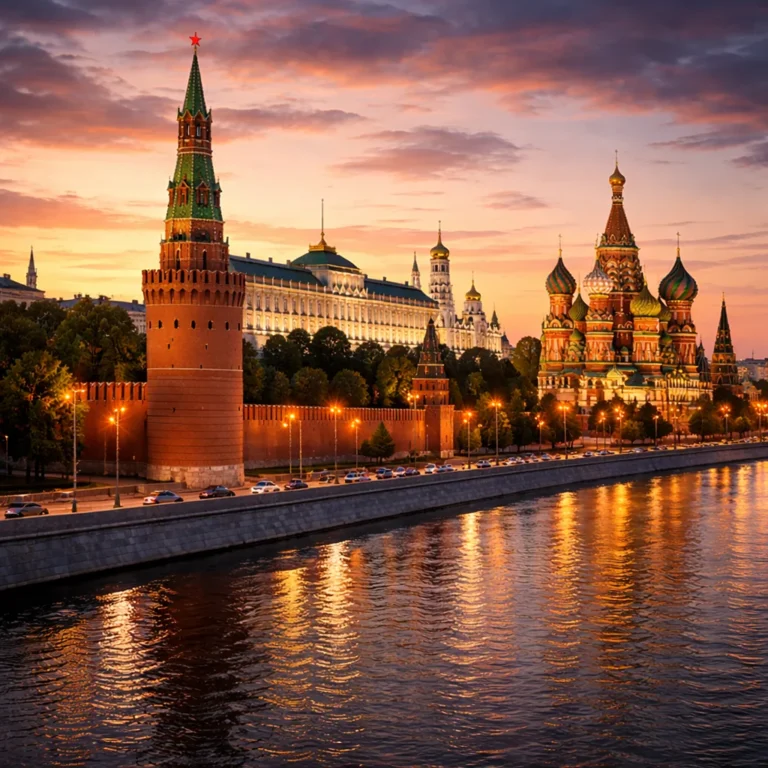
The Kremlin serves as the fortified heart of Moscow and the center of Russian political power. Initially, builders constructed it as a small wooden outpost before it grew into the massive complex we see today. Furthermore, the red walls hide centuries of royal intrigue, secret tunnels, and priceless treasures. Consequently, this UNESCO World Heritage site remains one of the most mysterious places on Earth. Explore these fascinating details about the Russian citadel.
Kremlin
Originally, the Kremlin walls were white, not red. In the 18th and 19th centuries, workers painted the bricks with white lime to protect them from the weather. Therefore, iconic paintings from that era depict a “white-stone Moscow” rather than the red fortress of today.
The Tsar Bell is the largest bell in the world, but it has never rung. During its construction, a fire broke out, and the cold water used to extinguish the flames caused a massive chunk to break off. Thus, the 200-ton giant sits silently on a pedestal as a museum exhibit.
Similarly, the Tsar Cannon has never fired a shot in war. The massive weapon has a caliber of 890 millimeters, which technically makes it the largest bombard by caliber in existence. However, researchers believe it was built purely for military intimidation rather than actual combat.
During World War II, the government disguised the Kremlin as a residential neighborhood. To protect it from German airstrikes, artists painted fake windows and doors on the walls to make them look like apartment blocks. Remarkably, this optical illusion helped the complex survive the war with minimal damage.
The ruby stars on the towers spin like weather vanes. Because the stars weigh about one ton each, they would catch too much wind and potentially snap the towers if they were stationary. Consequently, engineers designed them to rotate so they always face the wind, reducing the pressure on the structure.
Napoleon Bonaparte tried to blow up the Kremlin when he retreated. In 1812, the French emperor ordered his troops to destroy the fortress as they fled Moscow. Fortunately, heavy rain dampened many of the fuses, so the explosions only damaged a few towers instead of leveling the entire site.
Legends say a secret subway system exists beneath the ground. Locals call it “Metro-2” and believe it connects the Kremlin to underground bunkers and other government outposts. Although officials rarely confirm its existence, defectors and urban explorers have reported finding entrances to these hidden lines.
The Ivan the Great Bell Tower was once the tallest building in all of Russia. For centuries, the law forbade anyone from building a structure taller than its 81-meter height. This ensured that the bell tower remained the supreme lookout point for fires and approaching enemies.
President Vladimir Putin commutes to the Kremlin by helicopter. Previously, his motorcade caused massive traffic jams throughout Moscow whenever he traveled to work. Therefore, engineers built a special helipad within the walls in 2013 to solve the gridlock problem.
The Kremlin contains the world’s largest collection of Fabergé eggs. The Armoury Chamber holds ten of these exquisite imperial Easter eggs, which the Tsars gifted to their wives. Intricately, each egg opens to reveal a unique mechanical surprise, such as a tiny train or a golden hen.
It is the largest active fortress in Europe. While many medieval castles serve only as museums today, the Kremlin still functions as the official residence of the President of the Russian Federation. Consequently, it blends modern government operations with medieval architecture.
The clock on the Spasskaya Tower weighs a staggering 25 tons. The chimes from this clock tower officially mark the New Year for Russians, similar to the ball drop in Times Square. Furthermore, the clock face measures over six meters in diameter, making it visible from far across Red Square.
The Archangel Cathedral serves as the burial place for the Tsars. Before the capital moved to St. Petersburg, almost every Russian ruler from Ivan Kalita to Ivan the Terrible was buried here. Visitors can see the rows of sarcophagi that hold the remains of the Rurik and early Romanov dynasties.
Workers replaced the original double-headed eagles with stars. Before the Soviet era, golden eagles topped the towers to symbolize the Tsar’s power. However, the communist government melted them down in the 1930s and replaced them with the illuminated red stars we see today.
Finally, the complex forms an irregular triangle shape. Unlike many square fortresses, the Kremlin walls follow the contours of Borovitsky Hill where the Neglinnaya and Moskva rivers meet. Thus, the walls vary in height and thickness depending on the terrain they stand upon.
How useful was this post?
Click on a star to rate it!
This AI-assisted post was rigorously curated and fact-checked for accuracy by: