15 Interesting Facts About Mao Zedong
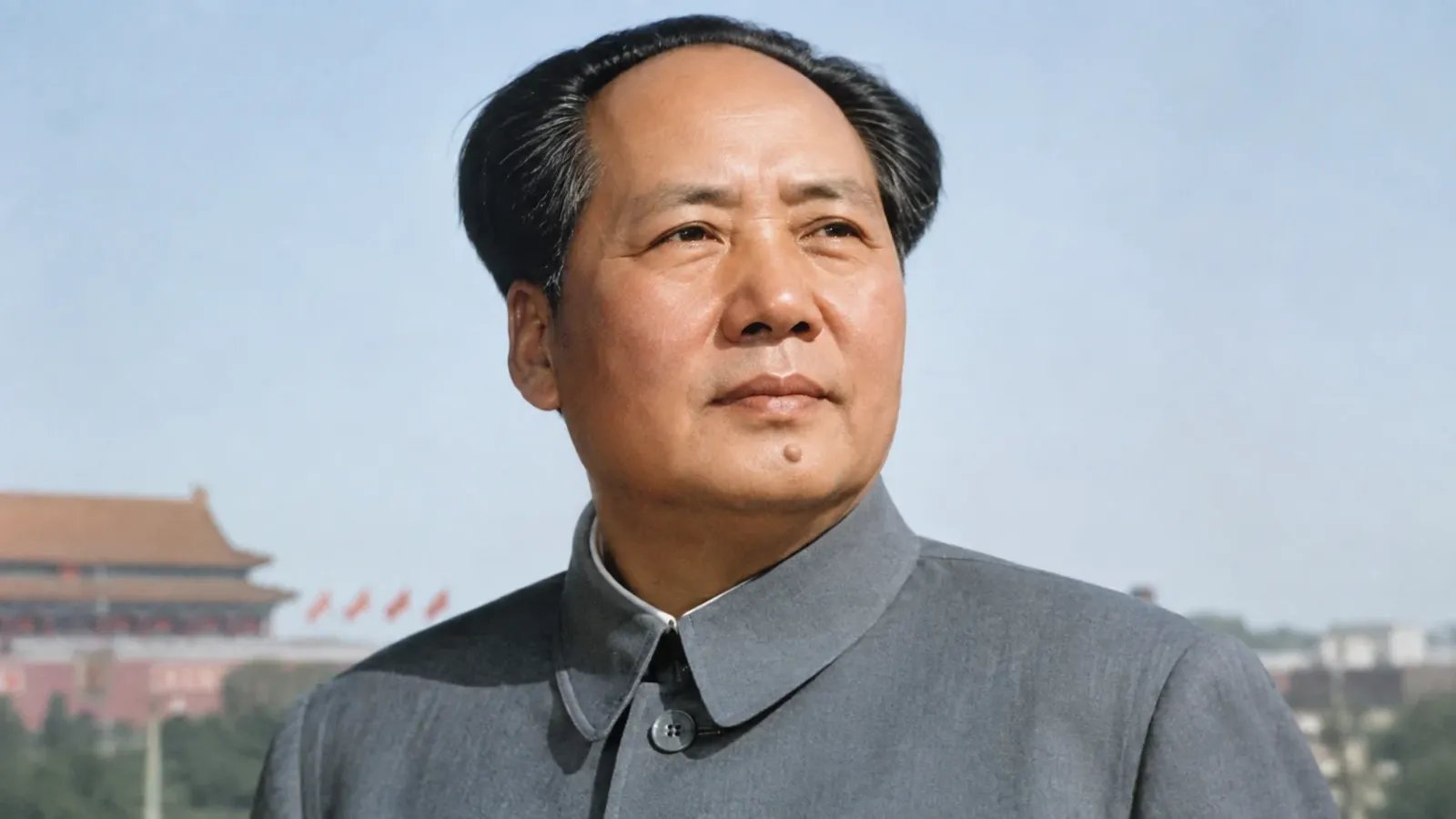
Mao Zedong is often reduced to a monolithic dictator, but the man was wildly complex. Contrary to the peasant myth he cultivated, Mao came from a wealthy farming family. From adopting disastrous agricultural pseudoscience that reshaped global ecology to his obscure early career, discover the surprising historical realities behind the founding father of modern China.
1. Mao Zedong was not born into rural poverty, but rather to one of the wealthiest farming families in his village.
Despite heavily cultivating a public image as a champion of the destitute peasant class, Mao was born in Shaoshan to a father who was a wealthy grain merchant and landowner. His family owned over two and a half acres of land, a massive estate by local standards, which afforded Mao the rare privilege of receiving a formal education instead of performing grueling manual labor his whole life.
2. Before becoming a revolutionary leader, Mao worked as an assistant librarian at Peking University.
In 1918, Mao took a low-paying job cleaning and cataloging books in the university's library under the directorship of Li Dazhao, an early Chinese Marxist. It was here that he was first exposed to communist literature, though he was often ignored by the intellectual elites who frequented the library because of his rural Hunanese accent, an experience that deeply fueled his lifelong disdain for intellectuals.
3. Mao refused to ever brush his teeth, preferring instead to rinse his mouth with tea and chew the leaves.
Defying modern dentistry, Mao insisted that a tiger never brushes its teeth, asking his personal physician why a tiger's teeth stay sharp without toothpaste. Instead, he relied on an ancient Chinese practice of washing his mouth out with green tea and chewing the remaining leaves. As a result, his teeth became coated in heavy green plaque and many completely rotted away by the end of his life.
4. His Four Pests campaign inadvertently caused a massive ecological disaster by targeting sparrows.
In 1958, Mao ordered the eradication of rats, flies, mosquitoes, and sparrows, believing the birds were eating too much grain. Millions of citizens aggressively hunted the birds to near-extinction, completely disrupting the local ecosystem. Without sparrows to eat them, locust populations exploded, swarming the countryside and destroying crops, which became a major contributing factor to the Great Chinese Famine.
5. Mao mandated the adoption of Soviet agricultural pseudoscience, leading to widespread crop failures.
Influenced by Soviet biologist Trofim Lysenko, Mao forced farmers to adopt bizarre planting methods, such as close planting, which falsely assumed that seeds of the same class would not compete with one another for nutrients. Farmers were ordered to plant seedlings impossibly close together, resulting in stunted growth and massive crop death, worsening the catastrophic food shortages of the Great Leap Forward.
6. He used his proficiency in swimming as a powerful political propaganda tool well into his old age.
At the age of 72, amidst rumors of failing health and weakening political grip, Mao famously swam across the Yangtze River. The highly publicized 1966 event was designed to demonstrate his physical vitality and readiness to lead the impending Cultural Revolution. State media claimed he swam nearly ten miles in just over an hour, a superhuman feat that successfully galvanized his young Red Guard supporters.
7. Mao was an avid poet and calligrapher whose distinct handwriting style is still widely used in China today.
Far from a purely pragmatic military man, Mao considered himself a traditional scholar and wrote dozens of poems in classical Chinese styles. His highly idiosyncratic and flowing calligraphy, known as Mao-style or Maoti, remains deeply respected in artistic circles. Today, his distinct brushstrokes are still used to spell out the mastheads of major Chinese state newspapers and university signs.
8. He accidentally started a bizarre religious cult centered around mangoes during the Cultural Revolution.
In 1968, Pakistan's foreign minister gifted Mao a crate of mangoes, which Mao then re-gifted to a group of factory workers. Having never seen the exotic fruit, the workers viewed them as sacred relics of the Chairman's love. The mangoes were preserved in formaldehyde, replicated in wax, and paraded through streets as objects of veneration, sparking a nationwide frenzy where mango imagery dominated textiles, posters, and household items.
9. Mao suffered from lifelong insomnia and relied on heavy doses of barbiturates to sleep.
The Chairman's erratic sleep schedule was legendary among his inner circle, as he often worked through the night and slept during the day. His personal physician documented that Mao was completely dependent on sleeping pills, sometimes taking up to ten times the normal dosage just to achieve a few hours of rest. This nocturnal lifestyle meant his staff and top officials had to constantly adapt to his unpredictable waking hours.
10. Mao once offered to export ten million Chinese women to the United States to boost bilateral trade.
During a bizarre 1973 late-night meeting with Henry Kissinger, a declining Mao jokingly suggested that China was too poor to offer much in trade except for women. He claimed China had an excess of women who caused disasters and offered to send ten million of them to the U.S. to stir up trouble. Kissinger diplomatically deflected the bizarre proposition, and the strange exchange was kept out of public records for years.
11. Despite his nationalist and anti-Western rhetoric, Mao secretly learned English in his later years.
Although he heavily criticized Western imperialism, Mao took up English lessons in the 1950s and resumed them with intense dedication during the 1970s. He wanted to read foreign news and literature directly, without relying entirely on translators. By the time Richard Nixon visited China in 1972, Mao was able to exchange basic English pleasantries with the American president.
12. His early political ideology was deeply rooted in anarchism rather than strict Marxism.
Before discovering the works of Karl Marx, a young Mao was heavily influenced by the writings of Russian anarchist Peter Kropotkin. He advocated for decentralized, leaderless societies and mutual aid. It wasn't until the success of the Bolshevik Revolution in Russia that Mao pivoted his beliefs toward the centralized authoritarianism of Marxism-Leninism, though his chaotic launch of the Cultural Revolution later echoed his youthful anarchist tendencies.
13. He banned traditional Chinese martial arts, viewing them as a threat to his regime.
Mao believed that traditional martial arts, deeply intertwined with secret societies, religious sects, and local militias, posed a risk of organized rebellion. During the Cultural Revolution, masters of Kung Fu and Tai Chi were persecuted, and training lineages were broken. The state eventually replaced these ancient combat practices with Wushu, a highly choreographed, state-approved performance sport stripped of its lethal applications.
14. Mao genuinely believed that reading too many books was dangerous for a person's intellect.
Paradoxically, despite being a former librarian and avid reader himself, Mao harbored a deep suspicion of formal academia. He famously stated that reading too many books makes one stupid and believed that true knowledge came from practical, physical labor in the fields. This philosophy culminated in the closure of universities for a decade and the violent persecution of teachers and professors by his Red Guards.
15. Soviet-Chinese tensions forced scientists to rely on untested methods to embalm Mao's body, causing it to temporarily swell.
When Mao died in 1976, the Chinese government decided to preserve his body for public display, similar to Lenin. However, due to the Sino-Soviet split, they could not ask Moscow for their proprietary embalming secrets. Chinese scientists had to experiment with formaldehyde formulas, which initially caused Mao's face and body to swell grotesquely and leak fluid, forcing technicians to massage the body for hours to return it to a recognizable shape.
Sources & References
This AI-assisted post was rigorously curated and fact-checked for accuracy by:
 Martin Roháček
How fun was this article? 🤔
Tap a star to rate it
🧠 Quiz: How closely were you paying attention?
10 questions — all answers are in the article above!
Enjoyed these facts? There's more! 💌
Fresh fun facts in your inbox. No spam, ever.