The Formidable Matriarch: 15 Fascinating Facts About Maria Theresa
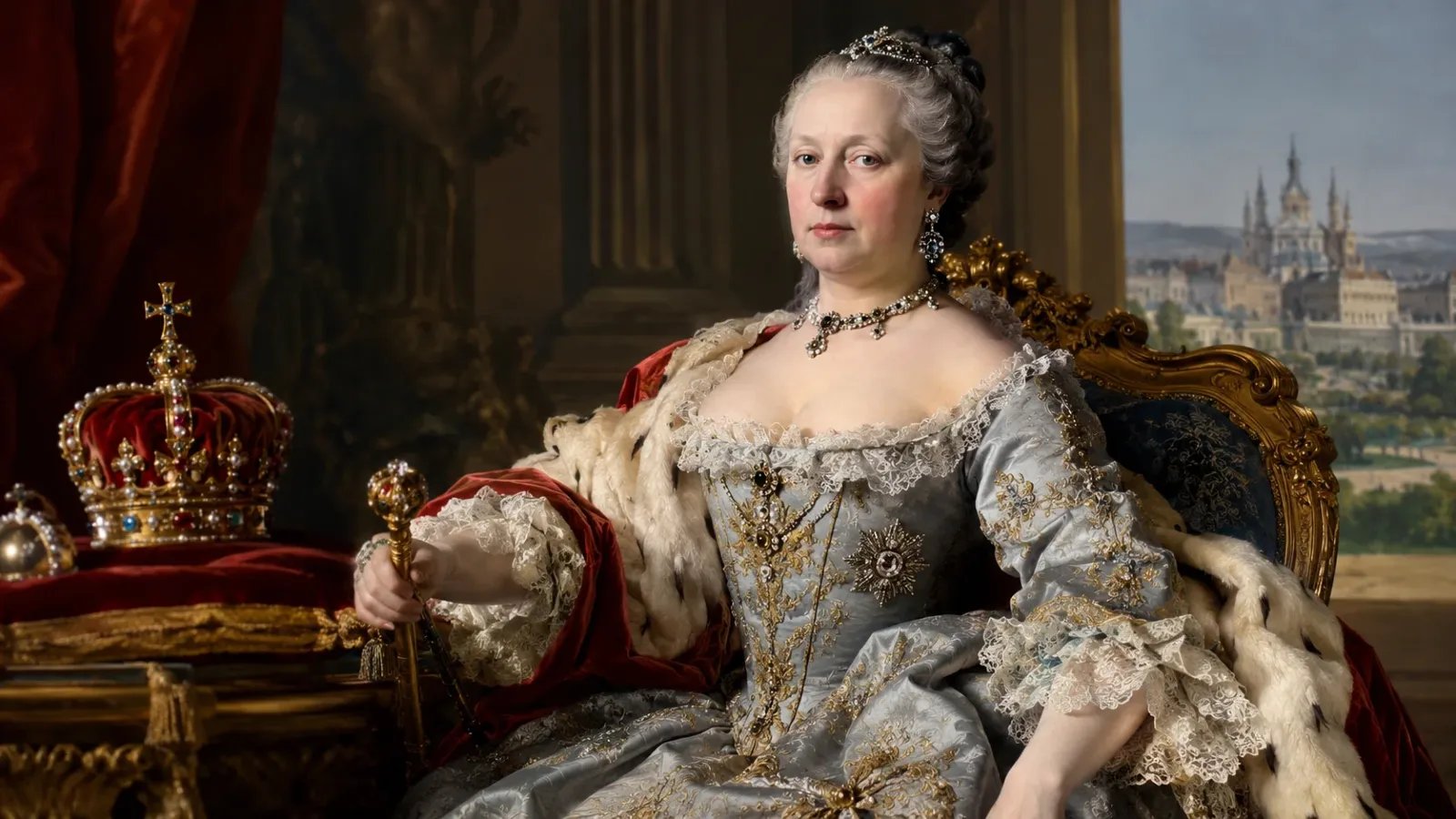
Maria Theresa was the only female ruler of the Habsburg dominions. While many assume she was a passive figurehead, she inherited a bankrupt state and built a powerhouse. Far from weak, this formidable monarch modernized medicine, reformed education, and fiercely defended her realm against all of Europe.
1. Maria Theresa was never Holy Roman Empress in her own right.
Although she is remembered as an empress, the Holy Roman Empire did not allow a woman to be elected emperor. Her husband, Francis Stephen of Lorraine, was elected Holy Roman Emperor on 13 September 1745, making her an empress consort. However, she held the real power in the Habsburg lands, ruling as queen of Hungary and Bohemia and archduchess of Austria. She is the only woman to have held the position of Habsburg ruler in her own right.
2. She created a Chastity Commission to police morals.
Maria Theresa was particularly concerned with the sexual morality of her subjects. In 1752 she established a Chastity Commission (Keuschheitskommission) to clamp down on prostitution, homosexuality, adultery, and even sex between members of different religions. The commission cooperated closely with the police and even employed secret agents to investigate people's private lives. It is a striking example of how far she, a strict Catholic, was willing to go to enforce morality.
3. She introduced compulsory schooling.
In the 1770s the reform of the schooling system for all levels of society became a major policy. In 1774 Maria Theresa issued the General School Ordinance, drafted with the help of the educator Johann Ignaz von Felbiger, which required children of both sexes between six and twelve to attend school. It created primary schools in parishes and introduced standard textbooks and teacher training. Enforcement was slow, especially in rural areas, but the reform laid the foundation for the modern education system in Central Europe.
4. After smallpox struck her family, she promoted inoculation.
Smallpox was a constant threat to the royal family. It killed several of her children and relatives, and in 1767 she caught the disease herself and survived. After the epidemic of 1767 she promoted inoculation, an early and risky method of protection. She had herself and two of her children inoculated, and she hosted a dinner for the first sixty-five inoculated children at Schönbrunn Palace, waiting on them herself. She is credited with changing the negative view of inoculation among Austrian physicians.
5. She defended her inheritance against several invading powers.
When her father, Charles VI, died in 1740, Frederick II of Prussia invaded Silesia, and other powers, including France and Bavaria, also challenged her right to inherit. She was crowned queen of Hungary in Pressburg in 1741 after months of negotiation with the Hungarian Diet, and according to tradition, she made a dramatic appeal to the Hungarian nobles holding her infant son, which won her significant support. She lost most of Silesia to Prussia, but she kept the rest of the Habsburg lands.
6. She gave birth to sixteen children.
Between 1737 and 1756, Maria Theresa gave birth to sixteen children in nineteen years. Thirteen survived infancy, and ten reached adulthood. She arranged marriages for her children to strengthen alliances with other European powers. Her daughter Marie Antoinette became Queen of France, Maria Carolina became Queen of Naples, and her son Joseph II succeeded her as ruler of the Habsburg lands.
 Rulers, Kings and Emperors
Discover the captivating truths behind history's most iconic rulers, kings, and emperors. From eccentric geniuses and tactical masterminds to deeply flawed sovereigns, explore the hidden lives of those who shaped the modern world.
See All Facts
Rulers, Kings and Emperors
Discover the captivating truths behind history's most iconic rulers, kings, and emperors. From eccentric geniuses and tactical masterminds to deeply flawed sovereigns, explore the hidden lives of those who shaped the modern world.
See All Facts
7. She was deeply intolerant of religious minorities.
A pious Catholic, Maria Theresa despised Freemasons, Jews, and Protestants. In December 1744 she proposed the expulsion of around 10,000 Jews from Prague after accusations that they had been disloyal during the Bavarian-French occupation, and the order was expanded to all Jews in Bohemia and parts of Moravia. After protests and economic pressure, the measures were later softened. Protestants were also deported to remote regions such as Transylvania. Her son Joseph II ended many of these policies with his Patent of Toleration in 1781.
8. She modernized medicine with the help of Gerard van Swieten.
Maria Theresa recruited the Dutch physician Gerard van Swieten to reform the University of Vienna's medical teaching. Together with another Dutch physician, Anton de Haen, he founded the Viennese Medical School, which introduced bedside clinical teaching. She also banned the creation of new burial grounds without government permission, which helped counter unhygienic burial customs. In 1770 she strictly regulated the sale of poisons.
9. She is credited with helping end the witch hunts in her lands.
Although the criminal code of 1769 still criminalized witchcraft, Maria Theresa is credited with ending witch hunts in the Habsburg lands. In Zagreb, she opposed the methods used against Magda Logomer, also called Herrucina, who was the last woman prosecuted for witchcraft in the city, following her intervention. Her physician van Swieten, who investigated reports of vampires and witches, also helped promote a more skeptical, Enlightenment approach.
10. Her penal code allowed torture, though she later banned it.
In 1769 the Constitutio Criminalis Theresiana was published, a codification of the traditional criminal justice system that had existed since the Middle Ages. It allowed the use of torture to establish the truth and criminalized witchcraft and various religious offences. It came into force in Austria and Bohemia but not in Hungary. Under pressure from reformers, the empress abolished torture in the Austrian and Bohemian lands in 1776.
11. She founded a military academy that is still in operation.
After her military defeats against Prussia, Maria Theresa reformed the army and its officer training. In 1751 she founded the Theresian Military Academy at Wiener Neustadt, which still trains officers of the Austrian army today and claims to be the oldest military academy in the world. She also established the Theresianum in Vienna in 1746 to educate noble sons for state service and the Oriental Academy in 1754 to train diplomats.
12. She kept a close eye on her daughters abroad.
Maria Theresa wrote frequently to her children after they left Vienna. Her letters to Marie Antoinette in France were full of advice and reproaches. She received information from the Austrian ambassador in Paris, and she criticized her daughter's extravagance and her neglect of Austrian interests. The correspondence shows how the empress treated her children as part of her family and dynastic strategy.
13. Her government issued the first Austrian banknotes.
The Seven Years' War (1756 to 1763) strained the finances of the Habsburg monarchy. In 1762 the Vienna City Bank (Wiener Stadtbanco) began issuing banknotes, the first paper money in the Habsburg lands. The public was suspicious of paper money at first, and the monarchy's later financial troubles led to problems with its value. Still, it was an important step in Central European finance.
14. She transformed Schönbrunn into a grand imperial residence.
Maria Theresa had the former hunting lodge at Schönbrunn rebuilt as a splendid summer residence, which became a stage for Habsburg ceremony. In 1752 her husband Francis Stephen founded a menagerie in its grounds, now the oldest zoo in the world still in operation. In 1762 the six-year-old Mozart played at the palace for the empress, and according to a famous story he jumped into her lap afterward.
15. She was the only woman to rule the Habsburg monarchy in her own right.
Maria Theresa (13 May 1717 to 29 November 1780) ruled the Habsburg monarchy from 1740 until her death and was the only woman to hold the position in her own right. She was sovereign of Austria, Hungary, Croatia, Bohemia, and many other lands. She died in Vienna at the age of 63 and was buried in the Imperial Crypt. With the help of advisers such as Kaunitz and Haugwitz, she left behind a state that was stronger and better organized than the one she had inherited.
Sources & References
This AI-assisted post was rigorously curated and fact-checked for accuracy by:
 Martin Roháček
How fun was this article? 🤔
Tap a star to rate it
🧠 Quiz: How closely were you paying attention?
10 questions — all answers are in the article above!
Enjoyed these facts? There's more! 💌
Fresh fun facts in your inbox. No spam, ever.