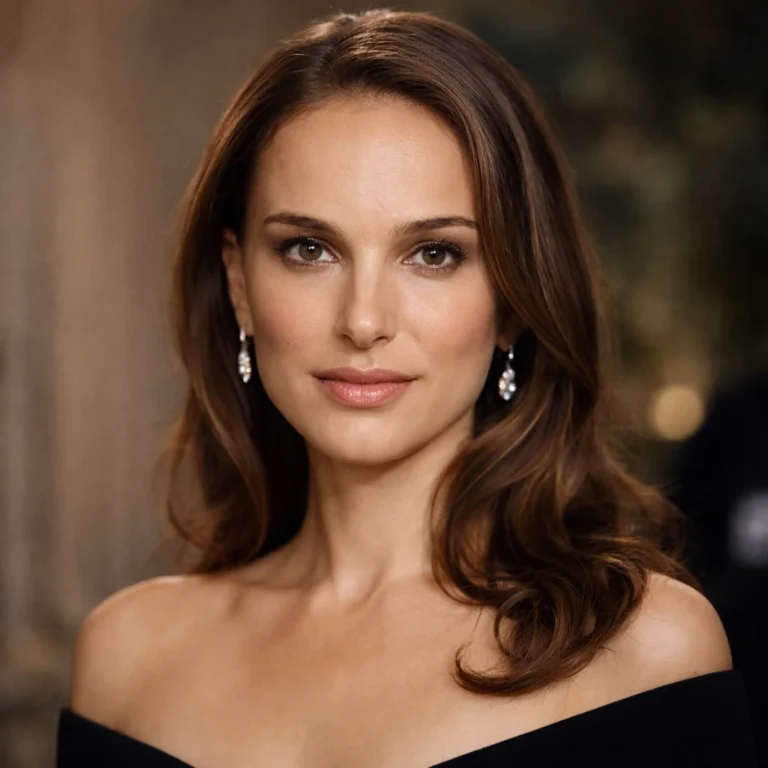
Natalie Portman transitioned from a child prodigy to a Hollywood powerhouse seamlessly. She balances blockbuster roles with serious academic achievements. Furthermore, she champions social causes and environmental activism off-screen. Consequently, she remains one of the most respected figures in the entertainment industry. Explore these fascinating details about the Harvard-educated star.
Natalie Portman
She was born Neta-Lee Hershlag in Jerusalem, Israel. Therefore, she uses her grandmother’s maiden name, “Portman,” to protect her privacy and separate her personal life from her acting career.
She famously missed the premiere of Star Wars: Episode I – The Phantom Menace. Prioritizing her education, she stayed home to study for her high school final exams instead of walking the red carpet.
Natalie Portman earned a bachelor’s degree in psychology from Harvard University in 2003. Famously, she told the New York Post, “I’d rather be smart than a movie star.”
She co-authored two scientific papers that appeared in professional journals. Impressively, she reached the semi-finals of the Intel Science Talent Search in high school for her research on enzymatic production of hydrogen.
A casting agent discovered her in a pizza parlor when she was just 11 years old. Consequently, she landed her debut role as Mathilda in the classic action film Leon: The Professional.
She met her future husband, Benjamin Millepied, on the set of Black Swan. Specifically, he worked as the choreographer for the film and helped her train for the demanding ballet sequences.
Natalie Portman speaks Hebrew and English fluently as her native languages. Additionally, she has studied French, Japanese, German, and Arabic to varying degrees of proficiency.
She follows a strict vegan diet and actively advocates for animal rights. Furthermore, she produced and narrated the documentary Eating Animals to expose the harsh realities of factory farming.
She shocked audiences with her profane rap video on Saturday Night Live. Hilariously, the sketch shattered her “good girl” image as she smashed chairs and aggressively rapped about her life.
She trained for 10 months to build muscle for Thor: Love and Thunder. Because she played the Mighty Thor, she wanted to physically embody the superhero without relying heavily on CGI effects.
She co-founded the professional women’s soccer team Angel City FC in Los Angeles. Thus, she helps promote women’s sports and fights for equal pay within the athletic world.
She wrote, directed, and starred in the film A Tale of Love and Darkness. Notably, she insisted on filming the movie entirely in Hebrew to stay true to the original memoir by Amos Oz.
Unlike many peers, she never attended a traditional drama school. Instead, she learned her craft directly on movie sets and through working with legendary directors like Mike Nichols.
She shaved her head on camera for a pivotal scene in V for Vendetta. Bravely, she performed the act in a single take because she could not reattach the hair if she made a mistake.
Finally, she went viral for calling out the lack of female nominees at the 2018 Golden Globes. Boldly, she introduced the category by saying, “And here are the all-male nominees.”
How useful was this post?
Click on a star to rate it!
This AI-assisted post was rigorously curated and fact-checked for accuracy by:
Pulp Fiction redefined cinema in the 1990s with its non-linear storytelling and sharp dialogue. Quentin Tarantino wove together multiple storylines involving mob hitmen, a boxer, and a pair of diner bandits into a pop culture masterpiece. Furthermore, the film revitalized John Travolta's career and established Samuel L. Jackson as a Hollywood icon. Consequently, the movie remains a treasure trove of hidden details and production secrets. Explore these intriguing details about the film that changed independent cinema forever.
Pulp Fiction
The famous Bible verse does not actually exist in the Bible. Samuel L. Jackson’s intense recitation of Ezekiel 25:17 is mostly a fabrication by Quentin Tarantino and not a direct scripture quote. In reality, the director took the speech from the 1976 martial arts movie The Bodyguard featuring Sonny Chiba.
Filmmakers of Pulp Fiction shot the adrenaline needle scene in reverse. To ensure the safety of the actors and achieve a realistic effect, John Travolta started with the needle touching Uma Thurman’s chest and pulled it away violently. Editors then reversed the footage in post-production to make it look like a forceful strike.
Vincent Vega’s car belonged to Quentin Tarantino in real life. The director let the production use his classic 1964 Chevelle Malibu for the film. Unfortunately, thieves stole the vehicle during production, and police did not recover it until nearly two decades later.
A lightbulb and a battery created the briefcase’s mysterious glow. While fans theorize that the case contained diamonds, gold, or even Marsellus Wallace’s soul, the prop department simply used an orange light to illuminate John Travolta’s face. Tarantino purposely left the contents undefined to let the audience use their imagination.
Daniel Day-Lewis desperately wanted the role of Vincent Vega. The acclaimed actor aggressively campaigned for the part, but Tarantino preferred Michael Madsen for the role. When Madsen chose to film Wyatt Earp instead, the studio cast John Travolta, which relaunched his superstar status.
Robert Rodriguez directed the scenes that featured Tarantino. Because Tarantino played the character Jimmie, he needed someone else to stand behind the camera to monitor his performance. Therefore, he asked his close friend and fellow director Robert Rodriguez to handle those specific sequences.
The “Bad Mother F***er” wallet belonged to Tarantino. The director used his own personal wallet as a prop for Jules Winnfield in the final diner scene. The inscription references the theme song from the 1971 film Shaft.
Steve Buscemi appears as a waiter dressed like Buddy Holly. Originally, Tarantino wanted Buscemi to play the role of Jimmie, but scheduling conflicts prevented it. Instead, the actor made a brief but memorable cameo serving milkshakes at Jack Rabbit Slim’s.
Courtney Love claimed that Kurt Cobain almost played the drug dealer Lance. The singer stated that Tarantino offered the role to the Nirvana frontman, but he declined. However, Tarantino later denied this story and said he never met Cobain.
A real rabbit inspired the name Honey Bunny. Linda Chen, who typed up the handwritten script for Tarantino, owned a pet rabbit with that name. When the rabbit died, the director named Amanda Plummer’s character in her honor.
Vincent and Mia did not actually win the dance contest. Although they return to the house holding the trophy, a faint radio broadcast later in the film mentions that someone stole the trophy from the restaurant. This implies that the pair likely swiped the award rather than winning it fairly.
The movie uses the F-word 265 times. This high count gave the film the record for the most uses of the profanity in a 1994 movie. However, Tarantino’s previous film, Reservoir Dogs, still beat it with 269 uses.
Laurence Fishburne turned down the role of Jules Winnfield. He rejected the part because he felt the script glamorized heroin use. This decision opened the door for Samuel L. Jackson to deliver one of the most iconic performances of his career.
Pulp Fiction cost only 8.5 million dollars to produce. Despite its low budget, the movie grossed over 200 million dollars worldwide. This massive financial success proved that independent films could compete with major studio blockbusters.
Finally, the story of Pulp Fiction begins and ends in the same diner. Due to the non-linear timeline, the movie opens with Pumpkin and Honey Bunny planning a robbery and ends with them executing it. This circular structure ties the intersecting stories together perfectly.
Anthony Hopkins is a titan of the acting world who scares and delights audiences in equal measure. Although he is best known for playing villains, he is actually a gentle musician and painter in real life. Furthermore, his career has spanned decades, earning him the highest honors in the industry. Consequently, his personal journey offers as many surprises as his movie roles. Explore these fascinating details about the man behind the mask.
Anthony Hopkins
He won an Oscar for only sixteen minutes of screen time. In the movie The Silence of the Lambs, he appears on camera for a very short portion of the film. Nevertheless, his terrifying performance was so impactful that he won the Academy Award for Best Actor.
Surprisingly, Anthony Hopkins composed a waltz that became a global hit. He wrote the piece of music called “And The Waltz Goes On” when he was a young man, but he was too shy to release it. Eventually, he sent it to the famous violinist André Rieu, who performed it for a massive audience in Vienna.
He famously improvised the creepy hissing noise in The Silence of the Lambs. During the scene where he mentions eating liver and fava beans, he spontaneously made the slurping sound to disturb his co-star, Jodie Foster. Instantly, the director loved the unscripted moment and decided to keep it in the final cut.
Passionately, he wrote a fan letter to the cast of Breaking Bad. After he watched the entire series in two weeks, he felt compelled to email Bryan Cranston. Specifically, he told the actor that his performance as Walter White was the best acting he had ever seen.
Unfortunately, he struggled in school due to undiagnosed dyslexia. As a child, he felt isolated because he could not keep up with his classmates academically. Therefore, he turned to painting and playing the piano as a way to express his emotions.
Deliberately, he chose not to blink his eyes while playing Hannibal Lecter. He wanted the character to look reptilian and absolutely focused on his prey. Consequently, this intense, unblinking stare became one of the most iconic traits of the villain.
Anthony Hopkins is the oldest person to ever win a Best Actor Oscar. Recently, he took home the trophy for his role in The Father at the age of 83. Thus, he broke the previous age record held by the late Christopher Plummer.
Officially, Queen Elizabeth II knighted him for his services to the arts. He received the high honor at Buckingham Palace in 1993. Hence, you can formally address him as Sir Anthony Hopkins.
Obsessively, he reads his script aloud over 200 times before filming begins. He believes in over-preparing so that the lines become a natural reflex for him. As a result, he can recite complex dialogue effortlessly while performing difficult actions.
Originally, he wanted to be a concert pianist rather than an actor. Although he eventually chose drama school, he never lost his love for the piano. Frequently, he posts videos on social media where he plays beautiful classical music in his home.
Late in life, doctors diagnosed him with Asperger’s Syndrome. Interestingly, he views this condition as an advantage for his acting career. He claims it helps him deconstruct characters and analyze their behavior more deeply than other actors.
He has been sober for nearly fifty years. Previously, he battled a severe addiction to alcohol that threatened to ruin his life and career. However, he quit drinking in 1975 and often speaks openly about his recovery to inspire others.
Creatively, he is an accomplished painter with his own art studio. He describes his painting style as wild and free, using bright colors and chaotic strokes. Furthermore, his original artwork is quite valuable and hangs in galleries around the world.
Adorably, he often plays the piano for his cat, Niblo. The actor posts heartwarming clips of himself holding the cat while he plays gentle melodies. In fact, these videos have made him a viral sensation on TikTok and Instagram.
Finally, Anthony Hopkins played Odin in the Marvel Cinematic Universe. He enjoyed the role of the Norse god because it required very little acting effort. Playfully, he joked that he just had to put on the beard and the armor to look commanding.