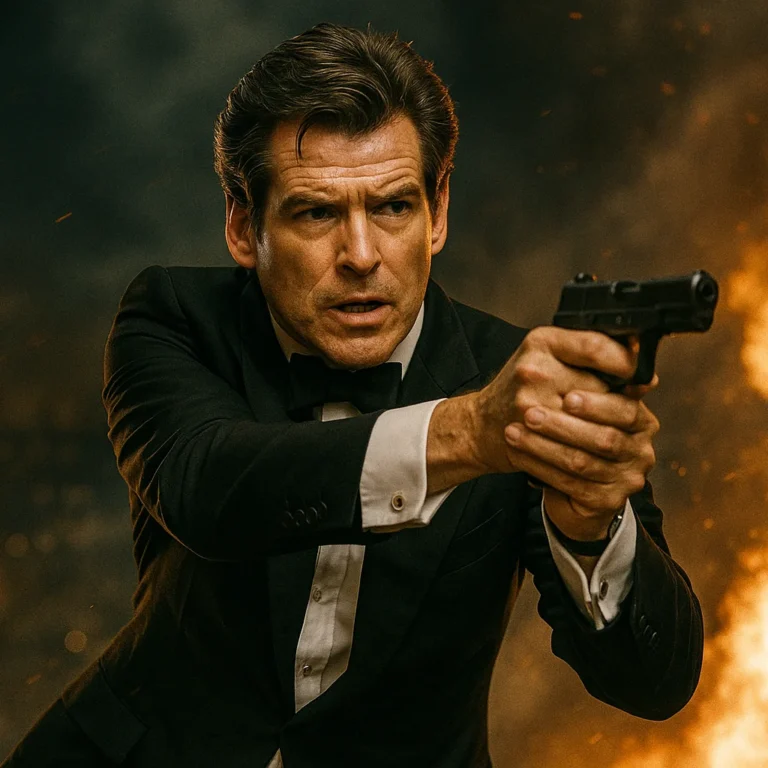
Pierce Brosnan redefined James Bond for the ‘90s and 2000s with charm, daring stunts, and lasting appeal. Explore fascinating insights into his career and life beyond 007.
Pierce Brosnan
Pierce Brosnan’s grandparents raised him after his mother left to work in England and his father left the household shortly after his birth.
Before becoming James Bond, Brosnan was a trained commercial illustrator and studied at the Drama Centre in London.
He rose to fame playing the title role in the TV series Remington Steele (1982–1987), which made him a household name in the United States.
Producers initially cast Brosnan as James Bond in the late 1980s, but he had to postpone because his contract with Remington Steele prevented him, so Timothy Dalton took the role instead.
He officially became James Bond in 1994, debuting with GoldenEye in 1995, which was the highest-grossing Bond film at that time.
Brosnan played James Bond in four films: GoldenEye, Tomorrow Never Dies, The World Is Not Enough, and Die Another Day.
He brought a suave and charming yet tough edge to Bond, revitalizing the character for a new generation.
Brosnan’s Bond used more gadgets than his predecessors, including a pen that could helicopter and an invisible car.
He gained a reputation for performing many of his own stunts during Bond films, enhancing the action scenes’ realism.
After the Bond series, Brosnan starred in diverse films such as Mamma Mia!, Percy Jackson & the Olympians, and The November Man.
He is an avid environmentalist and has campaigned for ocean conservation efforts globally.
Brosnan is also a painter, with his artworks exhibited in galleries.
He became a U.S. citizen in 2004, though he retains his Irish citizenship.
In 2003, Pierce Brosnan was appointed an Honorary Officer of the Order of the British Empire (OBE) for his contributions to film.
Brosnan remains one of the most beloved and recognizable James Bonds, helping keep the franchise thriving into the 21st century.
How useful was this post?
Click on a star to rate it!
This AI-assisted post was rigorously curated and fact-checked for accuracy by:
Robert Rodriguez brought Frank Miller's gritty graphic novels to life with groundbreaking visual style. He ignored traditional filmmaking rules to create a living, breathing comic book on screen. Furthermore, he resigned from the Directors Guild of America to ensure Frank Miller received proper credit. Consequently, the film remains a unique masterpiece of the noir genre. Explore these fascinating details about Basin City.
Sin City
Robert Rodriguez filmed the opening scene solely to convince Frank Miller to make the movie. Specifically, he shot “The Customer is Always Right” as an audition tape to prove he would treat the source material with respect.
Quentin Tarantino directed one scene in the film for the salary of one dollar. As a friend, he stepped in to direct the sequence where Dwight talks to a dead Jackie Boy in the car.
The production of Sin City used only four physical sets for the entire movie. Surprisingly, the actors performed almost exclusively in front of green screens, with the digital backgrounds added later.
Miho uses the exact same swords that appeared in the movie Kill Bill. Tarantino had the props in his garage and generously lent them to the production team for the character.
Robert Rodriguez quit the Directors Guild of America before the movie’s release. He resigned because the guild refused to let him credit Frank Miller as a co-director on the project.
Mickey Rourke and Elijah Wood never met during the entire filming process. Although their characters fight in the movie, they shot their individual scenes months apart on a digital soundstage.
The crew used fluorescent red liquid to create the white blood. Interestingly, this special fluid glowed under black light, which made it easier for the digital artists to process the color.
Brittany Murphy filmed all of her scenes in a single day. The actress delivered her memorable performance as Shellie quickly because the digital schedule allowed for rapid shooting.
Jessica Alba had a strict “no nudity” clause in her contract. Therefore, the filmmakers used creative lighting and camera angles to hide her body during her striptease performances.
The movie does not have a traditional screenwriter credit. Instead, the credits simply state that the film is “Based on the graphic novels by Frank Miller” because they used the books as the script.
Leonardo DiCaprio originally turned down the role of Junior. Consequently, Nick Stahl took the part of the creepy yellow villain after the superstar passed on the project.
Frank Miller appears in Sin City as a priest. Unfortunately for him, his character meets a gruesome end when Marv kills him in the confessional booth.
Robert Rodriguez saw Benicio del Toro at the Oscars and told him not to cut his hair. Thus, the actor kept his long, messy look to play the role of the corrupt cop Jackie Boy.
Elijah Wood wore special contact lenses to play the silent killer Kevin. These white lenses gave him a soulless look that made his character appear even more terrifying on screen.
Finally, Robert Rodriguez performed almost every major job on the film himself. remarkably, he served as the director, cinematographer, editor, and composer to maintain complete creative control.
George Clooney stands as one of the last true movie stars, bridging the gap between Old Hollywood charm and modern celebrity. While fans know him for his smooth style in the Ocean's franchise, he also possesses a mischievous side that fuels his legendary pranks. He successfully transitioned from a television doctor on ER to an Oscar-winning director and producer. Furthermore, his humanitarian work and business ventures prove he offers much more than just a handsome face. Prepare to meet the man who cuts his own hair with a vacuum cleaner.
George Clooney
He owned a pot-bellied pig named Max for eighteen years. George Clooney often joked that the three-hundred-pound animal was the longest successful relationship of his life. The pig slept in his bedroom and occasionally appeared in interviews with him.
Surprisingly, he cuts his own hair with a Flowbee. He revealed that he has used the vacuum cleaner attachment for decades because it is fast and easy. Therefore, his famous red carpet haircuts actually come from a television infomercial device.
He once gave fourteen of his closest friends one million dollars each. He invited “The Boys” to dinner and handed them suitcases full of cash to thank them for their support before he became famous. In addition, he paid the taxes on the gifts so they could keep the full amount.
He constantly apologizes for Batman & Robin. He openly admits that he thought he had destroyed the Batman franchise with his performance. Consequently, he often jokes about the infamous “bat-nipples” on his costume during interviews.
He tried out for the Cincinnati Reds baseball team in 1977. Before he pursued acting, George Clooney wanted to play professional baseball like his favorite players. Unfortunately, the team cut him after the first round of tryouts, ending his sports dreams.
He sold his tequila company for one billion dollars. He originally started Casamigos with friends simply because they wanted a tequila that didn’t cause hangovers. However, the brand grew so popular that a major beverage company bought it for a record-breaking sum.
He voiced a dog on South Park. In the early days of the show, he asked for a role and the creators cast him as Sparky, the gay dog. Uniquely, his entire performance consisted only of various barks and whimpers.
He lived in a friend’s closet when he first moved to Los Angeles. With no money and no job, he relied on the kindness of his friend to survive the early days. Thus, the future superstar slept in a cramped closet until he found steady acting work.
He worked as a door-to-door insurance salesman. Before his big break, he took several odd jobs to pay the bills, including selling women’s shoes and cutting tobacco. He admits he was terrible at selling insurance because he always checked if the customers really needed it.
He suffered from facial paralysis in high school. George Clooney developed Bell’s palsy during his freshman year, which paralyzed half of his face for several months. Although students nicknamed him “Frankenstein,” he credits the experience with helping him develop a sense of humor.
He put a rude bumper sticker on Brad Pitt’s car as a prank. The sticker read “F*ck Cops” in large letters, and he placed it on the car right before Pitt drove through Los Angeles. Naturally, police officers pulled Pitt over almost immediately.
His aunt was the legendary singer Rosemary Clooney. He worked as her driver when he was a struggling actor, driving her to various singing gigs. She served as his connection to the golden age of show business and offered him career advice.
He starred in Return of the Killer Tomatoes. One of his earliest film roles involved fighting mutant vegetables in this cult horror-comedy. It serves as a reminder that even the biggest stars often start at the bottom of the Hollywood ladder.
He played a handyman on The Facts of Life. Long before ER, he appeared as the character George Burnett on the popular eighties sitcom. He charmed the main characters and the audience, hinting at the heartthrob status he would later achieve.
Finally, George Clooney became the highest-paid actor in 2018 without appearing in a movie. Thanks to the massive sale of his tequila company, he topped the Forbes list despite having no major film releases that year. This feat highlighted his incredible business acumen outside of entertainment.