Glowing Bays and a Fortress with Six Levels: 15 Fascinating Facts About Puerto Rico
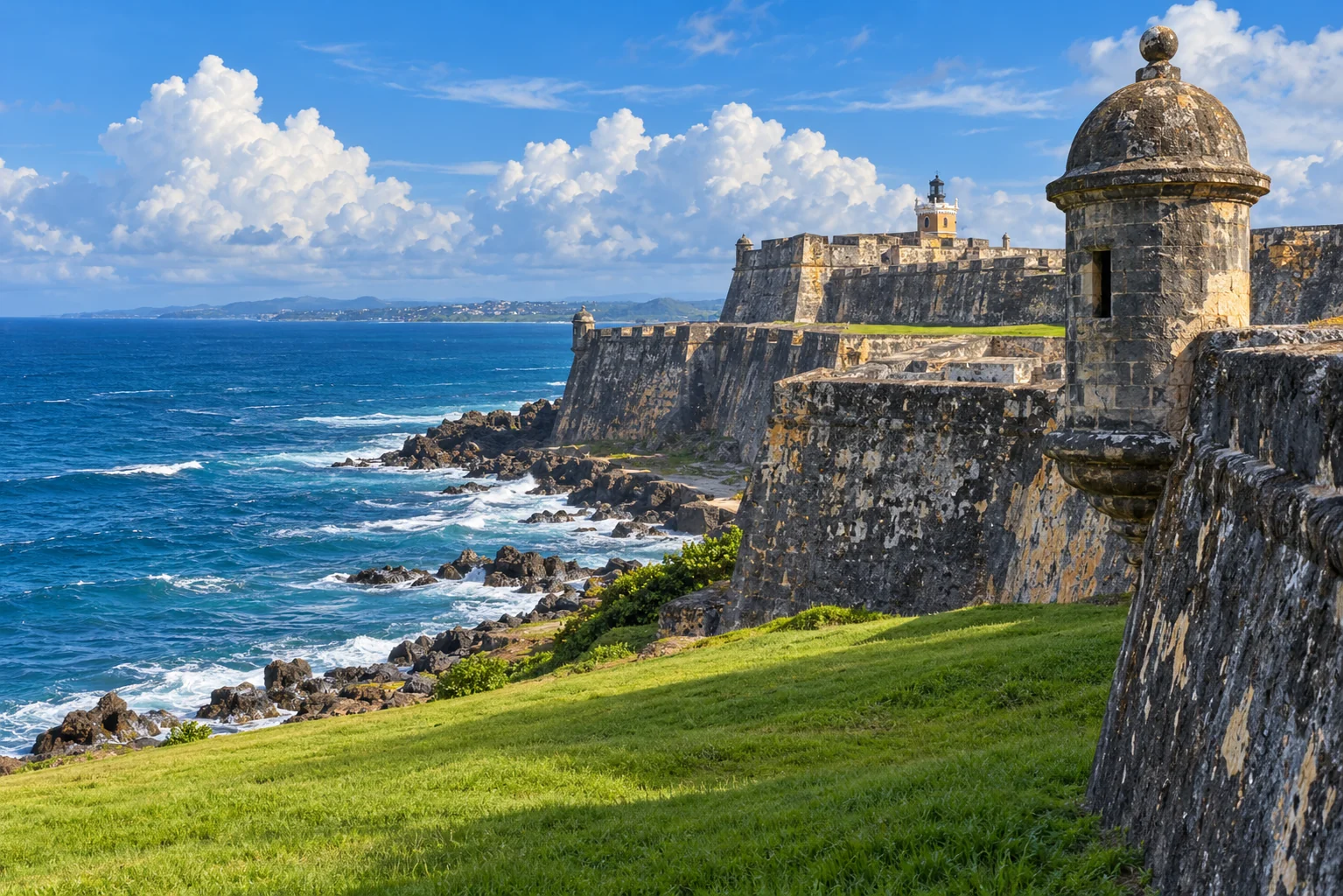
Puerto Rico has a night soundtrack made by tiny frogs, bays that flash when the water moves, and stone fortifications built across centuries. Its story also reaches into astronomy, migration and the African roots of its music. These fifteen facts follow the archipelago from its offshore islands to a deep Atlantic trench, keeping its distinctive history in view.
1. Puerto Rico is an archipelago
The main island shares its name with a wider group of islands and cays. Vieques and Culebra lie to the east, while other islands include Mona and Desecheo to the west. This geography helps explain the variety hidden inside a single destination name. A beach or wildlife story from Vieques is part of Puerto Rico, even though it takes place across a stretch of sea from the main island.
2. U.S. citizenship dates to a 1917 law
The Jones-Shafroth Act granted Puerto Ricans statutory U.S. citizenship in 1917 and reorganized the island's government. Puerto Rico had come under U.S. control following the Spanish-American War in 1898. Citizenship and statehood are separate questions: the territory did not become a state through that law. The distinction is central to understanding the island's relationship with the United States.
3. Its great migration crossed a cultural boundary within one country
Puerto Ricans moving to the fifty states are undertaking internal migration as U.S. citizens. After the Second World War, many made that journey, especially to major urban centers. The Library of Congress describes the distinctive tension involved: people could move legally within their country while leaving a homeland with its own culture and identity. That history connects the archipelago with communities far beyond the Caribbean.
4. El Morro's six levels developed over centuries
Construction of Castillo San Felipe del Morro began in 1539 at the entrance to San Juan Bay. Engineers transformed the original defensive structure into a thick-walled fortress with six levels facing the Atlantic. Its commanding form is the result of successive changes, not a single building campaign. Watching ships from the ramparts means looking along a line of sight that shaped imperial strategy for generations.

5. Francis Drake failed to take San Juan
In 1595, Drake attacked while the Spanish defenses were still developing. His expedition failed to capture the city, a result that strengthened El Morro's reputation. The encounter is a useful corrective to the idea that famous privateers always got their way. Geography, defensive fire and decisions made in one harbor could overturn an attacker's formidable reputation.
6. An English force succeeded from the landward side
George Clifford, Earl of Cumberland, captured San Juan in 1598 after approaching the defenses from land. His forces held their prize only briefly before disease helped force their withdrawal. The episode exposes a practical weakness behind the imposing sea-facing fortress. A position strong against ships could still depend on the security of its approaches from the island.
 You might also like
15 Surprising Facts About the Bermuda Triangle: Myths & Science
7. Its World Heritage site is a defensive system
UNESCO inscribed La Fortaleza and San Juan National Historic Site in 1983. The property includes several forts and surviving walls, not just El Morro. Its significance lies in the adaptation of European military engineering to a Caribbean harbor across centuries. Walking between the components reveals how a city became part of a coordinated defensive landscape rather than simply sheltering behind one castle.
8. El Yunque is unique within the U.S. National Forest System
El Yunque is the system's tropical rainforest, located in the Luquillo Mountains of northeastern Puerto Rico. That carefully defined distinction matters: the United States also has temperate rainforests and tropical forests outside this administrative system. The Forest Service's atlas documents an exceptionally rich landscape of elevation, rainfall and habitats. A relatively small area contains a remarkable range of tropical forest conditions.
9. A tiny frog gives the night its name
The common coquí's familiar name echoes the male's two-part call. The sound is deeply associated with Puerto Rico and carries different functions: research distinguishes the territorial 'co' component from the 'quí' associated with attracting females. Coquí is also used for a group of related frogs, so the island's nightly chorus represents more biological variety than one mascot might suggest.
10. The Puerto Rican parrot came close to disappearing
By the 1970s, the wild Puerto Rican parrot population had fallen to a tiny remnant, commonly reported as around thirteen birds. Captive breeding, habitat work and releases became essential to recovery efforts. Hurricanes have repeatedly complicated that work. The green parrot is therefore more than a colorful forest resident: its survival records decades of conservation in a place where a single storm can reshape an ecosystem.
11. Three celebrated bays produce living light
Mosquito Bay on Vieques, Laguna Grande near Fajardo and La Parguera are known for bioluminescence. Concentrations of microscopic dinoflagellates emit light when disturbed, producing flashes around moving water. The effect depends on ecological conditions and is easier to see against darkness. It is a living chemical response, not a permanent blue illumination of the entire bay like an electric light.
12. The Atlantic's deepest point lies in the nearby trench
North of Puerto Rico, the Puerto Rico Trench reaches the deepest part of the Atlantic Ocean. A modern multibeam survey reported Brownson Deep at about 8,378 meters, with a stated uncertainty of five meters. Older maps and publications give somewhat different depths and names. That precision reflects measurement methods, making the survey date as important as the impressive number.
13. Arecibo's giant telescope is part of scientific history
Arecibo's 305-meter telescope helped make Puerto Rico a major site of radio astronomy and planetary radar research. Its suspended instrument platform collapsed on December 1, 2020, after cable failures. Older travel descriptions can leave the impression that the great dish still operates. Its achievements remain significant, while the collapse itself became the subject of detailed engineering investigation.
14. In bomba, the drummer answers the dancer
Bomba brings together percussion, song and dance in a tradition rooted in Puerto Rico's African heritage. A striking feature is the exchange between a dancer and the lead drummer, who responds to the dancer's movements. The dancer is helping shape the rhythmic conversation. That relationship gives a performance its immediacy, with gestures and drum responses creating something more interactive than choreography laid over a fixed accompaniment.
15. Plena carries stories on hand drums
Plena is a distinct Puerto Rican musical tradition associated with narrative songs and hand-held frame drums called panderos. Its lyrics have conveyed the experiences and concerns of coastal communities. Although often heard during festive seasons, it is performed throughout the year. Listening for the story as well as the rhythm reveals why plena has served as a vehicle for community expression, not simply background music for celebration.
How did these facts land?
Know someone who'd love these facts? Share them 👇