The Temporal Triumph: 15 Fascinating Facts About Back to the Future
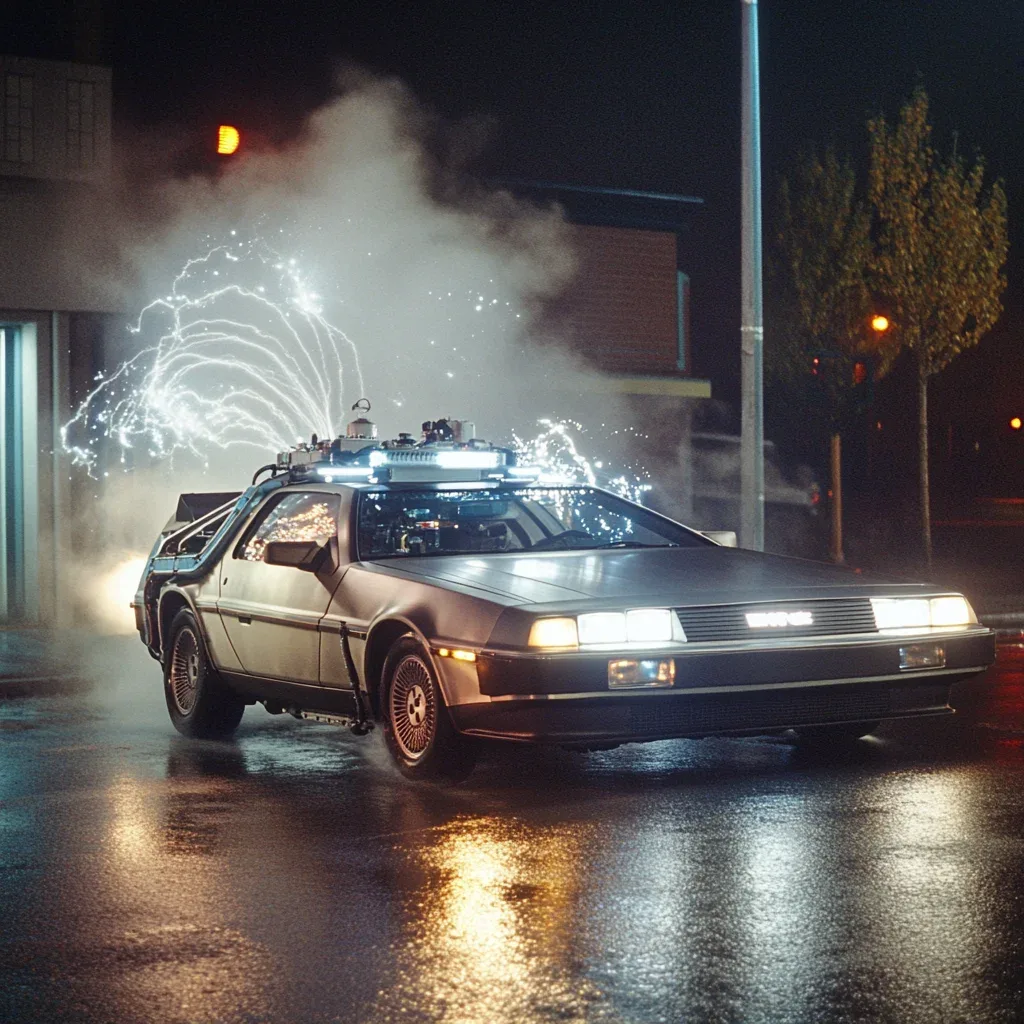
When Back to the Future hit theaters in 1985, it revolutionized science fiction filmmaking and became an instant pop-culture phenomenon. However, behind the flux capacitor and iconic DeLorean lies a chaotic production history marked by studio rejections, emergency recasting, and bizarre executive demands. From lead-lined refrigerator time machines to secret rock star cameos, the story behind making the trilogy is as wild as time travel itself. Here are 15 unbelievable facts about Hollywood's favorite time-travel saga.
1. The Time Machine Was Originally a Household Refrigerator
In early drafts written by Bob Gale and Robert Zemeckis, the time machine was a stationary device attached to a household refrigerator. To travel back to the present from 1955, Marty had to strap the fridge to a truck and drive it into a nuclear test site in Nevada. However, Steven Spielberg and Zemeckis grew concerned that impressionable young viewers would lock themselves inside refrigerators while attempting to travel through time. Additionally, the logistics of moving a stationary appliance around made the film's narrative pacing cumbersome. Replacing the appliance with a mobile DMC DeLorean solved both safety concerns and dynamic visual pacing, giving cinema one of its most iconic vehicles.
2. Eric Stoltz Filmed as Marty McFly for Six Weeks Before Being Fired
Michael J. Fox was always director Robert Zemeckis's first choice, but scheduling conflicts with his hit sitcom Family Ties initially prevented him from starring. The filmmakers cast actor Eric Stoltz instead, filming with him for over five grueling weeks and completing roughly forty percent of the movie. While Stoltz was a dedicated method actor, his dramatic interpretation lacked the comedic intensity and kinetic energy required for Marty McFly. After reviewing early footage, producer Steven Spielberg agreed that the tone was drastically off, prompting a costly and painful decision to recast. Stoltz was let go, Fox was brought on under an exhausting dual schedule, and several scenes had to be completely reshot.
3. The Script Was Rejected More Than 40 Times by Every Major Studio
Long before becoming a blockbuster hit, Back to the Future faced immense pushback from Hollywood studio executives. Screenwriters Bob Gale and Robert Zemeckis pitched the screenplay over forty times, only to be turned down by every major production house. Disney rejected the project outright because executives found the core dynamic—a mother inadvertently falling in love with her own time-traveling son—far too inappropriate for a family brand. Conversely, other studios deemed the story too sweet and tame compared to the raunchy teen comedies popular in the mid-1980s. The project only found momentum after Zemeckis directed the massive box-office hit Romancing the Stone, proving his commercial viability.
4. Universal Head Sid Sheinberg Wanted to Rename the Film "Spaceman from Pluto"
Executive Sid Sheinberg, the head of Universal Pictures, was convinced that no movie with the word "future" in the title had ever made money. He sent a formal memo to director Robert Zemeckis strongly suggesting they alter the title to Spaceman from Pluto, along with changing Marty's farm pseudonym to a literal alien. Panic-stricken by the absurd request, Zemeckis turned to executive producer Steven Spielberg for advice. Spielberg handled the situation brilliantly by sending Sheinberg a reply thanking him for his hilarious "joke" memo, which amused the entire crew. Embarrassed to admit he was serious, Sheinberg dropped the issue, and the iconic title remained intact.
5. Michael J. Fox Filmed the Movie and Family Ties Simultaneously on 3 Hours of Sleep
Once Michael J. Fox was finally allowed to play Marty McFly, he was forced to endure a grueling schedule to satisfy both production commitments. Family Ties creator Gary David Goldberg insisted that the sitcom take priority, meaning Fox rehearsed and filmed television episodes during the day. A waiting vehicle would then rush him to the Universal lot, where he filmed Back to the Future until four in the morning. Fox survived on roughly three hours of sleep per night for nearly three consecutive months. Despite the overwhelming exhaustion, his frantic energy on camera perfectly matched Marty McFly's breathless panic throughout the film.
6. The DeLorean's Engine Audio Was Dubbed with a Powerful V8 Sound Effect
While the DMC DeLorean looked futuristic and sleek on screen, the vehicle's real-world mechanical performance was notoriously underwhelming. Stock DeLoreans were built with a modest Peugeot-Renault-Volvo V6 engine that produced a meager 130 horsepower, making it difficult for the car to accelerate rapidly. Sound designers realized that the stock engine audio sounded sluggish rather than thrilling for a temporal transport vehicle. To give the car a menacing and powerful acoustic presence, the audio team dubbed the aggressive rumble of a Porsche 928 V8 engine over the film's driving sequences. This auditory illusion made the DMC-12 sound like a high-performance machine capable of ripping through spacetime.
7. The Iconic 88 Miles Per Hour Threshold Was Chosen Purely for Visual Aesthetics
Fans have spent decades searching for complex physics or temporal science behind why the DeLorean needed to reach 88 miles per hour to trigger the flux capacitor. However, screenwriter Bob Gale revealed that the exact speed was chosen without any scientific basis whatsoever. During early storyboard sessions, the production team needed a speed high enough to sound dangerously fast for a residential street yet achievable for a street car. More importantly, the digital speedometer display inside the vehicle featured custom LED readouts. Gale and Zemeckis felt that the pair of eights looked visually striking, symmetrical, and easy for audiences to recognize instantly on screen.
8. Doc Brown's Companion Was Originally a Chimpanzee Named Shemp
In the initial screenplay drafts written by Bob Gale and Robert Zemeckis, Doc Brown's faithful animal companion was not a dog, but a chimpanzee named Shemp. The primate was intended to participate in the temporal experiment during the Twin Pines Mall sequence. However, Universal Pictures executive Sid Sheinberg flatly refused the idea, claiming that movies featuring chimpanzees never made money at the box office. Although Zemeckis and Gale disputed his logic, they agreed to substitute the chimp with a sheepdog named Einstein. The change ultimately added a warm, grounded dynamic to Doc Brown's eccentric laboratory persona.
9. Elijah Wood Made His Feature Film Debut in Back to the Future Part II
Long before starring as Frodo Baggins in The Lord of the Rings, an eight-year-old Elijah Wood landed his very first credited feature film role in 1989's Back to the Future Part II. Wood played one of two young boys standing near the 1980s retro arcade machine inside the Cafe 80s in futuristic 2015. In the scene, Marty McFly shows off his arcade prowess by mastering the light-gun game Wild Gunman. Wood's character expresses total disappointment, delivering the iconic burn that having to use your hands to play a video game is like "a baby's toy." The tiny cameo remains one of the most famous child-actor debuts in modern cinema history.
10. Flea of the Red Hot Chili Peppers Played Marty's Nemesis Douglas J. Needles
Rock musician Michael "Flea" Balzary, best known as the iconic bassist for the Red Hot Chili Peppers, featured prominently as a minor antagonist in the second and third installments. Flea portrayed Douglas J. Needles, a shady coworker who continuously pressures Marty McFly into making impulsive, prideful mistakes by calling him "chicken." In Back to the Future Part II, Needles goads an older Marty into executing an illegal financial transaction that gets Marty fired from his job. In the climax of Back to the Future Part III, Needles challenges Marty to a street drag race in 1985, setting up Marty's ultimate moment of character growth when he refuses to race.
11. Huey Lewis Made a Secret Cameo Rejecting His Own Hit Song
Rocker Huey Lewis contributed two major songs to the soundtrack of Back to the Future, including the chart-topping hit "The Power of Love." Director Robert Zemeckis offered Lewis an uncredited cameo in the early high school sequence of the first film as a cheeky nod. Lewis played the strict faculty judge evaluating bands during the Hill Valley High School Battle of the Bands auditions. When Marty's band, the Pinheads, performs a blaring, heavy-guitar instrumental version of "The Power of Love," Lewis's character interrupts them with a megaphone. He declares that the band is "just too darn loud," allowing Lewis to officially reject his own song on screen.
12. Parts II and III Were Filmed Back-to-Back in a Groundbreaking Production Strategy
When the massive success of the original film demanded sequels, Robert Zemeckis and Bob Gale decided to film Part II and Part III simultaneously. This back-to-back production schedule was virtually unprecedented for a major Hollywood studio franchise at the time. Shooting both films back-to-back saved millions of dollars in set construction and actor contract renewals, allowing Universal to release both movies only six months apart. The process was exhausting for Zemeckis, who spent his days editing Part III in Los Angeles while overseeing post-production on Part II in northern California. Today, block-shooting multi-part sequels is a standard industry practice across Hollywood.
13. A Director's Joke Sparked a Nationwide Search for Real Hoverboards
Following the release of Back to the Future Part II in 1989, director Robert Zemeckis gave a tongue-in-cheek television interview asserting that hoverboards were real. He claimed that anti-gravity technology had existed for years, but toy companies refused to sell hoverboards due to safety concerns from parent groups. Millions of children and parents took Zemeckis's deadpan prank literally, flooding retail stores and toy manufacturers with urgent buying requests. Mattel, whose logo appeared on the movie's prop hoverboards, had to handle thousands of confused customer service calls asking when the product would hit shelves. Zemeckis later apologized, admitting he never anticipated audiences would believe his humorous claim.
14. Thomas F. Wilson Carried Printed FAQ Cards to Deal with Fans
Actor Thomas F. Wilson delivered an unforgettable performance as the menacing bully Biff Tannen, along with his various relatives across the timeline. Over the years following the trilogy's release, Wilson found himself answering the exact same fan questions everywhere he went in public. To save time and conserve his vocal cords, Wilson printed custom business-card-sized fliers packed with concise answers to the most common queries. The cards addressed details such as confirmation that the manure was fake, praise for Michael J. Fox's friendliness, and explanations of how visual effects were filmed. Wilson would hand these pre-printed cards to curious fans with a smile, turning repetitive encounters into a beloved piece of fan trivia.
15. The DeLorean Time Machine Is Officially a Registered Historic Vehicle
In 2021, the iconic DMC-12 DeLorean time machine used in the original film received one of the highest cultural honors an automobile can achieve in the United States. The vehicle was officially inducted into the National Historic Vehicle Register by the U.S. Library of Congress and the Historic Vehicle Association. This status permanently archived the car's engineering drawings, historical documentation, and 3D scans inside the Library of Congress alongside landmark vehicles like the original Ford Model T. Additionally, the film itself was inducted into the National Film Registry in 2007 for being culturally, historically, and aesthetically significant. The DeLorean remains one of the most celebrated and protected vehicles in motion picture history.
Sources & References
This AI-assisted post was rigorously curated and fact-checked for accuracy by:
 Martin Roháček
How fun was this article? 🤔
Tap a star to rate it
🧠 Quiz: How closely were you paying attention?
10 questions — all answers are in the article above!
Enjoyed these facts? There's more! 💌
Fresh fun facts in your inbox. No spam, ever.