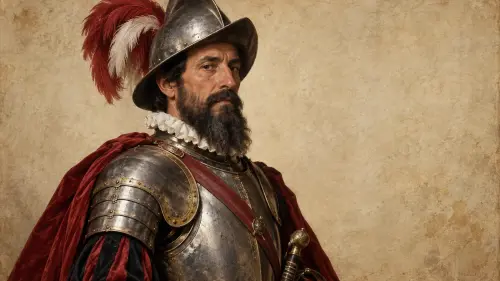
The Overwhelmed Monarch: 15 Fascinating Facts About Charles V
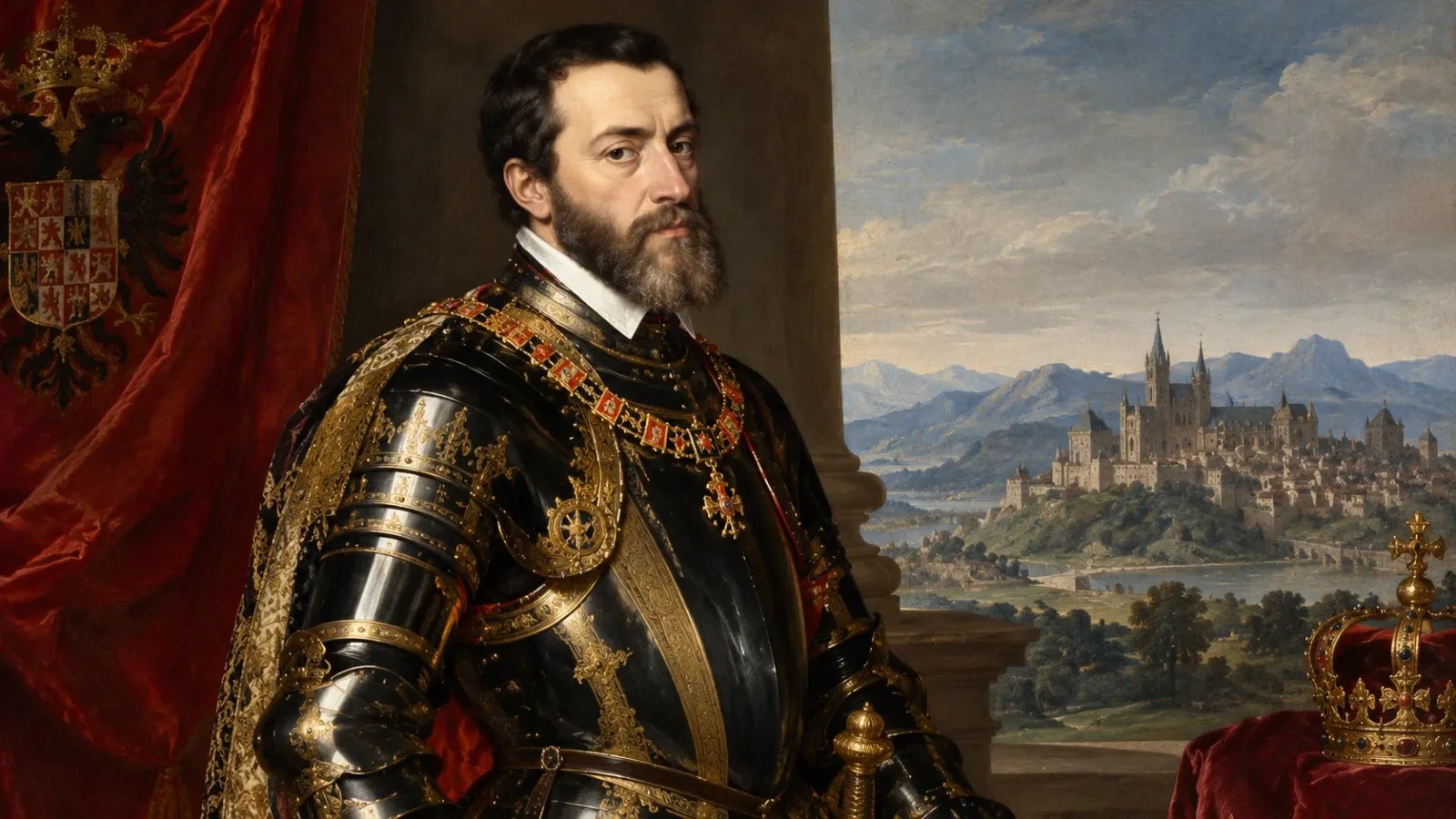
Often misremembered as just another European king, Charles V was actually the ruler of the first truly global empire, spanning Europe and the Americas. Far from a power-hungry tyrant, he was an exhausted bureaucrat desperately trying to hold together a fragile mosaic of realms. Discover the bizarre medical history, military blunders, and hidden complexities of this misunderstood sovereign.
1. Charles V grew up speaking French, and had to promise to learn Spanish.
Charles was born in Ghent in 1500 and raised in the Burgundian Netherlands, so French was his native language. When he came to Spain in 1517 as a teenager, the Castilian Cortes of Valladolid accepted him as king in 1518 on conditions, which included that he would learn to speak Castilian and not appoint foreigners to office. He later became proficient in Spanish. A witticism often attributed to him says he spoke Spanish to God, Italian to women, French to men, and German to his horse, but there is no contemporary evidence that he said it.
2. The Habsburg jaw affected the way he ate.
Charles suffered from an enlarged lower jaw (mandibular prognathism), a congenital deformity that became worse in later Habsburg generations, giving rise to the term "Habsburg jaw." It may have been caused by the family's long history of marriages between close relatives. Contemporary observers reported that his teeth did not meet properly, which made it hard to chew and may have contributed to his digestive problems.
3. His troops sacked Rome and held the Pope prisoner.
In 1527, in the war against the League of Cognac, a largely unpaid imperial army, many of them German Protestant mercenaries, stormed and plundered Rome. Pope Clement VII was effectively imprisoned in the Castel Sant'Angelo. The event humiliated the papacy, and as a result the Pope was reluctant to annul the marriage of Henry VIII of England and Charles's aunt, Catherine of Aragon. This helped lead Henry to break with Rome and begin the English Reformation.
4. He challenged the king of France to a duel.
Charles and Francis I of France fought a series of wars, mostly in Italy. In 1528, after Francis had refused to honor the treaty that freed him from captivity, Charles formally challenged him to settle the quarrel in single combat. Francis accepted in principle, but the argument over the conditions never ended, and the duel never took place. It showed that Renaissance rulers still liked to present themselves in the language of medieval chivalry.
5. He funded Ferdinand Magellan's voyage around the world.
After the Portuguese king rejected Magellan's proposal to reach the Spice Islands by sailing west, the 18-year-old Charles agreed in 1518 to back the expedition and provided five ships. Magellan himself was killed in the Philippines in 1521, and only one ship, commanded by Juan Sebastián Elcano, returned to Spain in 1522. It was the first circumnavigation of the world, and it greatly expanded Europe's picture of the globe.
6. Gout forced him to flee in a litter.
Charles suffered from painful gout for much of his life, and historians have linked it to his rich diet. In 1552, when the Protestant Elector Maurice of Saxony turned on him and marched toward Innsbruck, Charles had to flee the city during an attack of gout. He barely reached Villach, carried in a litter and in a state of semi-consciousness. The humiliating escape contributed to his decision to give up power.
 Rulers, Kings and Emperors
Discover the captivating truths behind history's most iconic rulers, kings, and emperors. From eccentric geniuses and tactical masterminds to deeply flawed sovereigns, explore the hidden lives of those who shaped the modern world.
See All Facts
Rulers, Kings and Emperors
Discover the captivating truths behind history's most iconic rulers, kings, and emperors. From eccentric geniuses and tactical masterminds to deeply flawed sovereigns, explore the hidden lives of those who shaped the modern world.
See All Facts
7. According to a famous story, he attended his own funeral service.
After stepping down, Charles retired in 1557 to the Monastery of Yuste in Extremadura, where he lived modestly, surrounded by clocks and paintings by Titian. A well-known tradition says that he had a funeral service held for himself while still alive, to prepare his soul for death. Historians debate whether this really happened. He died in 1558 of an illness diagnosed in modern times as malaria.
8. He ruled much of the Americas but never visited them.
During Charles's reign, Spanish conquistadors defeated the Aztec Empire under Hernán Cortés (1519 to 1521) and began the conquest of the Inca Empire under Francisco Pizarro. The flow of silver from New Spain and Peru financed his wars in Europe. Charles governed these lands through councils, viceroys, and a slow transatlantic bureaucracy, and he never crossed the Atlantic.
9. He gave up his crowns while still alive.
Exhausted by decades of war, financial problems, the religious division of Germany, and his declining health, Charles decided to abdicate. In 1555 and 1556, in ceremonies in Brussels, he handed the Netherlands and the Spanish kingdoms, including the Americas, to his son Philip II. The Holy Roman Empire went to his brother Ferdinand. Voluntary abdication of such vast power was extremely rare.
10. A local legend says he was born in a toilet.
Charles was born on 24 February 1500 in the Prinsenhof in Ghent, the son of Philip the Handsome and Joanna of Castile. A well-known local legend says that Joanna, who was at a ball, felt labor pains and gave birth in a palace latrine. Historians cannot confirm the details. What is documented is that the people of Ghent celebrated the birth of their prince in the streets for hours.
11. He issued the New Laws and halted conquests for a debate on Native rights.
Influenced by the friar Bartolomé de las Casas, Charles issued the New Laws of 1542, which sought to curb the exploitation of Indigenous people and end grants of Native labor in perpetuity. The conquistadors in Peru rebelled, and the viceroy sent to enforce the laws was killed, so the crown had to soften them. In 1550 Charles also suspended further conquests while theologians debated their justice at Valladolid, where Las Casas faced the scholar Juan Ginés de Sepúlveda.
12. He was fascinated by clocks.
In his retirement at Yuste, Charles surrounded himself with clocks. Some historians see them as symbols of his lack of time, and others as a reflection of his desire for order. His court clockmaker and engineer was Juanelo Turriano. Later legends credited Turriano with making astonishing automata for the emperor, such as tiny marching soldiers, but these tales are likely exaggerated.
13. He outlawed Martin Luther but kept his promise of safe passage.
In 1521, Charles summoned Luther to the Diet of Worms, promising him safe conduct. When Luther refused to recant, the emperor issued the Edict of Worms, which declared Luther an outlaw. Charles nevertheless honored the safe conduct and let him leave, after which Luther was hidden at Wartburg Castle by the Elector of Saxony. There he translated the New Testament into German. Charles never managed to end the religious division.
14. He personally led the expedition that captured Tunis.
When the corsair Hayreddin Barbarossa, allied with the Ottoman sultan, took Tunis in 1534, Charles took part in person in a large expedition to recapture it. The city fell in 1535, and many Christian captives were freed. The campaign was celebrated across Europe as a great victory, and the artist Jan Cornelisz Vermeyen, who accompanied the expedition, later designed a famous set of tapestries depicting it.
15. He ruled a huge empire but constantly borrowed money.
Charles inherited the resources of the Netherlands, Spain, and the Americas, but his wars against the French, the Ottomans, and the German Protestant princes were extremely expensive. Over his reign he borrowed around 28 million ducats, of which 5.5 million came from the Fugger family of Augsburg and 4.2 million from the Welsers. The Fuggers had also financed his election as emperor in 1519. The debts left his son Philip II with a crown close to bankruptcy.
Sources & References
This AI-assisted post was rigorously curated and fact-checked for accuracy by:
 Martin Roháček
How fun was this article? 🤔
Tap a star to rate it
🧠 Quiz: How closely were you paying attention?
10 questions — all answers are in the article above!
Enjoyed these facts? There's more! 💌
Fresh fun facts in your inbox. No spam, ever.