The Misunderstood Predator: 15 Fascinating Facts About Rattlesnakes
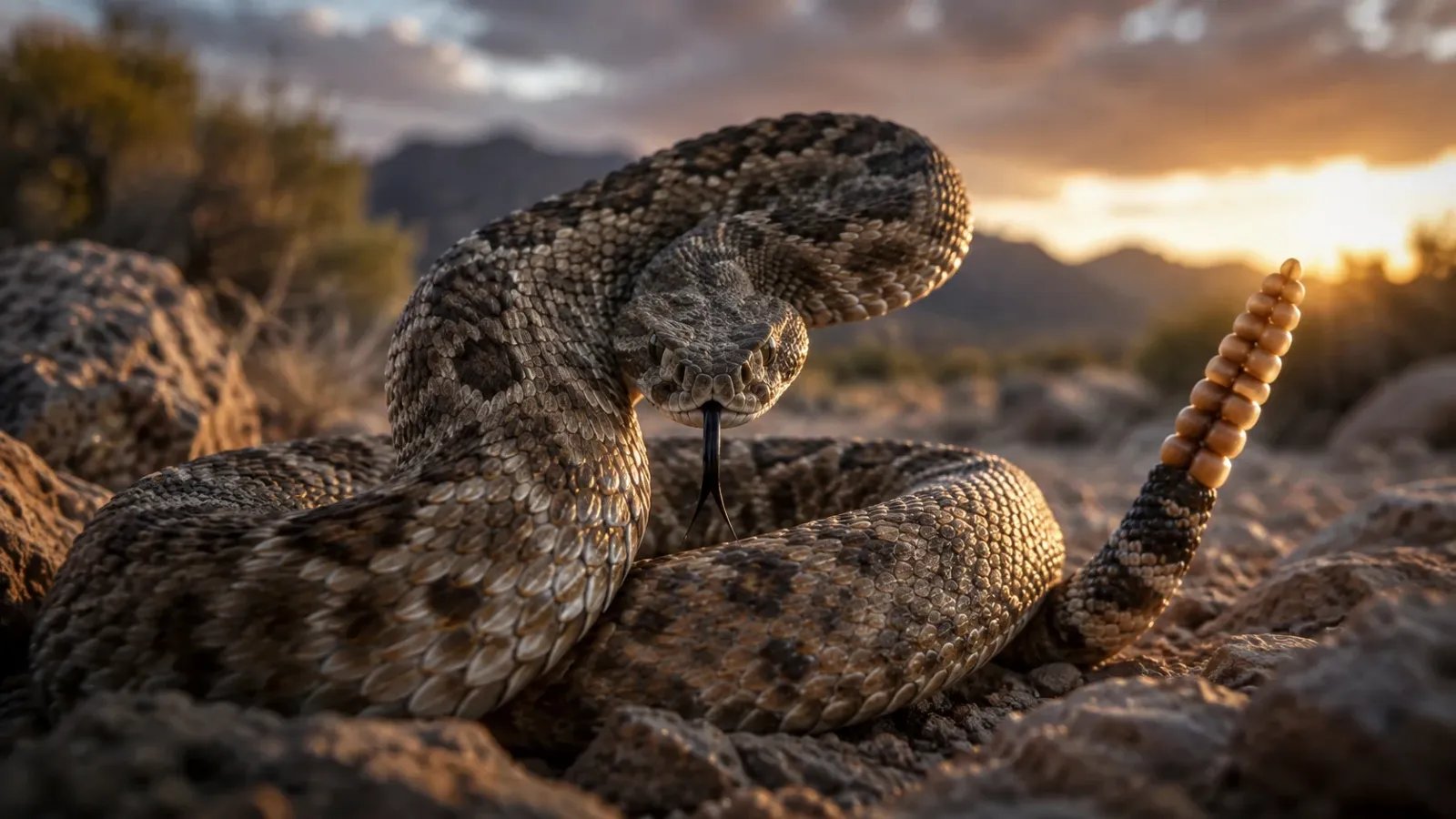
Rattlesnakes are often branded as aggressive monsters, but this is a myth. Far from being ruthless killers, these pit vipers are complex, shy predators equipped with infrared vision and sophisticated venom systems. They'd rather warn you than bite you. Dive into the incredible biology and untold secrets of these amazing reptiles, from their regenerative rattles to their secret social lives.
1. A rattlesnake cannot be accurately aged by counting the segments on its rattle.
It is a common misconception that each button on a rattle represents a year of life. In reality, a rattlesnake adds a new segment to its rattle every time it sheds its skin, which can happen multiple times a year depending on food availability and growth rates. Furthermore, older segments frequently break off due to wear and tear in the wild, making the rattle a highly unreliable calendar.
2. The famous rattle makes its sound through hollow keratin shells knocking together, not from loose beads inside.
Unlike a maraca, the snake's rattle contains no free-floating particles. The structure is composed of loosely interlocking, hollow rings made of keratin, the same material as human fingernails. Special shaker muscles in the snake's tail contract up to fifty times per second, causing these empty shells to violently click against one another to produce the signature buzzing warning.
3. Rattlesnakes possess a sixth sense that allows them to see the thermal radiation of their prey in total darkness.
As pit vipers, rattlesnakes have specialized heat-sensing organs located in pits between their eyes and nostrils. These organs contain highly sensitive membranes that detect minute temperature changes, allowing the snake to construct a detailed thermal map of its surroundings. This biological infrared camera is so precise that a blindfolded rattlesnake can accurately strike a running mouse.
4. Female rattlesnakes are devoted mothers who exhibit complex social behaviors and form familial bonds.
Dispelling the myth of the cold-blooded, solitary reptile, research shows that pregnant rattlesnakes often gather in communal dens called rookeries to regulate their body temperatures together. After giving birth to live young, mothers stay with their neonates for several weeks to protect them from predators until their first shed. Some species even recognize and associate with their kin years later.
5. Rattlesnakes consciously control the amount of venom they inject and frequently deliver dry bites.
Producing venom is biologically expensive, so a rattlesnake does not waste it thoughtlessly. When striking defensively at a human or large predator, rattlesnakes deliver a dry bite with no venom at all up to twenty-five percent of the time. They meter their venom carefully based on the size and species of their prey, reserving the lethal doses for meals they actually intend to consume.
6. A striking rattlesnake accelerates faster than a fighter jet pilot enduring high gravitational forces.
The mechanics of a rattlesnake strike are a marvel of physics. They can launch the front half of their body at speeds reaching ten feet per second, completing a bite in a mere fraction of a second. This explosive acceleration exposes the snake's brain to gravitational forces that would cause a human pilot to lose consciousness, yet the snake's physiology is perfectly adapted to withstand the shock.
 Reptiles, Amphibians and Snakes
From venomous serpents and heavily armored crocodilians to shape-shifting amphibians, explore the fascinating biology and hidden secrets of Earth's most incredible cold-blooded marvels.
See All Facts
Reptiles, Amphibians and Snakes
From venomous serpents and heavily armored crocodilians to shape-shifting amphibians, explore the fascinating biology and hidden secrets of Earth's most incredible cold-blooded marvels.
See All Facts
7. The rattle likely evolved to prevent the snakes from being crushed by large, stampeding megafauna.
Biologists believe the rattle originally developed on the open plains of North America during the Pleistocene epoch. Rather than a tool for hunting, the loud buzzing served as an acoustic warning system to alert grazing megafauna, such as ancient bison and mammoths, that a venomous creature was underfoot. This mutually beneficial adaptation kept the snake from being trampled and the mammal from being bitten.
8. A rattlesnake's heart grows in mass by up to forty percent within days of consuming a large meal.
Digesting a massive prey item requires an enormous metabolic output. To handle the sudden demand for oxygen and nutrient transport, the rattlesnake undergoes a rapid physiological transformation. Its heart significantly increases in size, and its digestive organs rebuild their cellular lining almost overnight. Once digestion is complete, these organs shrink back down to conserve energy until the next meal.
9. Rattlesnakes do not always rattle before they strike.
The belief that a rattlesnake will always politely announce its presence is a dangerous fallacy. If a snake is stepped on or entirely surprised, it may strike instantly in a panic without vibrating its tail. Additionally, on cold days, a snake may be too lethargic to rattle, or it may simply choose to rely on its incredibly effective camouflage to remain undetected rather than giving away its position.
10. The distinctive triangular head of a rattlesnake is completely filled with massive venom glands.
The broad, arrowhead shape of a rattlesnake's head is not just an arbitrary morphological trait. The widened jaws accommodate large, specialized venom glands situated just behind the snake's eyes. When the snake decides to bite, powerful muscles contract around these fleshy pouches, squeezing the toxic proteins through ducts and out of the hollow fangs like a hypodermic needle.
11. Rattlesnake fangs operate on a hinged biological folding system that allows them to be tucked away.
Unlike snakes with fixed fangs, a rattlesnake has highly evolved maxilla bones that act as hinges. When the snake's mouth is closed, its long, curved fangs fold flat against the roof of the mouth, encased in a fleshy sheath. As the snake opens its jaws to strike, the bone rotates, erecting the fangs at a ninety-degree angle to effectively puncture the target.
12. Some modern rattlesnake populations are evolving to rattle less frequently due to human interference.
In areas with high human populations, natural selection is inadvertently altering rattlesnake behavior. Snakes that rattle loudly draw attention to themselves and are frequently killed by fearful humans. Conversely, snakes with a genetic predisposition to remain silent or snakes with damaged rattles tend to survive and pass on their genes, leading to localized populations of unusually quiet rattlesnakes.
13. Despite being associated with dry deserts, rattlesnakes are exceptionally buoyant and capable swimmers.
It is a myth that rattlesnakes are restricted to arid wastelands. They thrive in swamps, forests, and alpine meadows, and they are excellent swimmers. Because of their large internal lungs, which stretch down a significant portion of their bodies, rattlesnakes float easily. They have been observed swimming across large lakes and rivers, holding their distinctive rattles above the water's surface to keep them dry.
14. Rattlesnakes survive freezing winter temperatures by entering a state of suspended animation called brumation.
Because they are ectothermic, rattlesnakes cannot generate their own body heat. During winter, they retreat into deep crevices, caves, or abandoned mammal burrows below the frost line. They enter brumation, a reptilian equivalent of hibernation, where their heart rate slows to a crawl and they stop eating entirely for months. Hundreds of snakes of varying species may share the same winter den to survive.
15. The presence of rattlesnakes drastically reduces the transmission of tick-borne diseases like Lyme disease.
Rattlesnakes are a vital ecological keystone species. Because their diet consists heavily of small rodents, which are the primary carriers of disease-laden ticks, a single rattlesnake can inadvertently remove thousands of ticks from an ecosystem every year. By keeping the rodent population in check, these misunderstood predators act as a natural biological shield protecting human populations from zoonotic diseases.
Sources & References
This AI-assisted post was rigorously curated and fact-checked for accuracy by:
 Martin Roháček
How fun was this article? 🤔
Tap a star to rate it
🧠 Quiz: How closely were you paying attention?
10 questions — all answers are in the article above!
Enjoyed these facts? There's more! 💌
Fresh fun facts in your inbox. No spam, ever.