The Complex Emperor: 15 Fascinating Facts About Constantine the Great
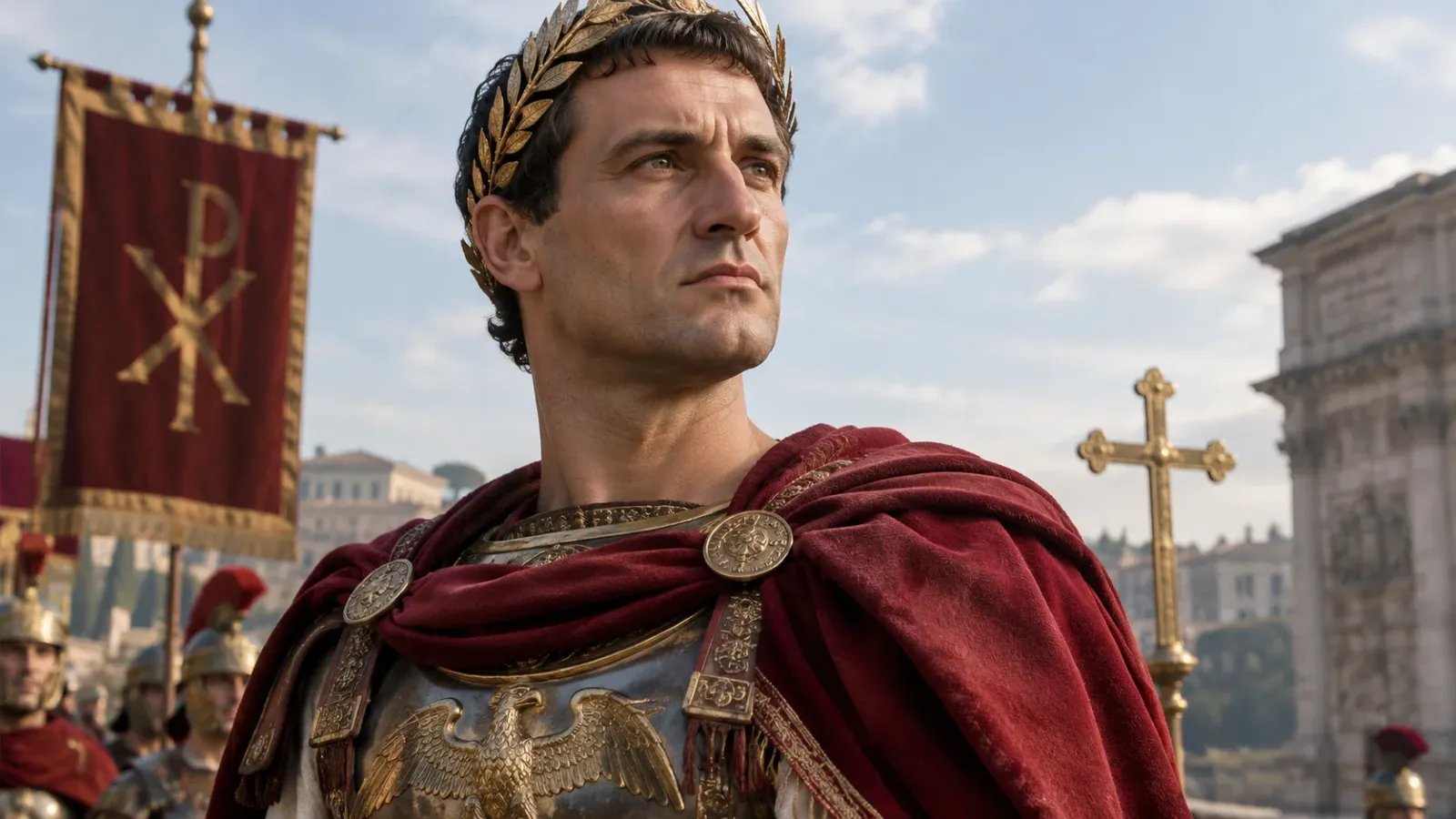
Constantine wasn't just the man who Christianized Rome; he was a shrewd and ruthless politician who ended the persecution of Christians, founded Constantinople, and reshaped the empire. Behind the pious legends lie a murky family tragedy, a famous forgery, and a faith he embraced gradually. Discover the historical truths behind Rome's most transformative emperor.
1. Constantine did not make Christianity the official religion of the Roman Empire.
Contrary to popular belief, Constantine did not ban paganism. Together with his co-emperor Licinius, he agreed in 313 CE (the so-called Edict of Milan) to grant religious freedom to Christians and to return confiscated Church property. The measure applied to all faiths. It was Emperor Theodosius I who declared Nicene Christianity the state religion decades later, in 380 CE. Throughout Constantine's reign, traditional pagan cults remained legal and widespread.
2. The famous vision before the Battle of the Milvian Bridge exists in two different versions.
The popular story of a flaming cross in the sky with the words "In this sign, conquer" comes from Eusebius of Caesarea, who wrote that Constantine told him about it under oath many years after the battle. A different account, by the Christian writer Lactantius, written closer to the event, speaks of a dream in which Constantine was told to mark his soldiers' shields with a Christian symbol. The accounts differ in important details, and historians debate what really happened. Constantine's soldiers did fight under a new symbol in 312 CE, and he defeated Maxentius at the Milvian Bridge.
3. Constantine kept issuing coins honoring the sun god for years after he favored Christianity.
Constantine began to support Christianity in 312, but his coinage kept showing Sol Invictus, the "Unconquered Sun," until about 325. In 321 he also made the day of the sun, Sunday, an official day of rest. This suggests careful political balancing: Christian and pagan subjects could both see their beliefs reflected in imperial imagery. It took years before Christian symbols clearly replaced the old ones.
4. In 326 he had his eldest son executed and his wife killed, and no one knows exactly why.
In 326 CE, Constantine had his eldest son and co-ruler Crispus arrested and executed at Pola, reportedly with "cold poison." A few weeks later his wife Fausta, Crispus's stepmother, was killed in an overheated bath. Their names were scratched from inscriptions, and later writers were reluctant to describe the events. Some ancient writers suggested that Fausta had accused Crispus falsely and was punished when the truth emerged, but the real reasons remain unknown. It is one of the darkest episodes of his reign.
5. The Donation of Constantine is one of history's most famous forgeries.
For centuries, the Church cited a document in which Constantine supposedly handed the Pope authority over Rome and the western provinces. The text was actually written in the eighth century, probably in the circle of Pope Stephen II. In 1440 the Italian humanist and priest Lorenzo Valla proved it was a forgery by showing that its Latin contained words and expressions that did not exist in Constantine's time. The fake had supported papal claims for roughly six hundred years.
6. He was baptized only shortly before his death.
Constantine supported the Church for a quarter of a century but was baptized only in 337 CE, as he lay dying near Nicomedia. His baptizer was the Arian bishop Eusebius of Nicomedia. Some historians think he waited because baptism was believed to wash away all sins, and a ruler who sometimes had to order executions might prefer to receive it as late as possible. Delayed baptism was not unusual at the time.
 Rulers, Kings and Emperors
Discover the captivating truths behind history's most iconic rulers, kings, and emperors. From eccentric geniuses and tactical masterminds to deeply flawed sovereigns, explore the hidden lives of those who shaped the modern world.
See All Facts
Rulers, Kings and Emperors
Discover the captivating truths behind history's most iconic rulers, kings, and emperors. From eccentric geniuses and tactical masterminds to deeply flawed sovereigns, explore the hidden lives of those who shaped the modern world.
See All Facts
7. He summoned the Council of Nicaea although he was not yet baptized.
In 325 CE Constantine called some three hundred bishops to Nicaea to deal with the dispute over the nature of Christ, which threatened the unity of the Church and the empire. He was still unbaptized and was not a trained theologian. Eusebius describes him opening the council in splendid purple and gold robes and encouraging the bishops to reach agreement. The council produced the first version of the Nicene Creed, and the episode set a lasting precedent for rulers involving themselves in Church affairs.
8. The story that he was cured of leprosy by Pope Sylvester is a later legend.
A medieval tradition claimed that Constantine suffered from leprosy, was cured by baptism from Pope Sylvester I, and then showed his gratitude to the Church. This legend appeared only in later Christian writing, in the Acts of Sylvester, long after the emperor's death. It is not supported by ancient historians who knew him, and it conflicts with the fact that he was baptized shortly before his death by a different bishop. The story helped promote papal prestige, and the Donation of Constantine later built on it.
9. Near the end of his life he allowed a temple to his own family in Italy.
In an inscription known as the Hispellum Rescript, from about 333 to 337, Constantine allowed the Umbrian town of Hispellum to build a temple dedicated to his family, the Flavian dynasty, and to hold theatrical shows and gladiatorial games there. He added the condition that the temple must not be "polluted by the deceits of any contagious superstition," which is usually read as a ban on pagan sacrifices. The text shows how carefully this Christian-friendly emperor balanced traditional imperial ceremony with his new faith.
10. He chose the site of Constantinople largely for strategic reasons.
Constantine founded his new capital at the old Greek city of Byzantium and dedicated it in 330 CE. The site stood on a defensible peninsula controlling the Bosphorus, the key trade route between the Black Sea and the Mediterranean. It was also closer to the empire's wealthy eastern provinces and to the Danube and Persian frontiers than Rome was. The city remained the capital of the eastern Roman, or Byzantine, Empire until 1453.
11. His laws were harsh, especially for women.
Constantine's legislation reflected his authoritarian rule. A law of 331 allowed a woman to divorce her husband only if he was a murderer, a poisoner or sorcerer, or a violator of tombs. A woman who divorced without such grounds could lose her property and be deported to an island. Another law decreed that a nurse who helped an unmarried girl to be seduced should have molten lead poured down her throat. These measures were meant to strengthen what Constantine saw as public morality, and they show how brutal late Roman penal law could be.
12. His mother Helena went on a famous pilgrimage to the Holy Land.
Helena, Constantine's mother, traveled to Palestine around 326 to 328 CE, when she was in her late seventies. According to Eusebius, she funded churches at the traditional sites of Christ's birth in Bethlehem and his ascension on the Mount of Olives. Later legends added that she found the True Cross in Jerusalem, a story that does not appear in Eusebius and is not historically proven. Whatever the truth, her journey gave great momentum to Christian pilgrimage and church building in the Holy Land.
13. He disbanded the Praetorian Guard.
The Praetorian Guard had served as bodyguard to the emperors since Augustus, but it had also made and unmade emperors and had supported his rival Maxentius. After his victory in 312 CE, Constantine disbanded it and destroyed its fortified camp in Rome. Palace guard units such as the Scholae Palatinae took over its role, and the army was reorganized into mobile field forces and frontier troops. The reforms made the emperor less dependent on a single powerful unit.
14. He introduced a gold coin that stayed stable for centuries.
The Roman currency had been badly damaged by inflation, and silver coins had been repeatedly debased. Constantine's reform made the gold solidus, struck at 72 to the pound of gold, the standard coin. It kept its weight and purity for centuries and became the basis of the Byzantine monetary system. Ancient writers claim that he partly financed his reforms with treasure taken from pagan temples.
15. The Arch of Constantine was largely decorated with reused sculptures.
The triumphal arch next to the Colosseum, dedicated in 315 CE to celebrate the victory over Maxentius, includes sculptures taken from older monuments of Trajan, Hadrian, and Marcus Aurelius. In some of the reliefs the emperors' heads were recut to resemble Constantine. Earlier art historians saw this reuse as a sign of declining skill. Many scholars now see it as a deliberate message, presenting Constantine as the heir to the empire's best rulers.
Sources & References
This AI-assisted post was rigorously curated and fact-checked for accuracy by:
 Martin Roháček
How fun was this article? 🤔
Tap a star to rate it
🧠 Quiz: How closely were you paying attention?
10 questions — all answers are in the article above!
Enjoyed these facts? There's more! 💌
Fresh fun facts in your inbox. No spam, ever.