
15 Fascinating Facts About the Eruption of Mount Vesuvius
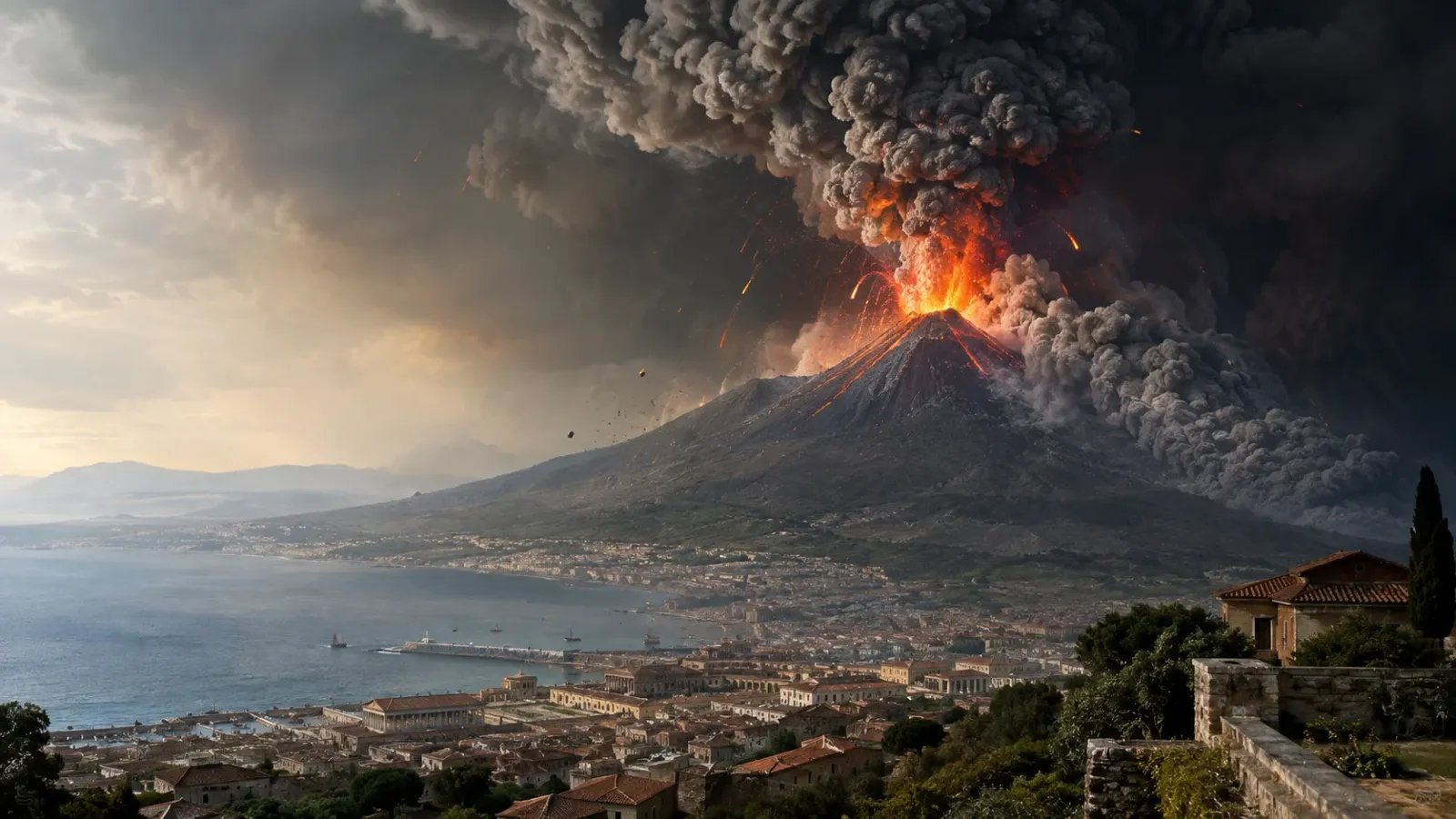
Forget the myth that Pompeii's victims were swallowed by slow-moving lava. The 79 AD eruption of Mount Vesuvius was a terrifyingly swift cataclysm of superheated gas and shattered rock that froze cities in time. Beyond the famous ash casts lies a complex story of advanced Roman engineering, frantic rescue missions, and a disaster that fundamentally shaped modern archaeology.
1. Mount Vesuvius did not release a single drop of slow-moving lava during the 79 AD eruption.
Most people imagine rivers of molten rock engulfing fleeing citizens, but the reality was far deadlier. Vesuvius unleashed a Plinian eruption, characterized by a massive, towering column of pumice, ash, and volcanic gases reaching high into the stratosphere. When this column collapsed, it sent pyroclastic surges, which are avalanches of superheated gas and fragmented rock, racing down the mountain at hurricane speeds. These devastating waves incinerated everything in their path long before lava could ever form.
2. The disaster prompted one of the first recorded civilian naval rescue missions in military history.
Pliny the Elder, the commander of the Roman fleet stationed at Misenum across the Bay of Naples, did not just sit back and observe the destruction. Upon seeing the ominous cloud and receiving a desperate plea for help from his friend Rectina, he ordered his warships to launch into the chaos. He intended to evacuate the stranded coastal populations, though this heroic effort ultimately cost him his life when he succumbed to toxic volcanic gases on the beach at Stabiae.
3. The eruption likely occurred in October, debunking the long-held belief that it happened in August.
For centuries, historians relied on a medieval transcription of Pliny the Younger's letters, which dated the eruption to August 24. However, modern archaeological discoveries at Pompeii, including autumnal fruits like pomegranates, braziers used for winter heating, and victims wearing heavy woolen clothing, strongly suggest a later date. The discovery of a charcoal inscription on a wall in 2018 provided concrete evidence that the disaster actually struck on October 24.
4. The Romans living in the shadow of Vesuvius had no idea they were residing next to an active volcano.
To the inhabitants of Campania, Vesuvius was merely a lush, fertile mountain covered in sprawling vineyards and wealthy estates. The volcano had been dormant for roughly 700 years prior to the 79 AD eruption, allowing its crater to become heavily overgrown and masking its geological nature. In fact, the Latin language did not even possess a specific word for volcano at the time, as the concept was entirely alien to the region's inhabitants.
5. The extreme heat of the pyroclastic surges turned the brains of some victims in Herculaneum into solid glass.
Herculaneum, located much closer to the volcano than Pompeii, faced the immediate, blistering brunt of the pyroclastic flows. Temperatures there spiked so rapidly, exceeding 900 degrees Fahrenheit, that victims' body fat ignited and their tissues instantly vaporized. In 2020, researchers analyzing remains from the town's boathouses discovered a vitrified black material inside a victim's skull, proving the intense heat fused the fatty tissue of the brain into actual glass.
6. The famous bodies of Pompeii are not actual petrified corpses but rather plaster casts filling empty voids.
A widespread misconception is that the victims were turned to stone by the ash. In reality, the victims' bodies were encased in hardened volcanic debris, and over centuries, their soft tissues completely decayed, leaving behind hollow cavities containing only skeletal remains. In the 1860s, archaeologist Giuseppe Fiorelli realized he could pour liquid plaster into these voids, creating hauntingly detailed casts that captured the exact postures, clothing folds, and facial expressions of the victims at the moment of their death.
7. A massive earthquake struck the region seventeen years before the eruption, acting as an unheeded warning sign.
In 62 AD, a catastrophic earthquake severely damaged Pompeii and Herculaneum, bringing down temples and public buildings. Unaware of tectonic and volcanic science, the Romans simply rebuilt, viewing the quake as an isolated act of the gods rather than magma rising beneath the Earth's crust. Frequent localized tremors continued right up until the eruption, but the citizens had become so accustomed to the shaking that they completely ignored the imminent threat.
8. The destruction of Pompeii was largely caused by a rare shift in the region's typical wind patterns.
During the summer and early autumn, the prevailing winds in the Bay of Naples generally blow toward the southwest, out over the Mediterranean Sea. Had this normal weather pattern held, the massive column of ash and pumice would have been blown safely away from the major population centers. Tragically, on the day of the eruption, an unusual northwesterly wind drove the colossal volcanic cloud directly southeast, burying Pompeii and its neighboring villas under millions of tons of debris.
9. The vast majority of Pompeii's population actually survived the eruption by evacuating the city early.
While the exact death toll remains debated, it is estimated that Pompeii had a population of around 15,000 to 20,000, yet only about 2,000 sets of remains have been found in the city. The initial phase of the eruption featured a steady, terrifying rain of pumice stones that lasted for hours, giving many citizens time to pack up their valuables and evacuate on foot or by cart. Those who perished were largely the poor, the enslaved, the elderly, or those who stubbornly chose to shelter in place.
10. The volcanic mud that buried Herculaneum preserved delicate organic materials that were destroyed in Pompeii.
While Pompeii was buried by dry, falling ash and pumice, Herculaneum was entombed by a dense, wet mixture of volcanic ash and boiling water that solidified like concrete. This hermetic seal locked out oxygen and moisture, remarkably preserving delicate organic materials for nearly two millennia. Archaeologists excavating the town have uncovered intact wooden roofs, doors, beds, woven baskets, and even fossilized loaves of bread still sitting in their ovens.
11. The eruption inadvertently saved the only surviving library of scrolls from the classical ancient world.
In Herculaneum, a luxurious estate known as the Villa of the Papyri, believed to have belonged to Julius Caesar's father-in-law, housed an extensive collection of ancient scrolls. The immense heat of the volcanic surge carbonized the papyrus, turning the scrolls into fragile, charcoal-like lumps, but the subsequent mudslide protected them from the ravages of time and insects. Today, scientists are using advanced artificial intelligence and phase-contrast X-ray tomography to virtually unroll and read these ancient philosophical texts without destroying them.
12. The term Plinian eruption was coined because a teenager wrote a highly detailed account of the disaster.
Pliny the Younger, the eighteen-year-old nephew of the fleet commander, watched the eruption unfold from a safe distance in Misenum. Years later, he wrote two detailed letters to the historian Tacitus, describing a dark, towering cloud shaped like an umbrella pine that blotted out the sun and unleashed torrents of ash. His precise, observational writing was so scientifically accurate that modern volcanologists adopted his name to classify any explosive eruption that creates a massive column of gas and volcanic ash reaching into the stratosphere.
13. Excavations of wealthy villas reveal that the Roman elite possessed sprawling coastal estates equipped with Olympic-sized pools.
The devastation was not limited to urban centers; it wiped out the luxury resort towns scattered along the coast, such as Oplontis. The Villa Poppaea, potentially owned by the Emperor Nero's second wife, was a massive complex featuring frescoed walls, extensive manicured gardens, and a colossal swimming pool. The ruins provide a stark look at Roman wealth inequality, demonstrating how the ultra-rich lived in unimaginable luxury right on the slopes of a dormant time bomb.
14. Humans were not the only victims immortalized in plaster, as archaeologists have uncovered the haunting remains of chained pets.
One of the most heartbreaking discoveries at Pompeii was the plaster cast of a guard dog found at the House of Orpheus. The cast perfectly captures the animal lying on its back, contorted in agony, wearing a bronze-studded collar and still attached to its chain, unable to escape the rising ash. Excavators have also found the remains of draft animals, horses still tethered in their stables, and even monkeys, illustrating the full ecological tragedy of the eruption.
15. The famous 79 AD eruption was not even the most violent explosion in Mount Vesuvius's geological history.
While culturally iconic, the 79 AD disaster is dwarfed by the Avellino eruption, which occurred roughly 3,800 years ago during the Bronze Age. The Avellino explosion was significantly more powerful, completely destroying thousands of early human settlements in the region and leaving a suffocating layer of ash that reached as far as modern-day Naples. This prehistoric cataclysm serves as a terrifying reminder to modern seismologists that Vesuvius is capable of producing blasts far more devastating than the one that erased Pompeii.
Sources & References
This AI-assisted post was rigorously curated and fact-checked for accuracy by:
 Martin Roháček
How fun was this article? 🤔
Tap a star to rate it
🧠 Quiz: How closely were you paying attention?
10 questions — all answers are in the article above!
Enjoyed these facts? There's more! 💌
Fresh fun facts in your inbox. No spam, ever.