The Pivotal Clash: 15 Fascinating Facts About the Battle of Gettysburg
When most people think of the Battle of Gettysburg, they imagine a perfectly orchestrated showdown that inevitably doomed the Confederacy, often repeating the enduring myth that this monumental clash…
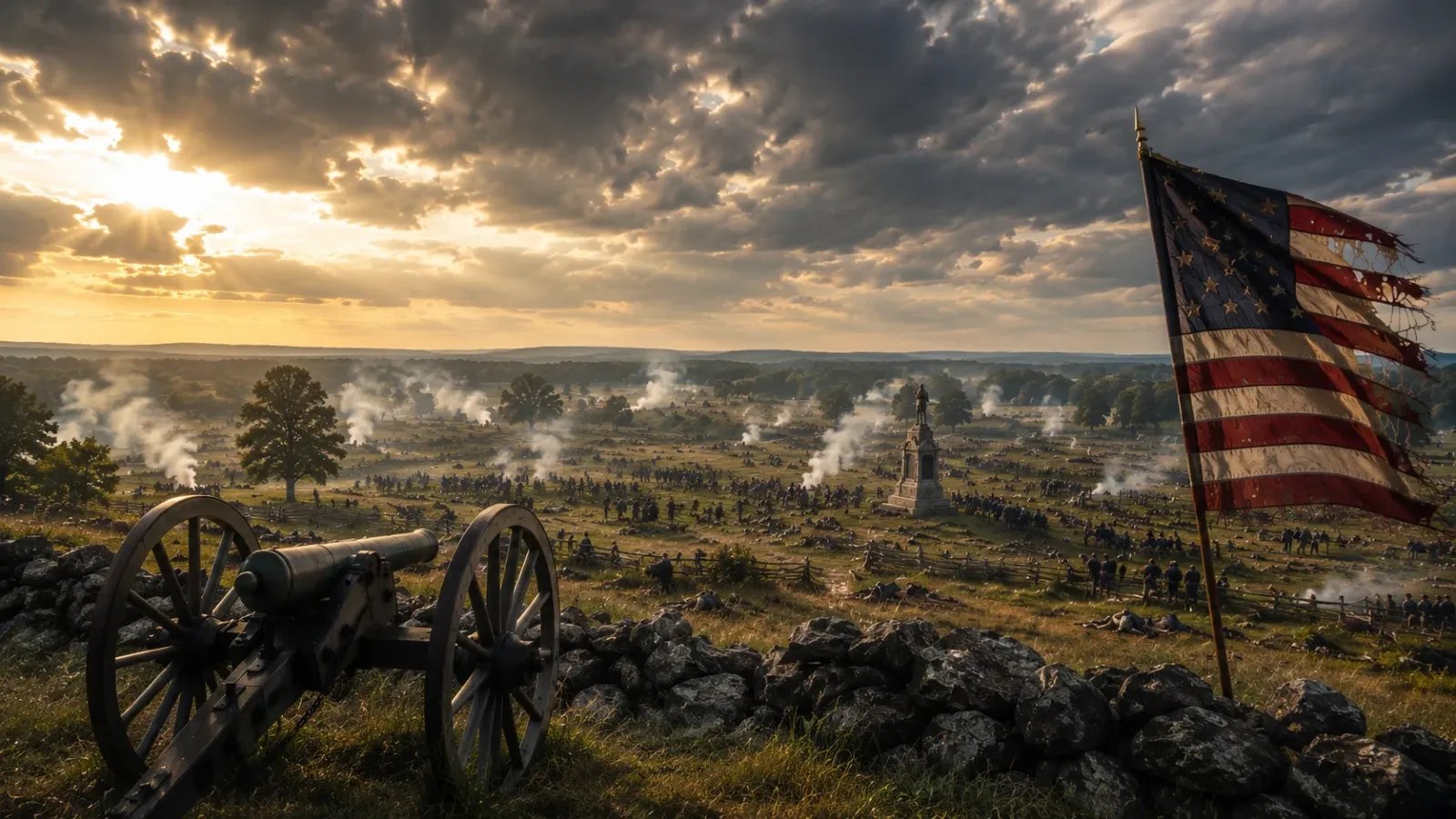
When most people think of the Battle of Gettysburg, they imagine a perfectly orchestrated showdown that inevitably doomed the Confederacy, often repeating the enduring myth that this monumental clash began because Confederate soldiers were simply looking for a stockpile of shoes. In reality, the three-day carnage that erupted in July 1863 was a sprawling, chaotic encounter born of blind maneuvers, miscommunications, and desperation, far removed from the tidy narratives of pop-culture history. As the bloodiest battle ever fought on North American soil, Gettysburg was a staggering logistical nightmare where disease, advanced weaponry, and raw human endurance collided in unprecedented ways. By peeling back the layers of romanticized battlefield lore, we can uncover a bizarre and gritty reality, from secret civilian heroics and unexpected biological hazards to rogue generals and forgotten casualties, that proves this historic turning point was far more complex than any textbook summary suggests.
1. The Fictional Fight for Footwear
A pervasive historical myth insists that the Battle of Gettysburg began because Confederate troops marched into town looking for a rumored supply of shoes. In truth, General Henry Heth sent his forces toward Gettysburg to reconnoiter the area and gather general supplies, not to raid a fictional shoe factory, as the town had no such facilities and had already been stripped of goods by earlier cavalry passages. The legend likely gained traction decades after the war as Southern generals attempted to excuse their accidental engagement with the Union army before General Robert E. Lee's forces were fully concentrated. This romanticized origin story masks the harsh reality that the battle was actually sparked by poor Confederate reconnaissance and an unexpected clash with seasoned Union cavalrymen holding the high ground.
2. The Geriatric Civilian Combatant
While Gettysburg is famous for its military commanders, one of its most fascinating participants was John Burns, a 69-year-old local cobbler and veteran of the War of 1812. Refusing to flee when Confederate forces approached his hometown, Burns casually walked out to the battlefield wearing a swallowtail coat and carrying a vintage flintlock musket. He joined the Union lines, fighting alongside much younger soldiers of the Iron Brigade, and managed to survive despite being wounded three times during the chaotic first day of combat. His unexpected bravery made him an overnight national sensation, eventually leading to a personal meeting with President Abraham Lincoln when the latter visited the battlefield months later to deliver his legendary address.
3. A Staggering Biological Nightmare
The aftermath of the three-day battle left the small farming community of Gettysburg with a horrifying public health crisis that history books often gloss over. With over 7,000 human corpses and roughly 5,000 dead artillery and cavalry horses rotting in the sweltering July heat, the town was engulfed in an unimaginable stench that caused widespread illness among the remaining residents. Citizens were forced to burn the animal carcasses in massive pyres, creating thick, nauseating smoke that hung over the valley for weeks. The immense task of burying the human dead was hastily handled by exhausted soldiers and local civilians, leading to shallow graves that were frequently disturbed by heavy rains and scavenging wild animals before the national cemetery was finally established.
4. The Posthumous Journey of General Reynolds
Major General John F. Reynolds was one of the highest-ranking and most respected casualties of the battle, killed instantly by a sniper's bullet on the very first day. However, the saga of his corpse is a bizarre historical footnote, as his frantic aides refused to leave his body behind during the Union retreat through the town streets. They commandeered a small wooden cart and smuggled their dead commander out of the war zone, transporting him in secret by train all the way to his hometown of Lancaster, Pennsylvania, before the battle had even concluded. This desperate extraction ensured Reynolds was spared the indignity of a mass battlefield grave, but it also robbed the Union army of its most capable battlefield tactician at a moment when leadership was desperately needed to halt the Confederate advance.
5. Robert E. Lee's Hidden Health Crisis
General Robert E. Lee is often depicted as a flawless tactician who simply suffered a rare string of bad luck during the Gettysburg campaign. Modern medical historians, however, suspect that Lee was suffering from severe cardiovascular disease, having experienced what was likely a heart attack just a few months prior in the spring of 1863. During the days of the battle, observers noted that Lee appeared sluggish, short of breath, and physically exhausted, which severely impacted his ability to personally oversee his disjointed forces. This hidden biological factor may explain his unusual passivity and his failure to coordinate the complex, multi-pronged assaults that had previously defined his military successes against the Union army.
6. An Acoustic Phenomenon Heard a Hundred Miles Away
Prior to the disastrous infantry assault known as Pickett's Charge on the third day, the Confederate army launched an unprecedented artillery barrage involving over 150 cannons firing simultaneously. The sheer concussive force of this bombardment created an atmospheric acoustic phenomenon where the deafening roar of the guns was heard as far away as Pittsburgh and even portions of Ohio. Despite this overwhelming display of firepower, a combination of poor fuse quality, thick lingering smoke, and miscalculated elevations caused the vast majority of Confederate shells to fly harmlessly over the Union infantry lines. Consequently, the loudest noise ever generated on the North American continent up to that point achieved almost nothing tactically, leaving the Union defenders firmly entrenched and ready to slaughter the approaching Rebel infantry.
7. The Exaggerated Lore of Little Round Top
Colonel Joshua Lawrence Chamberlain's bayonet charge at Little Round Top is celebrated as the singular event that saved the Union army from total destruction on the second day. While undeniably heroic, modern military historians argue that the tactical significance of this specific hill has been vastly overstated by postwar memoirs and Hollywood dramatizations. Even if the Confederates had managed to capture Little Round Top, they lacked the artillery, fresh troops, and logistical support necessary to hold the rocky summit or effectively bombard the central Union lines from that position. The true anchor of the Union defense was actually the sprawling network of reserves and artillery positioned closer to Cemetery Ridge, meaning Chamberlain's brilliant maneuver was just one small piece of a much larger, highly resilient defensive puzzle.
8. The Explosive Temper of the Victorious General
Union Commander George G. Meade had only been in charge of the Army of the Potomac for a mere three days before colliding with Lee's forces in Pennsylvania. Meade was notorious for his volatile, volcanic temper, earning him the moniker of a damned old goggle-eyed snapping turtle among his nervous subordinates. However, this aggressive irritability masked a highly analytical mind that perfectly suited the defensive requirements of the Gettysburg terrain. By trusting his corps commanders and utilizing a tightly compacted fishhook defensive line, Meade's grumpy but pragmatic leadership style allowed him to rapidly shift troops to plug gaps, effectively outmaneuvering Lee's scattered and poorly coordinated offensives.
9. The Tragic Anomaly of Jennie Wade
Despite the catastrophic exchange of artillery fire and millions of rifle bullets tearing through a heavily populated civilian area, the Battle of Gettysburg claimed only a single direct civilian casualty. Mary Virginia Wade, known as Jennie, was a 20-year-old seamstress who was baking bread for Union soldiers in her sister's kitchen when a stray Confederate bullet passed through two wooden doors and struck her in the heart. The bizarre trajectory of the fatal shot meant she died instantly on the morning of the third day, entirely unaware of the massive conflict reaching its climax just outside her window. Today, the bullet-riddled doors remain preserved in their original state, serving as a grim monument to the incredibly slim margins of life and death during urban nineteenth-century warfare.
10. The Prehistoric Spectators of the Carnage
Unbeknownst to the hundreds of thousands of soldiers fighting and dying across the Pennsylvania countryside, they were battling atop a remarkably preserved prehistoric graveyard. The iconic stone bridges and rocky defensive walls hastily assembled by soldiers during the battle were constructed using local sedimentary rock from the Late Triassic period. Decades after the battle, paleontologists discovered perfectly preserved dinosaur footprints embedded directly within the stone blocks used to build the battlefield's famous defensive breastworks. This means that soldiers fighting for the future of the United States were unknowingly taking cover behind the 200-million-year-old tracks of ancient reptiles, bridging two massively distant eras of earth's history in a single bloody conflict.
11. The Disastrous Artillery Fuse Flaw
The failure of the massive Confederate bombardment before Pickett's Charge was not merely a matter of bad aim, but a critical failure in the chemistry and manufacturing of their munitions. The Confederacy had recently shifted its artillery fuse manufacturing from Richmond to a different arsenal in Charleston, resulting in fuses that burned just slightly slower than what the gunners were accustomed to. Because the cannoneers cut their fuses based on old timing charts, the shells detonated seconds too late, exploding in the empty fields far behind the Union infantry lines. This obscure logistical defect in manufacturing chemistry arguably saved thousands of Union lives and ensured the utter destruction of the advancing Confederate infantry division.
12. The Bizarre Preservation of Sickles' Shattered Leg
Union General Daniel Sickles controversially disobeyed orders on the second day of battle, moving his men into an exposed peach orchard where they were heavily battered by Confederate assaults. During the fighting, a cannonball completely shattered his right leg, forcing a hasty battlefield amputation that ultimately saved his life. Instead of allowing the severed limb to be discarded in a mass medical trench, the eccentric Sickles packed it in a small box and shipped it to the newly founded Army Medical Museum in Washington, D.C. For the remainder of his life, Sickles would frequently visit the museum to view his own skeletal leg on display, using the gruesome artifact as a bizarre political prop to defend his questionable battlefield decisions.
13. The Catastrophic Exhaustion of the Rebel Cavalry
Confederate cavalry commander J.E.B. Stuart is notoriously blamed for leaving Robert E. Lee blind during the lead-up to the battle by taking his horsemen on a prolonged joyride around the Union army. What is less discussed is the severe biological toll this frantic maneuvering took on Stuart's men and their mounts by the time they finally arrived late on the second day. The cavalrymen had been in the saddle continuously for over a week, leading to intense sleep deprivation where soldiers were literally falling off their horses in a state of exhaustion. When Stuart finally engaged Union cavalry in a massive flanking attempt on the third day, his men were too physically devastated to break the Federal lines, turning a critical strategic maneuver into a sluggish and easily defeated skirmish.
14. The Devastating Ballistics of the Minie Ball
The unprecedented casualty rates at Gettysburg were largely driven by the widespread use of the Minie ball, a conical lead bullet that revolutionized nineteenth-century ballistics. Unlike round musket balls that often bounced off bone or passed cleanly through tissue, the heavy lead Minie ball flattened and expanded upon impact, completely shattering bones and destroying large swaths of muscle and vascular tissue. Civil War surgeons were completely unequipped to repair this level of catastrophic ballistic trauma, which is why amputation became the standard and immediate response to almost any limb wound. This deadly convergence of modernized ammunition and antiquated surgical practices transformed the fields of Gettysburg into the largest and most gruesome hospital site in American history.
15. The Macabre Backdrop of the Gettysburg Address
When President Abraham Lincoln arrived in Gettysburg four months after the battle to deliver his iconic speech, the site was far from a pristine national monument. The massive reburial effort was still entirely incomplete, and the pungent smell of rotting human remains still lingered heavily in the November air. As Lincoln spoke about a new birth of freedom, he was standing just yards away from open trenches and partially exhumed bodies that were in the gruesome process of being transferred to the new Soldiers' National Cemetery. The raw, visceral reality of this active graveyard provided a dark and deeply unsettling atmosphere that amplified the profound gravity of Lincoln's enduring words.
Sources & References
This AI-assisted post was rigorously curated and fact-checked for accuracy by:
 Martin Roháček
How fun was this article? 🤔
Tap a star to rate it
🧠 Quiz: How closely were you paying attention?
10 questions — all answers are in the article above!
Enjoyed these facts? There's more! 💌
Fresh fun facts in your inbox. No spam, ever.