Stone Pillars and Two Wars Underwater: 15 Fascinating Facts About Guam
Guam's history is written in stone house foundations, swift sailing canoes and wrecks resting in its harbor. The island's northern limestone and southern volcanic hills also sustain very different water systems. These fifteen facts explore CHamoru culture, the scars of war and the conservation work behind some of the Pacific's most remarkable survival stories.
1. Latte stones once held buildings above the ground
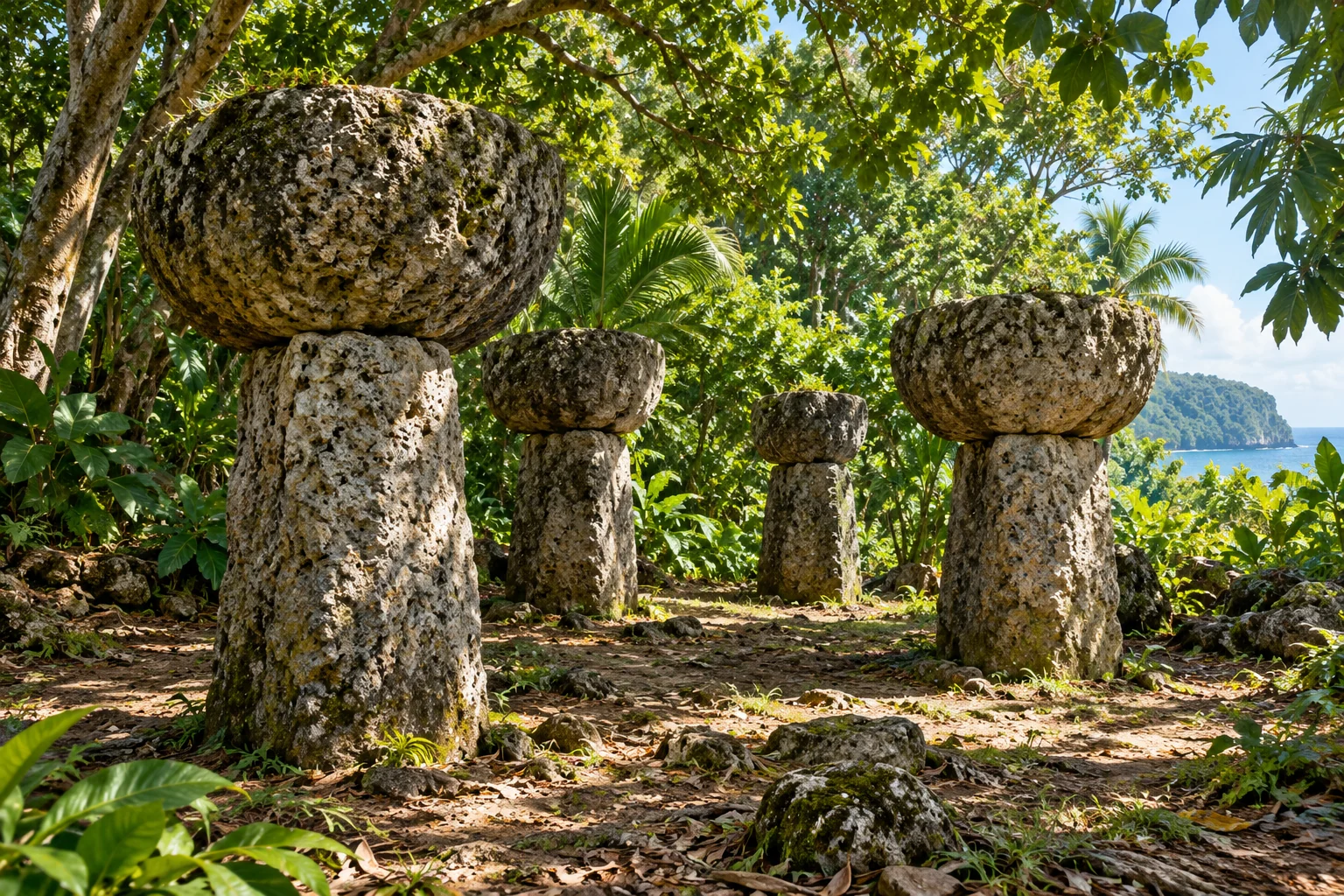
A latte combines an upright stone shaft with a hemispherical capstone. Ancient CHamoru builders arranged these supports in parallel rows beneath substantial wooden and thatched structures. The surviving stones are therefore architectural foundations, rather than isolated sculptures. Found across the Mariana Islands, they remain a powerful cultural symbol, echoed in modern buildings and public spaces on Guam.

2. Its sailing canoes astonished European visitors
Historical observers described CHamoru sailing craft as 'flying proas,' impressed by their speed and handling. These vessels belonged to a sophisticated seafaring tradition that connected communities across the Marianas. Colonial disruption left gaps in the surviving evidence about their construction. Early descriptions and drawings nevertheless preserve glimpses of a maritime technology whose performance challenged visiting sailors' expectations.
3. The island has two contrasting geological faces
Northern Guam is dominated by a limestone plateau, while volcanic hills characterize much of the south. The contrast records a volcanic foundation overlain in places by limestone formed in marine environments. It also helps explain why the landscape changes so noticeably across a relatively small island. Guam's beaches and reefs are only the visible edge of a much longer geological history.
4. Freshwater can sit in a lens above seawater
In northern Guam, wells draw from a freshwater lens within permeable limestone. Rainwater enters the rock and forms a body of groundwater associated with the surrounding saltwater. Much of southern Guam instead relies on surface runoff over less permeable volcanic terrain. Geology consequently shapes everyday water supply as directly as it shapes the view, making groundwater protection an important part of island life.
5. Guam belongs to the Marianas geographically
Guam is the largest and southernmost island of the Mariana chain. Politically, it is administered separately from the Commonwealth of the Northern Mariana Islands to its north. This difference can disappear on a small regional map, but it matters for understanding local history and government. The archipelago shares deep cultural connections while containing more than one modern political jurisdiction.
6. U.S. rule began after the Spanish-American War
Guam became a U.S. territory in 1898 and initially came under the administration of the U.S. Navy. That change ended Spanish rule but did not immediately create the civilian territorial government familiar today. The island's twentieth-century political history includes decades of naval administration, wartime occupation and later reforms. Those stages help explain why one date alone cannot describe the development of modern Guam.
 You might also like
The Mythic Island: 15 Fascinating Facts About Crete
7. The Organic Act changed citizenship and government
Signed on August 1, 1950, the Organic Act conferred U.S. citizenship on the people of Guam and established a civilian governmental framework. It was a major milestone following petitions and political advocacy by island residents. The change is still commemorated locally. Its significance lies both in legal status and in the long effort to give Guam's people a stronger role in governing their home.
8. Its first elected governor came much later
The move to civilian government did not immediately mean an elected governor. Guam's first gubernatorial election took place in 1970, two decades after the Organic Act. The gap separates two milestones often compressed into one sentence about self-government. Looking at the sequence makes clear that political reform on the island proceeded through distinct steps, each changing a different part of public life.
9. War arrived on December 8, 1941, by the local calendar
Japanese aircraft attacked Guam only hours after Pearl Harbor, but the date on Guam was December 8 because the islands lie on opposite sides of the International Date Line. The invasion that followed brought roughly thirty-two months of occupation. Remembering the local date preserves Guam's own chronology of a Pacific war whose opening is often described entirely from Hawaii's perspective.
10. July 21 marks the beginning of liberation
U.S. forces landed at Assan and Hågat on July 21, 1944, beginning the battle to retake Guam. Fighting continued as troops moved inland through fortified terrain. Liberation Day commemorates that landing, but the campaign was not completed in a single morning. The National Park Service preserves sites connected with both the military operations and the suffering of the island's civilian population.
11. One Japanese soldier remained hidden until 1972
Sergeant Shoichi Yokoi survived in Guam's jungle for almost twenty-eight years after U.S. forces returned in 1944. Found in 1972, he became internationally famous and faced the difficult transition back to postwar Japan. His story is often reduced to a remarkable survival anecdote. Local historical accounts also place it within the occupation's lasting human consequences and the complicated public reception of his return.
12. Two shipwrecks connect the world wars in one harbor
The German SMS Cormoran II was scuttled in Apra Harbor in 1917. Nearby lies the Japanese Tokai Maru, sunk during the Second World War. The wrecks rest close enough together to make their proximity a celebrated feature of the site. They offer an unusually compact connection between two global conflicts, embedded in a harbor whose strategic importance long predates modern tourism.
13. An introduced snake changed the sound of the forest
The brown treesnake probably arrived in cargo after the Second World War and spread across Guam. Its predation devastated native birds and other wildlife, while its climbing also caused electrical outages. The ecological consequences extended beyond the disappearance of individual species. Guam became a major case study in how an introduced predator can transform an island ecosystem and why preventing its spread elsewhere matters.
14. The ko'ko' survived through captive breeding
The flightless Guam rail, locally known as ko'ko', disappeared from the wild on Guam after the spread of brown treesnakes. A small number taken into human care became the basis for a breeding and recovery effort. Releases on other islands formed part of that work. Its history shows why recovery can require managing both the animal and the threat that originally drove it out.
15. Red rice gets its color from a seed
CHamoru red rice, hineksa' aga'ga', is commonly colored with water in which achote, or annatto, seeds have been soaked. Rice itself had ceremonial importance in the Marianas before becoming a modern staple. The distinctive dish combines that long relationship with an ingredient introduced during the Spanish period. Its place at gatherings makes a bowl of rice a compact record of cultural continuity and exchange.
How did these facts land?
Know someone who'd love these facts? Share them 👇