
The Horned Enforcer: 15 Fascinating Facts About Krampus
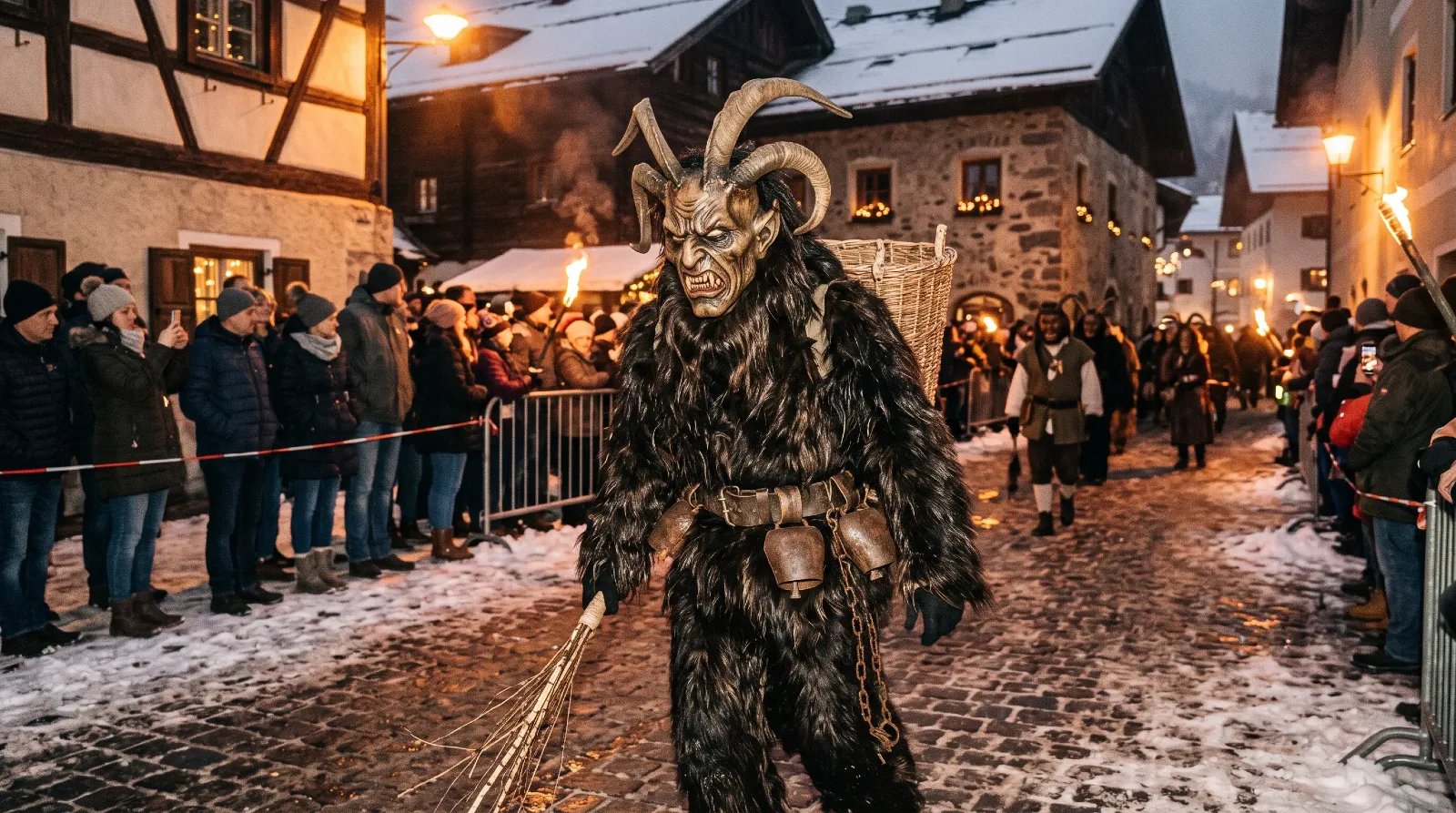
Forget the simplistic horror movie villain; Krampus is a complex, centuries-old figure rooted in Alpine folklore. Rather than a standalone demon, he traditionally works in tandem with Saint Nicholas to maintain winter discipline. Moving past the modern myth of a child-eating monster, explore the rich history, pagan origins, and psychological depths of Europe's most famous Yuletide enforcer.
1. Krampus takes his name from the Bavarian word for a dead, withered twig, contrary to the popular belief that it means claw.
While many modern sources claim the name derives from the Old High German word krampan, meaning claw, linguistic historians point to the Bavarian word krampn, which translates to a dead, dried-out twig or a shriveled entity. This etymology aligns perfectly with the bundles of birch twigs, known as ruten, that the creature famously carries to swat unruly children. The linguistic link to withered branches emphasizes his connection to the dead, dormant winter landscape rather than simply his physical monstrosity. It reflects a much older, agrarian understanding of winter as a time of literal withering, where Krampus acts as a personification of the harsh, unforgiving season.
2. Krampus originated as a pre-Christian nature spirit associated with the Alpine goddess Perchta before being absorbed into Christmas traditions.
Long before Saint Nicholas was introduced to the Alpine regions, Germanic pagan tribes celebrated the winter solstice with various animalistic spirits. Krampus-like figures were originally part of the wild hunt of Perchta, a dual-natured goddess who rewarded the hardworking and violently punished the lazy. When Christianity spread across Europe, the church attempted to stamp out these pagan rituals but ultimately failed to break the local populace's attachment to them. Instead, church leaders strategically allowed these horned entities to survive by tethering them to the newly dominant Saint Nicholas, transforming ancient winter spirits into Christian cautionary figures.
3. Krampus does not operate as an enemy of Saint Nicholas, but rather serves as his explicitly authorized subordinate.
In modern pop culture, Krampus is often depicted as the antithesis or archenemy of Santa Claus, locked in a battle of good versus evil. Historically, however, the two are partners who travel together on the evening of December 5th, known as Krampusnacht. Saint Nicholas handles the distribution of fruits, nuts, and sweets to the well-behaved children, while deliberately stepping aside to let his monstrous companion deal with the miscreants. This dynamic functioned as a classic good cop, bad cop routine, demonstrating a medieval worldview where divine reward and demonic punishment were administered side-by-side under the ultimate authority of the church.
4. Austria's authoritarian government banned Krampus traditions in 1934, branding him a creation of the Social Democrats.
After Engelbert Dollfuss established his authoritarian, clerical-fascist regime in Austria, the ruling Fatherland Front and the conservative Christian Social Party moved against the Krampus customs. Officials condemned the horned beast as an evil creation of the Social Democrats, a figure that in their eyes mocked religious morality and encouraged disorder. The bans pushed Krampus parades to the margins, and suspicion of the tradition lingered for years afterward. Even in the 1950s, Austrian authorities circulated pamphlets warning that Krampus was an evil man, yet the custom survived and roared back into the cultural mainstream in the decades that followed.
5. The birch branches Krampus carries were originally tools for pagan fertility rituals rather than instruments of punishment.
Today, the bundle of birch twigs Krampus brandishes is widely viewed as a cruel whip used to discipline naughty children. In pre-Christian Alpine traditions, however, being struck with birch branches held an entirely different, positive significance. Birch was considered a sacred tree representing vitality, purification, and new life, and lightly swatting someone with its branches was meant to transfer the tree's life force to humans during the dead of winter. It was only after centuries of Christian moralizing that this ritualistic act of blessing was reinterpreted as a punitive beating for moral transgressions.
6. Austrians and Germans exchanged bizarre and darkly humorous holiday greeting cards featuring Krampus making romantic advances toward women.
Beginning in the late nineteenth century, a massive craze swept across Austria, Germany and their neighbors for Krampuskarten, which were illustrated greeting cards exchanged in the days leading up to the Feast of Saint Nicholas. While some cards showed the beast terrorizing children, a surprisingly large subgenre depicted Krampus as a wealthy, well-dressed gentleman courting human women. These satirical cards featured the monster offering flowers, stealing kisses, or being playfully dominated by laughing ladies, complete with cheeky rhymes. This historical trend reveals that long before the internet, society was already playfully undermining the creature's terrifying reputation with subversive, darkly comedic holiday greetings.
 You might also like
The Radical Philosopher: 15 Fascinating Facts About Denis Diderot
7. The large woven basket Krampus wears on his back is an architectural nod to the traditional carrying vessels used by Alpine farmers.
Folklore claims that Krampus uses the wooden tub or woven basket strapped to his back to haul particularly wicked children away to hell or a freezing river. In reality, this iconic piece of his costume is a direct reflection of the local agrarian culture from which the myth was born. The kraxe or butte is a specialized, traditional backpack used by farmers in the mountainous regions of Austria and Bavaria to carry heavy loads of wood, harvested crops, or tools up steep inclines. By outfitting the monster with this commonplace rural tool, early storytellers grounded the supernatural terror in the everyday, recognizable reality of Alpine village life.
8. The heavy iron chains Krampus drags around were added by the Catholic Church to symbolize the devil being bound.
The deafening clatter of rusty chains is one of the primary auditory warnings that Krampus is approaching a village. While the horns and fur date back to pagan nature spirits, historians point out that the chains were a later addition imposed by medieval Christian authorities. The church introduced the chains to symbolize the binding of Satan by the archangels, visually communicating to the peasantry that even this terrifying creature was subordinate to Christian divine law. Over time, the chains became a staple of the costume, often augmented with large, discordant cowbells to create an even more chaotic and terrifying noise during the winter procession.
9. Customs Differ from Village to Village
Tyrolean heritage accounts emphasize differences in names, masks, clothing and performance between communities. Modern groups may organize events and set rules, but there is no single centuries-old code requiring every performer across Austria and Bavaria to belong to a registered association.
10. Krampus's obscenely long, lolling tongue is a visual borrowing from medieval artistic depictions of the plague.
Virtually every historic and modern depiction of Krampus features a wildly elongated, pointed tongue hanging out of his mouth. Art historians trace this specific physical trait back to medieval religious artwork and theater, where a protruding tongue was universally understood as a symbol of death, decay, and demonic mockery. It was also a common visual symptom associated with plague victims in early European medical illustrations, adding a layer of visceral horror for medieval audiences. By adopting this specific, gruesome feature, early mask makers ensured the creature visually broadcasted pestilence and sin to a population that was largely illiterate.
11. In the Czech Republic and Slovakia, the Krampus role is played by a devil who visits homes alongside Saint Nicholas and an angel.
Krampus is far from the only horned enforcer of Central Europe. On the eve of December 6th, Czech and Slovak towns fill with trios of costumed visitors: Saint Nicholas, known as Mikuláš, a white-robed angel, and a soot-faced, chain-rattling devil called a čert. The devil threatens misbehaving children with his sack or basket, while the angel hands out treats to those who recite a poem or sing a song. The custom mirrors the Alpine pairing of Nicholas and Krampus, showing how the good cop, bad cop tradition spread throughout the former Habsburg lands with only small local variations.
12. Historically, women were strictly forbidden from dressing as Krampus, a taboo that is only now being challenged in modern Alpine communities.
For centuries, participating in the Krampuslauf was an exclusive rite of passage for young, unmarried men in Alpine villages. The intense physical demands of wearing suits weighing up to ninety pounds, combined with deeply entrenched patriarchal traditions, meant women were relegated entirely to the role of spectators. It was considered culturally taboo and uniquely unlucky for a woman to don the demonic mask. In recent years, however, a cultural shift has occurred, and several progressive Passen associations have begun secretly allowing women to perform behind the masks, sparking intense debate about gender and historical preservation in Austria.
🤔 Quick guess
According to authentic Alpine folklore, how does Krampus typically travel on Krampusnacht?
13. Early Krampus performers did not wear carved wooden masks but instead blackened their faces using a mixture of animal fat and pine soot.
Before the intricate, hand-carved wooden masks became the defining feature of Krampus costumes in the seventeenth century, the disguise was much more rudimentary. In isolated farming communities, young men would simply obscure their identities by smearing a thick paste of pig fat and soot from pine fires directly onto their faces. They would then don sheepskins inside-out and attach real goat horns to their heads using leather straps. This early iteration was cheaper, accessible to the poorest farmers, and allowed the performers to terrorize their neighbors under the complete cover of anonymity before the craft of mask-making became a specialized local industry.
14. Krampus is not a singular mythological entity, but rather a species of creatures that travel in large packs.
Pop culture frequently refers to the Krampus, treating him as a singular supernatural individual in the same vein as Santa Claus or the Easter Bunny. However, in authentic Alpine folklore, the word operates more like a plural noun describing an entire race of mischievous mountain spirits. During the traditional Krampusnacht, Saint Nicholas is not accompanied by just one demon, but by a chaotic herd of dozens or even hundreds of them. This pack mentality enhances the psychological terror of the myth, as bad children aren't just hiding from a lone enforcer, but from a coordinated swarm of beasts flooding their village.
15. In some localized Alpine traditions, Krampus is accompanied by a softer, equally ancient counterpart known as the Habergeiss.
While Krampus dominates the spotlight of winter folklore, he often does not travel alone in his monstrous duties. In certain regions of Austria and Bavaria, the Krampus pack is accompanied by the Habergeiss, a towering, spectral creature that resembles a grotesque bird or a demonic goat-horse hybrid. Like Krampus, the Habergeiss is a remnant of pre-Christian agrarian winter rituals, but it often plays a more comedic or distinctly trickster role during the winter parades, snapping its wooden jaws at the crowd. The presence of these varied creatures proves that Krampus is just one surviving member of an incredibly diverse, ancient pantheon of winter monsters that once roamed the Alps.
How did these facts land?
Know someone who'd love these facts? Share them 👇
🧠 Quiz: How closely were you paying attention?
Think you remember the facts? 10 questions, tap an answer.