15 Surprising Facts About Maine
Wooden puffins helped revive a seabird colony, a roadside solar system spans miles, and an old farm became a 'desert': Maine rewards a closer look.
1. Wooden puffins helped real puffins return to an island
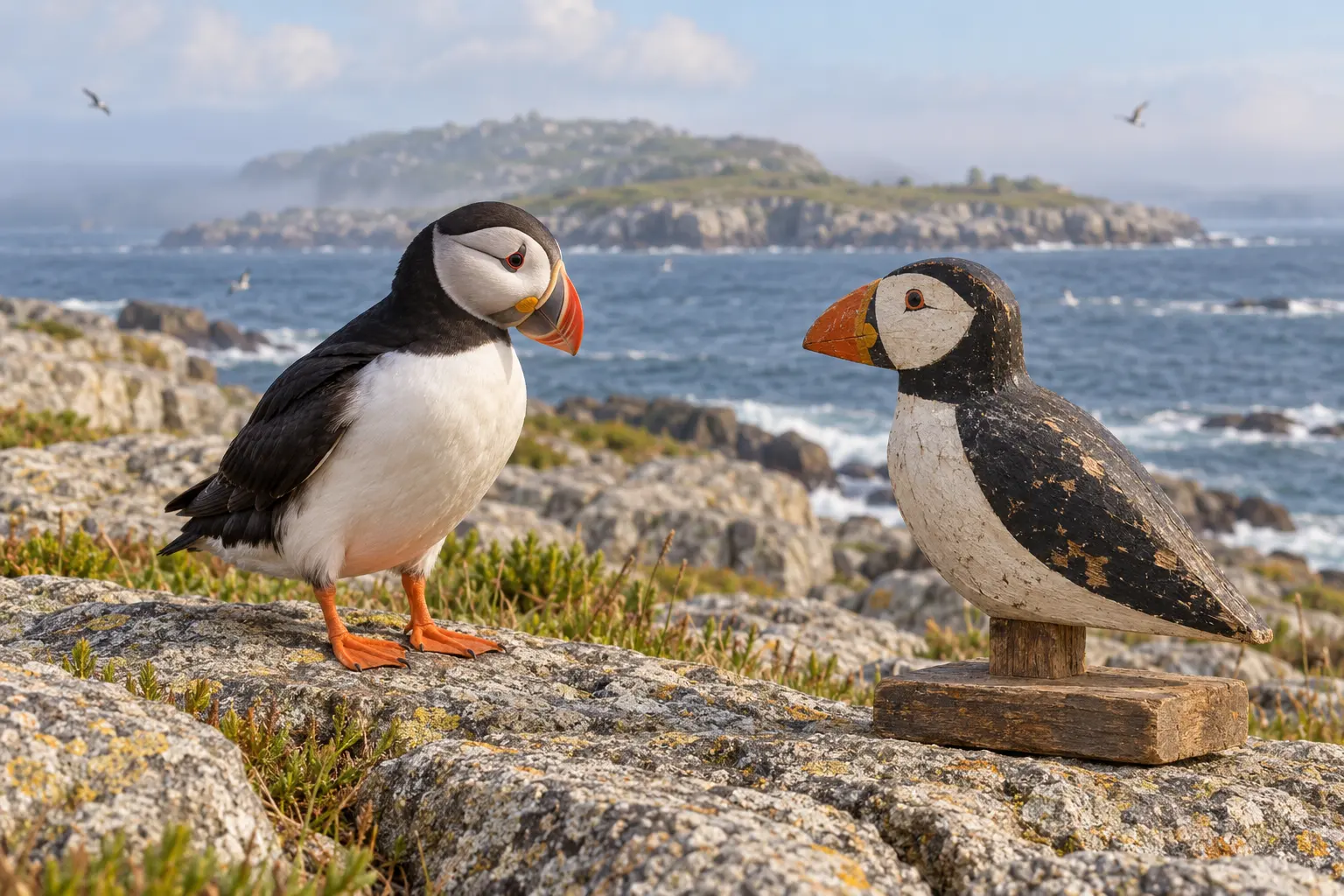
Project Puffin began in 1973 with an ambitious plan: raise chicks from Newfoundland on Maine's Eastern Egg Rock so they would return there as adults. Raising the birds was only part of the challenge. Researchers placed wooden puffin decoys around the island to make it look like an established colony, appealing to the birds' social instincts. In 1981, puffins finally bred there again. Participants later recalled the excitement of seeing a bird carrying fish beneath the boulders, evidence that it was feeding a chick.
2. Maine's 'desert' began with Ice Age deposits and an eroding farm
The Desert of Maine near Freeport is a sandy landscape in a climate far too wet to be a true desert. Its geological story began when retreating ice left loose sediment and strong winds formed dunes. Vegetation eventually stabilized many such deposits. Later, farming and grazing exposed the material again, allowing wind erosion to resume. On the Tuttle family's property, the spreading sand overwhelmed the farm. Henry Goldrup bought the land in 1919 and turned the unusual landscape into a tourist attraction.
3. Acadia had two earlier names and grew through land gifts
Before it was Acadia, the protected area was Sieur de Monts National Monument, established in 1916. It became Lafayette National Park in 1919 and received its present name in 1929. Land donations helped make the park possible: Eliza Homans's early gift included the Bowl, the Beehive, and part of Champlain Mountain. Organizers assembled thousands of acres for transfer to the federal government. This familiar landscape of mountains and coast thus became a park parcel by parcel, through purchases, gifts, and successive federal designations.
4. Chester Greenwood's earmuff patent describes a clever mechanical improvement
Farmington celebrates Chester Greenwood for his association with earmuffs, but his 1877 patent offers a more precise story than the familiar invention legend. Titled 'Improvement in Ear-Mufflers,' it describes a springy metal band and wire pad frames arranged to keep the warm coverings against the ears while limiting unwanted movement. Greenwood turned his design into a manufacturing business that employed local workers for decades. He also pursued other ventures, from bicycles and heating equipment to telephone service and further patented devices.
5. Wild-blueberry fields take turns producing a harvest
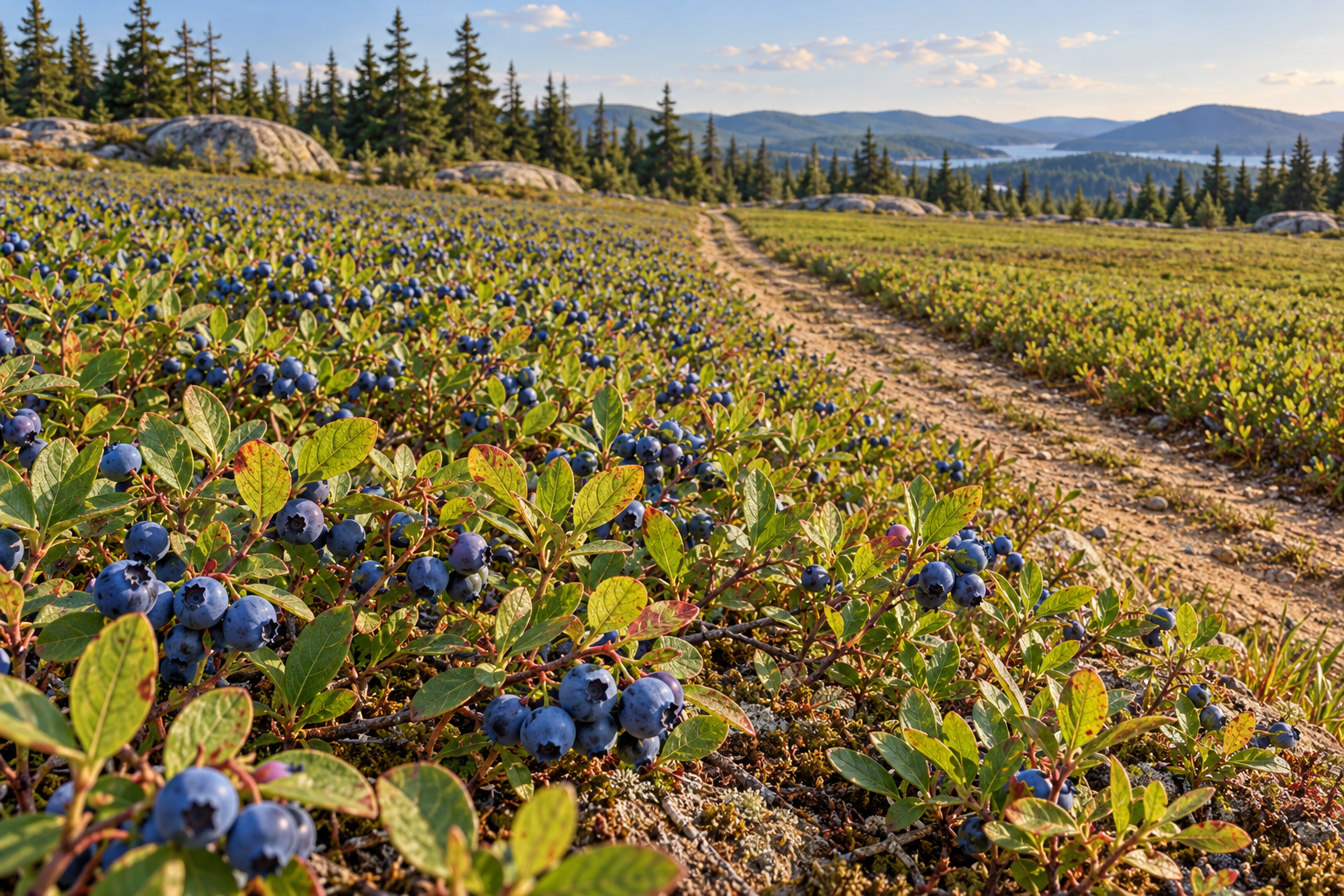
Maine's commercial lowbush-blueberry fields largely manage plants already growing naturally in the landscape. Growers commonly divide their land between two stages of a production cycle. After harvest, plants are pruned by mowing or burning; the following year produces new stems, leaves, and flower buds. Fruit comes in the second year. Alternating sections allow a farm to harvest annually while each section follows its two-year rhythm. A field can also contain many genetically distinct plants, creating a patchwork of berry sizes, colors, and flavors.
6. Old Sow's smaller whirlpools are called 'piglets'
Between Eastport, Maine, and Deer Island, New Brunswick, tidal water squeezes through the Western Passage and encounters a complicated underwater landscape. The resulting currents can form Old Sow, a huge whirlpool, with smaller vortices nicknamed 'piglets.' NOAA reports that the main swirl has been measured at more than 250 feet across, though its size changes with conditions. The churning also brings nutrients and small organisms up from deeper water, helping feed fish and seabirds. Its memorable name has several proposed explanations in local folklore.
 You might also like
The Palme d'Or Paradise: 15 Fascinating Facts About the Cannes Film Festival
7. Baxter State Park came with an unusual financial arrangement
Former governor Percival Baxter bought nearly 6,000 acres around Katahdin in 1930 and donated the first parcel to Maine in 1931, with conditions protecting its wild character. He continued adding land over the following decades. He also established trust funds to support the park's future, creating a lasting financial legacy alongside the landscape. Baxter is administered separately from Maine's larger state-park system, under its own authority. Its history combines conservation with detailed instructions about how a public gift should be managed and maintained.
8. A roadside solar system turns astronomical distances into a drive
Along U.S. Route 1 in northern Maine, planets stand at intervals that make the solar system's scale tangible. In the Maine Solar System Model, one mile represents one astronomical unit: the average Earth–Sun distance. The original project linked Presque Isle and Houlton over roughly forty miles and was formally unveiled in 2003. Local volunteers helped fabricate and install the models. Later additions extended the exhibit to more distant dwarf planets. The empty stretches between objects are part of the lesson about how much space separates worlds.
9. Maine's official soda helped put 'moxie' into the dictionary
The slang word 'moxie,' meaning courage, determination, or energy, derives from the Moxie soft-drink trademark. The drink began as a product promoted with extravagant medicinal claims, including the name 'Moxie Nerve Food.' Its creator, Augustin Thompson, came from Union, Maine, though he developed the business while living in Lowell, Massachusetts. In 2005, Maine adopted Moxie as its official state soft drink. A regional beverage therefore left a linguistic legacy that reaches far beyond the people who recognize its distinctive bitter taste.
10. A boundary dispute over timber became the 'Pork and Beans War'
In 1839, disputed logging rights helped bring Maine and neighboring New Brunswick to a dangerous confrontation. Both sides mobilized forces, arrests were made, and fortifications were built, but the Aroostook War produced no military battles. Its nickname, the 'Pork and Beans War,' recalls the food associated with the mobilized men. Diplomacy prevented escalation, and the Webster–Ashburton Treaty settled the boundary in 1842. Maine's archives preserve the conflict's paper trail, including militia records, correspondence, and a diary by agent William Parrott.
11. Uncle Tom's Cabin had an early audience in a Brunswick home
While living in Brunswick, Harriet Beecher Stowe read installments of Uncle Tom's Cabin to a circle of friends before sending them to the National Era for publication. One listener was Bowdoin student Joshua Chamberlain, who later became a Union general and governor of Maine. The household also sheltered John Andrew Jackson during his escape from slavery in 1850. Bowdoin's history of the house preserves both Jackson's account of Stowe's help and Chamberlain's recollection of the readings, connecting the novel to people who passed through her home.
12. A Maine senator challenged McCarthyism without naming McCarthy
On June 1, 1950, Senator Margaret Chase Smith delivered her 'Declaration of Conscience.' The Maine Republican defended independent thought and criticized the use of accusations to destroy reputations. She did not name Senator Joseph McCarthy in the speech, but the challenge to his methods was unmistakable. Six other Republican senators joined her declaration. The intervention did not immediately end McCarthy's influence; it was an early public stand that carried political costs. The Senate's historical account traces her growing doubts to requests for evidence behind his allegations.
13. Sweetgrass research changed when gatherers helped design the experiment
Research in Acadia examined Wabanaki knowledge that careful sweetgrass gathering can encourage future growth. An early experimental layout placed plots where experienced gatherers would not normally choose to harvest. Researchers revised the approach so gatherers selected suitable locations and used their customary practices. The gatherer-led plots showed an increase in stem density after harvest, unlike the original botanist-selected plots. Suzanne Greenlaw and her collaborators documented how knowledge of place, plant condition, and technique changed the experiment itself, as well as the understanding of harvesting.
14. Bath's shipyard reached a wartime rhythm of a destroyer every seventeen days
During World War II, Bath Iron Works achieved a remarkable rate of destroyer output, averaging a ship about every seventeen days during its intense wartime production. That figure describes the pace at which ships emerged from a busy yard with overlapping work, rather than the construction time of one vessel. Women joined the workforce as welders, painters, crane operators, and other skilled workers. The story links the naval war to the changing working lives of people in a small Maine city on the Kennebec River.
15. Archaeology recovered everyday life from an island the state had cleared
In 1912, Maine forcibly removed Malaga Island's mixed-race fishing community. Around forty people lost their homes, eight residents were committed to a state institution, and even the island's cemetery was exhumed. Decades later, archaeologists recovered tens of thousands of objects that helped document the daily lives obscured by hostile accounts of the community. The state apologized in 2010. Today the island's history is preserved through museum collections, research, and work with descendants, making an apparently quiet coastal landscape a record of a devastating public action.
How did these facts land?
Know someone who'd love these facts? Share them 👇