The Remarkable Ocean Wanderers: 15 Fascinating Facts About Penguins
Penguins are among the most extraordinary marine creatures on Earth, perfectly adapted to thrive in some of the globe's harshest environments. While widely recognized for their tuxedo-like appearance and adorable waddle, these flightless birds possess astonishing biological superpowers, from built-in salt filters to deep-sea diving capabilities. From ancient mega-giant ancestors to high-pressure defensive adaptations, discover the surprising science behind these iconic ocean swimmers.
1. Hidden Knees Beneath Their Feathers
Despite their iconic short-legged waddle, penguins actually have fully formed knees hidden beneath their dense body feathers and thick fat layer. Their leg skeleton consists of a femur, knee cap, tibia, and fibula, structured similarly to other birds. However, their upper legs are set far back inside the lower torso to aid in streamlining their bodies for hydrodynamics. This unique anatomical configuration keeps their center of gravity positioned for underwater swimming prowess rather than terrestrial agility. As a result, when walking on ice or land, they are forced to tilt side-to-side, producing their famous waddling stride.
2. Built-in Salt Filters Above Their Eyes
Living at sea and consuming marine prey means penguins swallow enormous quantities of saltwater, which would easily dehydrate or kill most land mammals. To solve this dilemma, penguins possess a specialized organ called the supraorbital gland located just above their eyes. This gland actively filters excess sodium chloride directly out of their bloodstream with remarkable efficiency. The concentrated salty fluid is then routed down to their nasal passages, where it is expelled through their beak or literally sneezed out into the environment. Thanks to this adaptation, penguins can drink pure ocean water freely without damaging their kidneys.
3. Record-Breaking Diving Capabilities
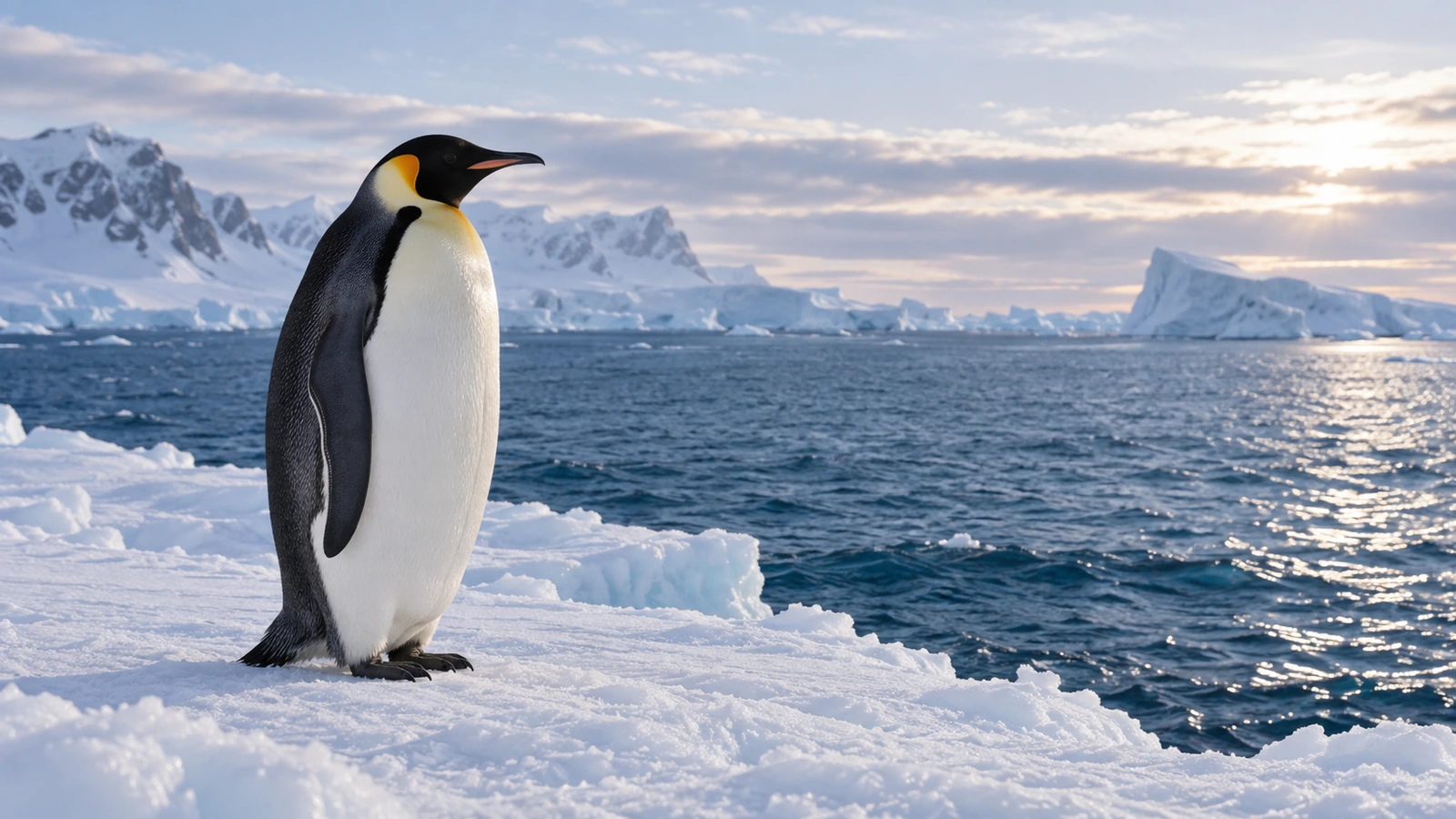
Emperor penguins are undisputed champion divers among birds, reaching staggering depths of up to 1,850 feet (565 meters) beneath the icy ocean surface. To survive the crushing pressure and extreme cold at these depths, their heart rate drops from around 60 to 70 beats per minute down to a mere 15 to 20 beats per minute. They can store massive amounts of oxygen in their muscles using high concentrations of myoglobin, allowing them to remain submerged for over 20 minutes at a time. Furthermore, their solid bones reduce buoyancy, helping them sink quickly toward prey without exerting excess energy. These remarkable traits enable them to hunt deep-sea squid and fish that remain completely inaccessible to other sea birds.
4. The Romantic Exchange of Courtship Pebbles
In several pebble-nesting species, such as the Adélie and Gentoo penguins, stones are the most prized currency during mating season. Male penguins meticulously search the rocky shores to find the smoothest, most perfect pebble to present to a prospective female. If the female accepts the gift, she places it into a nest scrap, signaling that the pair bond has been established. Nests made of clean stones keep precious eggs elevated above melting ice, muddy runoff, and freezing meltwater. Competition for these rocks is so fierce that penguins frequently steal choice pebbles from neighboring nests when their owners turn their back.
5. Sacrificial Testing for Marine Predators
When a flock of penguins gathers at the edge of an ice shelf, entering the water carries serious life-or-death risks from lurking predators like leopard seals and killer whales. To gauge whether the ocean is safe, the crowd will jostle and crowd around the rim until one unlucky individual gets nudged into the water. The remaining penguins freeze and watch intently to see if their companion is ambushed below the surface. If the sacrificial bird swims safely without being attacked, the entire group leaps into the water to feed immediately. If a predator strikes, the flock backs away from the ledge and waits for a safer opportunity.
6. The Extreme Isolation of the Catastrophic Molt
Unlike most birds that replace their feathers gradually over several months, penguins undergo an extreme event known as a catastrophic molt. Once a year, they shed all of their old, worn-out feathers simultaneously while growing a fresh, waterproof coat underneath. Because losing their feathers destroys their thermal insulation and waterproofing, penguins cannot enter the freezing ocean to hunt during this process. They are forced to remain on land for two to three weeks, looking disheveled while enduring complete starvation. Before the molt begins, penguins gorge themselves on prey to accumulate enough fat reserves to survive the ordeal.
 Birds of the World
From record-breaking aerial plunge-divers to massive flightless icons, the avian world is a marvel of evolutionary engineering. Discover the extraordinary intellects, specialized survival skills, and hidden superpowers of the planet's most fascinating birds.
See All Facts
Birds of the World
From record-breaking aerial plunge-divers to massive flightless icons, the avian world is a marvel of evolutionary engineering. Discover the extraordinary intellects, specialized survival skills, and hidden superpowers of the planet's most fascinating birds.
See All Facts
7. Speed Demons of the Underwater World
While they are famously clumsy on land, penguins transform into underwater acrobats that can outpace many species of fish. The Gentoo penguin holds the crown as the fastest underwater swimming bird, capable of reaching bursting speeds up to 22 miles per hour (35 kilometers per hour). Their wings have evolved into rigid, flattened flippers powered by powerful pectoral muscles that make up nearly a quarter of their total body mass. Unlike flying birds that derive lift only on the downstroke, penguins generate propulsion on both the upstroke and downstroke of their flippers. This continuous stroke allows them to dart through turbulent waves and make razor-sharp turns to capture elusive prey.
8. Strict Southern Hemisphere Distribution
A common misconception popularized by cartoons is that penguins and polar bears interact in the wild, but they actually live on opposite ends of the planet. Polar bears reside exclusively in the Northern Hemisphere around the Arctic, whereas almost all 18 species of penguins live in the Southern Hemisphere. The solitary exception is the Galápagos penguin, which lives near the equator off the coast of South America. Even then, the Galápagos penguin only crosses slightly into northern waters because the chilly Humboldt Current brings frigid ocean water up from Antarctica. Consequently, no wild penguin has ever set foot in the true Arctic region of the North Pole.
9. High-Pressure Projectile Defecation
Maintaining clean nests and pristine feathers is essential for a penguin's survival, especially when living in densely packed breeding colonies. To prevent contaminating their nesting sites with guano, penguins have developed the ability to launch their feces with astonishing force. Scientists studying this phenomenon found that penguins generate rectal pressures up to four times higher than humans to shoot excrement up to four feet (1.2 meters) away from their bodies. This high-pressure squirt ensures that their precious eggs and downy chicks remain unsoiled by waste while the parent stays seated on the nest. The resulting guano stains around colonies are so massive they can even be tracked from outer space by satellite sensors.
10. Countershading: The Ultimate Underwater Camouflage
Penguins feature a classic black-and-white feather pattern that serves as a vital survival mechanism known as countershading. When viewed from above by an aerial predator or prey, their dark back blends seamlessly into the shadowy depths of the deep ocean. Conversely, when a marine predator like a seal looks up from below, the penguin's bright white belly blends against the sunlit surface of the water. This optical illusion makes the penguin nearly invisible from both directions while swimming in open water. Evolution has honed this bi-colored design across almost all penguin species to maximize their stealth while hunting marine life.
11. Egg Balancing Act of King and Emperor Penguins
Not all penguins construct nests out of stones, vegetation, or mud scraps on the ground. King and Emperor penguins build no nests at all, choosing instead to carry their single egg on top of their webbed feet for the entire incubation period. A specialized, featherless fold of skin covered in dense down—known as a brood patch—hangs over the egg to keep it extremely warm against sub-zero temperatures. The parents must carefully shuffle across the ice while balancing the fragile egg on their toes, taking extreme care not to drop it onto the frozen ground where it would quickly freeze. Once hatched, the chick continues to shelter on top of its parents' feet until it grows enough insulating feathers of its own.
12. Prehistoric Giant Mega-Penguins
Modern penguins range in size from the tiny Little Blue penguin standing 13 inches tall to the impressive Emperor penguin reaching 4 feet. However, fossil records reveal that prehistoric giant penguins once dominated coastal ecosystems millions of years ago. Species such as Palaeeudyptes klekowskii, often called the colossus penguin, roamed the Earth during the Eocene epoch around 37 to 40 million years ago. Paleontologists estimate this ancient bird stood nearly 6 feet 7 inches (2 meters) tall and weighed upwards of 250 pounds (115 kilograms). These massive avian predators had long, spear-like beaks and easily towered over average adult humans.
13. Backward-Facing Spines Inside Their Mouths
Catching slick, wriggling fish underwater without hands presents a major challenge, but penguins have evolved a unique oral adaptation to prevent prey from escaping. Their mouth, palate, and tongue are lined with hundreds of sharp, backward-pointing fleshy spines called papillae. Made of keratin—the same tough protein found in human fingernails—these spines act like a one-way conveyor belt inside the bird's beak. Once a fish or squid is grabbed, the rearward spikes hold it securely, preventing it from slipping outward while the penguin swallows it whole. This ensures that even the slickest marine creatures are quickly funneled directly down the bird's esophagus.
14. Male Emperor Penguins Suffer Winter Fasting to Brood Eggs
While female Emperor penguins lay a single egg during the freezing Antarctic autumn, they immediately hand incubation duties over to their male partners. The females head out to the open ocean to feed for up to two full months, leaving the males behind to endure the brutal polar winter. During this time, male Emperor penguins huddle together tightly in massive groups to conserve body heat against howling winds and temperatures dropping to minus 40 degrees. They fast continuously for up to 115 days, losing roughly half of their total body mass while keeping the egg safe and warm on their feet. When the females finally return with stomachs full of fish to feed the newly hatched chicks, the emaciated males can finally head to the sea to eat.
15. Acoustic Signature Recognition in Crowded Colonies
In vast colonies comprising tens of thousands of screaming birds, finding a mate or a specific chick might seem nearly impossible. To solve this noise problem, each penguin possesses a unique vocal signature distinct from every other bird in the colony. Parents and chicks learn each other's precise acoustic frequencies and pitch patterns shortly after birth. When returning from long fishing expeditions, an adult bird stands at the edge of the sprawling colony and calls out into the chaotic noise. Through complex auditory processing, their partner or chick can pinpoint that exact call across huge distances and navigate directly through the crowd to reunite.
Sources & References
This AI-assisted post was rigorously curated and fact-checked for accuracy by:
 Martin Roháček
How fun was this article? 🤔
Tap a star to rate it
🧠 Quiz: How closely were you paying attention?
10 questions — all answers are in the article above!
Enjoyed these facts? There's more! 💌
Fresh fun facts in your inbox. No spam, ever.