The Indestructible Micro-Animal: 15 Fascinating Facts About Tardigrades
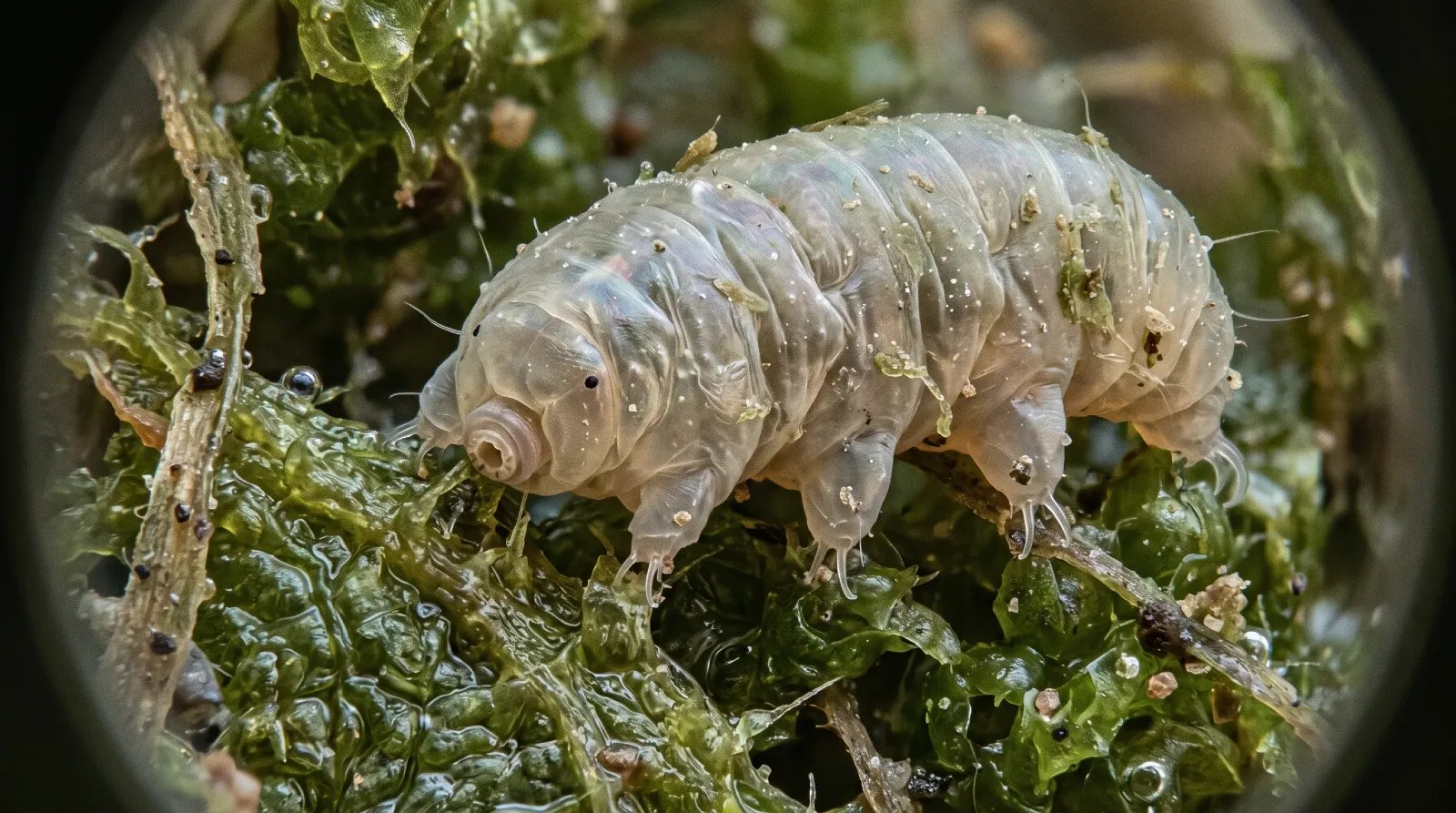
Tardigrades are barely half a millimetre long, yet they have survived the vacuum of space, temperatures close to absolute zero and being frozen for 30 years. These chubby, eight-legged "water bears" live in moss all around us and may be the toughest animals on Earth. Here are the surprising facts about these microscopic survivors.
1. Their nickname is "water bears".
Tardigrades were first described in 1773 by the German zoologist Johann August Ephraim Goeze, who called them "little water bears" because of their chubby bodies and lumbering walk. A few years later, the Italian scientist Lazzaro Spallanzani gave them the name Tardigrada, meaning "slow walkers". They are also sometimes called moss piglets.
2. They are tiny, with eight legs.
Most tardigrades are around half a millimetre long or smaller, barely visible to the naked eye. They have a plump, segmented body and four pairs of stubby legs, each ending in claws or sticky pads. Under a microscope, they look a little like miniature eight-legged bears or vacuum cleaner bags with legs.
3. They live almost everywhere.
Tardigrades have been found on mountaintops, in the deep sea, in tropical rainforests and in Antarctica. The easiest place to find them is in damp moss and lichen, even in a city park. Scientists have described around 1,500 species, and many more probably remain to be discovered.
4. They survive by drying out.
When their environment dries up, tardigrades pull in their legs, lose almost all their body water and curl into a dry, shrivelled ball called a tun. In this state, their metabolism almost stops completely. When water returns, they can rehydrate and start moving again within hours.
5. They can survive extreme temperatures.
In their tun state, some tardigrades can survive temperatures as low as minus 272 degrees Celsius, just one degree above absolute zero. They have also survived short exposures to around 150 degrees Celsius. Very few other animals can tolerate such extremes.
6. They are the first animals known to survive open space.
In 2007, tardigrades were sent into orbit on the European FOTON-M3 mission and exposed directly to the vacuum and radiation of space. When they returned to Earth, many of them revived, and some even went on to lay eggs that hatched normally. They were the first animals shown to survive the combination of space vacuum and cosmic radiation.
 You might also like
The Sovereign Leviathan: 15 Fascinating Facts About Blue Whales
7. Some may now be lying on the Moon.
In 2019, the Israeli spacecraft Beresheet crash-landed on the Moon. Among its cargo was a small capsule containing thousands of dried tardigrades. Scientists believe they probably did not survive the impact, but some have speculated that a few could still be scattered across the lunar surface in their dormant state.
8. Tardigrades frozen for 30 years came back to life.
In 2016, Japanese researchers revived tardigrades from a moss sample that had been collected in Antarctica in 1983 and kept frozen for more than 30 years. Some of the animals recovered, ate and even reproduced. One of them laid eggs that hatched into healthy young.
9. They can withstand huge doses of radiation.
Tardigrades can survive radiation doses hundreds of times higher than those that would kill a human. Part of the secret is a unique protein called Dsup, short for "damage suppressor", which binds to their DNA and protects it from harm. When scientists added Dsup to human cells in the laboratory, the cells became more resistant to X-rays.
10. They can survive crushing pressure.
Tardigrades have survived experiments in which they were subjected to pressures several times greater than those found at the deepest point of the ocean. Their ability to withstand both extremely high pressure and the vacuum of space makes them one of the most resilient animals known.
11. They can survive being fired from a gun, up to a point.
In a 2021 experiment, scientists fired frozen tardigrades from a gas gun at a target to test whether they could survive impacts like those of a meteorite. The animals survived impacts at speeds of up to about 900 metres per second, but not faster. This suggests tardigrades would be unlikely to survive being blasted from one planet to another on a meteorite.
12. They are not actually immortal.
Despite their reputation, tardigrades are not indestructible. In their active, hydrated state, they are fairly fragile and live for only a few months to a couple of years. Their extraordinary toughness applies mainly when they are dried out in their dormant tun state.
🤔 Quick guess
How old are the earliest known tardigrade fossils?
13. They can learn.
Tardigrades have very simple nervous systems, but they are capable of learning. In experiments, researchers trained one species to curl up into its defensive tun shape in response to a blue light that had previously been paired with a mild electric shock. This is a form of classical conditioning, the same kind of learning as in Pavlov's famous dogs.
14. Their bodies are mostly "head".
Tardigrades are distant relatives of insects and other arthropods. Genetic studies have revealed that they are missing several of the genes that build the middle of the body in other animals. As a result, most of a tardigrade's body corresponds to the head region of an arthropod.
15. They have been around for over 500 million years.
The earliest known tardigrade fossils date back to the Cambrian period, some 500 million years ago. That means their lineage has lived through every mass extinction since, including the one that wiped out the dinosaurs. A 2017 study even concluded that tardigrades would be likely to survive almost any astronomical catastrophe short of the Sun's death.
How did these facts land?
Know someone who'd love these facts? Share them 👇
🧠 Quiz: How closely were you paying attention?
Think you remember the facts? 10 questions, tap an answer.