The Golden Mirage: 15 Fascinating Facts About the California Gold Rush
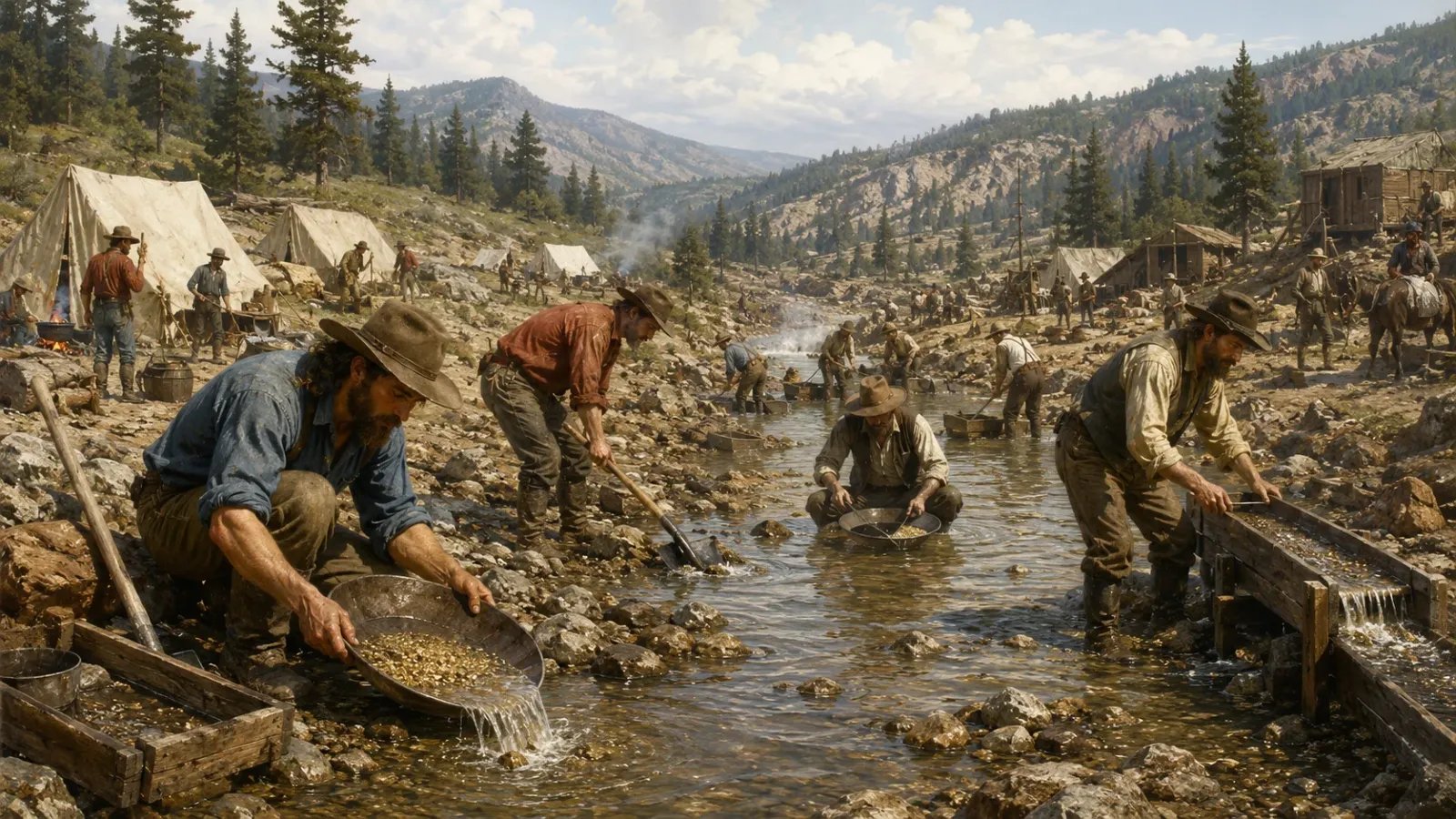
Forget the romanticized image of rugged lone prospectors striking it rich. The California Gold Rush was an environmental disaster and a corporate takeover that enriched merchants over miners. This era transformed global economies, decimated indigenous tribes, and birthed modern California through blood, greed, and hidden ingenuity.
1. James Marshall actually tried to keep his gold discovery a secret, but the news was leaked by a merchant looking to sell supplies.
Sam Brannan, a local merchant, walked through San Francisco holding a vial of gold, shouting about the discovery to manufacture a rush. Brannan had preemptively bought up all the mining supplies in the area, becoming California's first millionaire by selling shovels and pans at massive markups, rather than digging for gold himself.
2. Most people who traveled to California during the Gold Rush ended up losing money or barely breaking even.
The romanticized notion that panning for gold guaranteed immense wealth is a historical illusion. By the time the massive wave of Forty-Niners arrived, the easily accessible surface gold was largely depleted. The skyrocketing cost of living in mining camps, combined with the exorbitant prices of basic provisions, meant that any meager dust a prospector found was immediately spent on simple survival.
3. The influx of miners triggered one of the most drastic environmental catastrophes in North American history through a process called hydraulic mining.
When surface gold ran out, corporate syndicates took over with high-pressure water cannons known as monitors. These blasted away entire mountainsides to reveal gold-bearing quartz, washing millions of tons of gravel and toxic silt into the river systems. This raised riverbeds, caused devastating flooding in the Sacramento Valley, and choked agricultural lands with debris, forever altering California's topography.
4. Mercury was used extensively to extract gold from crushed ore, leaving a toxic chemical legacy that still poisons California waterways today.
Miners used liquid mercury to create an amalgam with fine gold particles, which was then heated so the mercury vaporized, leaving the gold behind. Millions of pounds of mercury were lost into the environment during this era. Today, the sediment in the San Francisco Bay and the Sierra Nevada watershed still holds dangerous concentrations of this heavy metal, bioaccumulating in fish and local wildlife.
5. The rapid population boom directly funded the construction of the Transcontinental Railroad by creating an inescapable economic demand to link California to the East.
Before the Gold Rush, California was a distant, sparsely populated territory. The sudden explosion of wealth and population made the grueling overland wagon routes and the dangerous sea voyage around Cape Horn obsolete. The sheer volume of gold flowing out of San Francisco and the desperate need for manufactured goods flowing in provided the economic imperative and political leverage to undertake the massive engineering feat of a transcontinental railway.
6. Women in the mining camps possessed massive economic leverage and often earned more than the men who were digging for gold.
Due to the extreme gender imbalance, as men made up over ninety percent of the population in early mining towns, domestic skills were highly commodified. Women who opened boarding houses, cooked meals, or started laundry businesses could charge exorbitant rates. A skilled pie maker or laundress could easily amass a small fortune safely, avoiding the backbreaking and uncertain labor of the gold fields.
7. The California Gold Rush was a distinctly international event that fundamentally transformed global migration patterns.
Word of the gold strike spread globally before it heavily impacted the American East Coast, bringing thousands of immigrants from Chile, Mexico, Hawaii, China, and Europe. This unprecedented multicultural convergence turned San Francisco from a sleepy village into a cosmopolitan metropolis almost overnight, though it also triggered severe xenophobia, racist foreign miner taxes, and brutal systemic violence against non-white immigrants.
8. The native indigenous population of California plummeted by an estimated eighty percent within two decades of the gold discovery.
The Gold Rush triggered an apocalyptic demographic collapse for Native Californian tribes. Beyond the devastation brought by new Eurasian diseases, the state government explicitly funded militia campaigns to exterminate indigenous people and clear land for mining claims. This state-sponsored genocide, combined with starvation caused by the ecological destruction of traditional food sources, decimated a population that had thrived for thousands of years.
9. Levi Strauss did not invent blue jeans for miners during the Gold Rush, despite the popular corporate mythology.
While Levi Strauss did move to San Francisco in 1853 to open a dry goods business, the iconic riveted denim pants were not invented until 1873, decades after the height of the rush. The invention was actually a collaboration with Jacob Davis, a tailor from Nevada, who realized that adding copper rivets to stress points could reinforce work pants. They patented the design long after the classic Forty-Niners had packed up their pans.
10. Hangtown fry, an omelet made with oysters and bacon, was created as a status symbol for newly wealthy miners who wanted to eat the most expensive ingredients possible.
In the mining camp of Placerville, originally known as Hangtown, a prospector who had just struck it rich reportedly walked into a local hotel and demanded the most expensive meal the chef could create. Because oysters had to be shipped on ice from the coast and bacon was a luxury brought over the mountains, combining them with eggs created a wildly overpriced culinary flex that became a lasting staple of Gold Rush culture.
11. San Francisco's modern financial district is built on top of a subterranean graveyard of abandoned Gold Rush ships.
When vessels arrived at the port of San Francisco, their crews frequently abandoned them to head straight for the gold fields. Hundreds of ships were left rotting in the shallow cove. As the booming city needed more land, residents simply sank these abandoned ships, filled them with sand and garbage, and built on top of them. Modern construction crews still occasionally unearth fully intact ship hulls beneath the city streets.
12. The massive influx of gold into the global market temporarily disrupted the international monetary system by wildly devaluing gold relative to silver.
As millions of ounces of California gold poured into global treasuries, the supply shock depressed the purchasing power of gold. Countries operating on a bimetallic standard, like the United States and France, suddenly found their silver coins being hoarded or melted down because the silver was worth more as a raw metal than as a fixed-rate coin, forcing major overhauls in global currency policies.

13. California's entry into the United States as a free state was accelerated by the Gold Rush, directly escalating the tensions that led to the Civil War.
The population exploded so rapidly that California bypassed the traditional territorial phase, applying directly for statehood in 1849. Because the independent-minded miners generally opposed slave labor, fearing wealthy Southern planters would monopolize claims with enslaved workers, California entered as a free state. This upset the delicate balance of power in Congress, resulting in the Compromise of 1850 and hastening the nation's march toward civil war.
14. The disease known as scurvy killed far more miners in the early years of the rush than cholera, violence, or mining accidents.
The men traveling to California primarily relied on salted meats and hardtack, both completely devoid of Vitamin C. Once in the mining camps, fresh fruits and vegetables were either unavailable or prohibitively expensive. The resulting malnutrition caused rampant scurvy, leading to weakness, internal bleeding, and tooth loss. It wasn't until agriculture caught up with the population boom that the deadly outbreaks subsided.
15. The California Gold Rush essentially ended not because the gold ran out, but because the extraction process required massive corporate capital that pushed out independent miners.
The easily panned placer gold in the riverbeds was largely exhausted by the mid-1850s. The remaining gold was trapped deep underground in quartz veins or buried under mountains, requiring advanced engineering, stamp mills, and large labor forces to extract. The era of the hopeful individual prospector died, replaced by a wage-labor economy dominated by well-funded mining corporations.
Sources & References
This AI-assisted post was rigorously curated and fact-checked for accuracy by:
 Martin Roháček
How fun was this article? 🤔
Tap a star to rate it
🧠 Quiz: How closely were you paying attention?
10 questions — all answers are in the article above!
Enjoyed these facts? There's more! 💌
Fresh fun facts in your inbox. No spam, ever.