The Visionary Monarch: 15 Fascinating Facts About Charles IV, Holy Roman Emperor
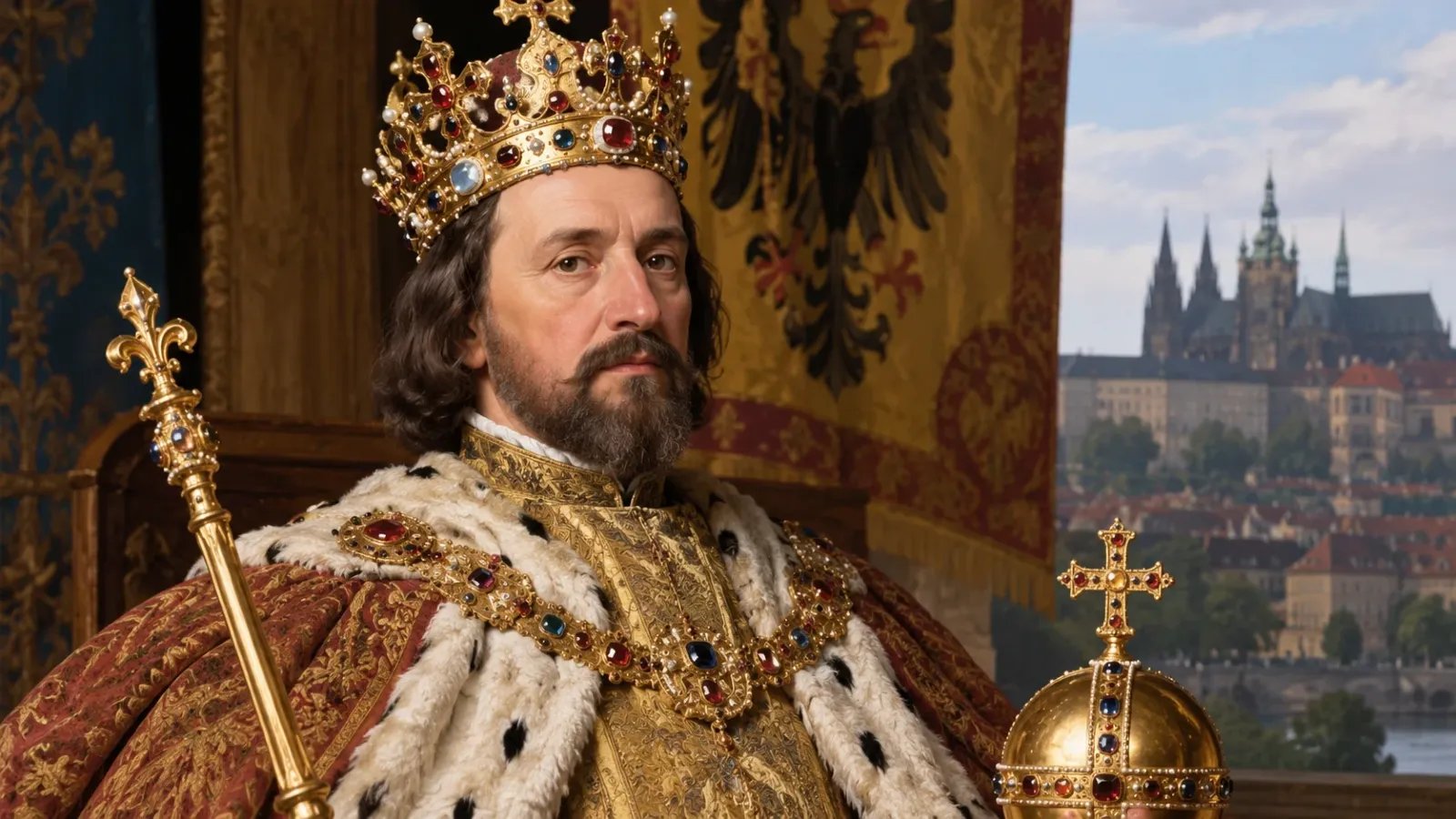
Charles IV was one of the most successful rulers of the fourteenth century. Through careful diplomacy, shrewd purchases, and ambitious building projects, he turned Prague into an imperial capital and left a lasting mark on Central Europe. Here are the surprising stories of the scholarly emperor.
1. Charles IV was born with the name Wenceslaus and took the name Charles in France.
Although he is remembered as Charles IV, the future emperor was baptized Wenceslaus (Václav) in honor of the patron saint of Bohemia. As a boy he spent seven years at the French royal court, where he received an excellent education. There he was confirmed and took the name Charles, after his uncle and godfather, King Charles IV of France. The new name linked him to the prestige of the French monarchy.
2. He wrote an autobiography, a rare achievement for a medieval ruler.
Charles IV is the author of the Vita Caroli, a Latin autobiography that covers his youth and the early years of his reign. It is one of the very few autobiographies written by a medieval monarch. In it he describes his upbringing, his adventures in Italy, and his religious experiences, and he portrays himself as a pious and peace-loving ruler. Historians note that this image was partly constructed by Charles himself, which makes the text as valuable for understanding how he wished to be seen as for the facts it records.
3. A tournament accident in 1350 almost left him paralyzed.
Charles IV enjoyed tournaments, and in 1350 he took part in one in Italy under a false name. According to Czech accounts, an opponent's blow to his helmet broke his jaw, and he fell from his horse. Chroniclers wrote of "powerlessness of all limbs," and doctors treated a damaged neck vertebra. He recovered after months, but when the anthropologist Emanuel Vlček examined his skeleton in the twentieth century, he found a bent cervical spine, which restricted his head movement, and Charles had to turn his whole body to look to the side.
4. He founded the first university in Central Europe.
Before 1348, students from Central Europe had to travel to Paris, Bologna, or Oxford to attend university. Charles founded the University of Prague in 1348, with the support of Pope Clement VI. It was the first university in Central Europe, and it was later named Charles University in his honor. It trained administrators and lawyers and helped to make Prague an intellectual center.
5. The Golden Bull of 1356 regulated the election of the emperor for centuries.
The Holy Roman Empire had often suffered from disputed elections. In 1356 Charles issued the Golden Bull, which named seven prince-electors with the right to elect the king of the Romans, laid down the voting procedure, and set the principle of majority decision. It also made the electoral territories indivisible and did not require papal approval of the election. The Golden Bull remained a fundamental law of the empire until 1806.
6. He spoke and wrote several languages.
Charles IV stated in his autobiography that he spoke and wrote Czech, German, French, Italian, and Latin. His upbringing in France and his stay in Italy helped him master them. The Golden Bull even ordered that the sons of the prince-electors should learn Italian and Czech, the languages of other parts of the empire, from the age of seven.
 Rulers, Kings and Emperors
Discover the captivating truths behind history's most iconic rulers, kings, and emperors. From eccentric geniuses and tactical masterminds to deeply flawed sovereigns, explore the hidden lives of those who shaped the modern world.
See All Facts
Rulers, Kings and Emperors
Discover the captivating truths behind history's most iconic rulers, kings, and emperors. From eccentric geniuses and tactical masterminds to deeply flawed sovereigns, explore the hidden lives of those who shaped the modern world.
See All Facts
7. He founded Prague's New Town, one of the largest urban projects of medieval Europe.
In 1348 Charles founded the New Town of Prague, which more than doubled the area of the city. It was laid out with wide streets and huge market squares, such as today's Charles Square, one of the largest medieval town squares in Europe. According to a popular theory, the positions of several churches were chosen to form a large symbolic cross across the city, although historians debate this. The project strengthened Prague's position as the imperial capital.
8. He collected relics and built a fortress for the imperial treasures.
Charles was deeply pious, and he collected relics, such as fragments believed to come from the True Cross and the Crown of Thorns. Karlštejn Castle, built from 1348 on his orders, was designed to protect the imperial regalia and the relics. Its Chapel of the Holy Cross is decorated with gold, semi-precious stones, and 129 panel paintings by Master Theodoric. Pilgrims came to Prague each year to see the relics displayed, which brought prestige and income.
9. According to legend, the Charles Bridge was started at a magical moment.
A popular tradition says that the foundation stone of the Charles Bridge was laid at 5:31 in the morning on 9 July 1357. Written out, the numbers form a palindrome: 1-3-5-7-9-7-5-3-1. According to the legend, this was calculated by court astrologers to bring good fortune. The tradition is popular rather than documented, but the bridge, built by the architect Peter Parler, did survive centuries of floods, and it remained Prague's only stone bridge over the Vltava until the nineteenth century.
10. He expanded his territories mostly through purchases and marriages.
Charles IV was known for building up his lands through diplomacy, inheritance, and money rather than war. He purchased parts of the Upper Palatinate, which he called New Bohemia, and acquired Lower Lusatia. His four marriages brought alliances and territories, such as the Silesian duchies of Świdnica and Jawor. The big exception was Brandenburg: in 1373, after a war that began with his invasion in 1371, it passed to the Bohemian crown.
11. The poet Petrarch urged him to go to Italy, but Charles ignored him.
Cola di Rienzo, the Roman tribune, visited Charles in Prague in 1350 and urged him to come to Italy, where the poet Petrarch and the citizens of Florence also hoped for his help. Charles ignored these appeals and even imprisoned Cola for a year. When he finally went to Rome for his coronation in 1355, he stayed only a few hours and left, which brought him the scorn of Petrarch. Charles' practical approach to Italy contrasted with the dreams of humanists.
12. He had to withdraw his ambitious law code.
In 1355 Charles tried to introduce the Maiestas Carolina, a code of law for Bohemia that would have strengthened royal power. The Bohemian nobles strongly resisted, as it limited their privileges. Knowing he could not push it through, and to save face, he declared that the document had accidentally burned in a fireplace. After that, Charles was careful not to try to centralize Bohemia against the nobility's wishes.
13. He survived a poisoning attempt as a teenager.
In 1331, the fifteen-year-old Charles was sent to Italy to help his father, King John of Bohemia. According to his autobiography, on the first day in Pavia, poisoned food was served to him and his companions. Charles survived because he was fasting after attending Mass, and he had the would-be poisoner arrested. The incident taught him early on how dangerous Italian politics could be.
14. The Crown of Saint Wenceslas legally belongs to a saint.
For his coronation as King of Bohemia in 1347, Charles IV had a magnificent crown made of gold, sapphires, spinels, emeralds, and pearls. In 1346 he declared that it belonged to Saint Wenceslas, patron saint of Bohemia, and not to the reigning monarch, who could only borrow it for the coronation. The crown weighs about 2.5 kilograms and is kept in St. Vitus Cathedral in Prague. A modern legend says that anyone who wears it without the right to do so will die within a year.
15. He ordered vineyards to be planted around Prague.
Charles IV, who knew the wines of France from his youth, supported viticulture in Bohemia. On 16 February 1358 he issued an order that people should plant vineyards on suitable hills within three miles of Prague. Whoever planted a vineyard was exempt from the land tax for twelve years. According to tradition, he brought Burgundy vines to Bohemia. The decree helped create the vineyards around Prague, and the district of Vinohrady is named after them.
Sources & References
This AI-assisted post was rigorously curated and fact-checked for accuracy by:
 Martin Roháček
How fun was this article? 🤔
Tap a star to rate it
🧠 Quiz: How closely were you paying attention?
10 questions — all answers are in the article above!
Enjoyed these facts? There's more! 💌
Fresh fun facts in your inbox. No spam, ever.