The Prehistoric Predator: 15 Fascinating Facts About Alligator Snapping Turtles
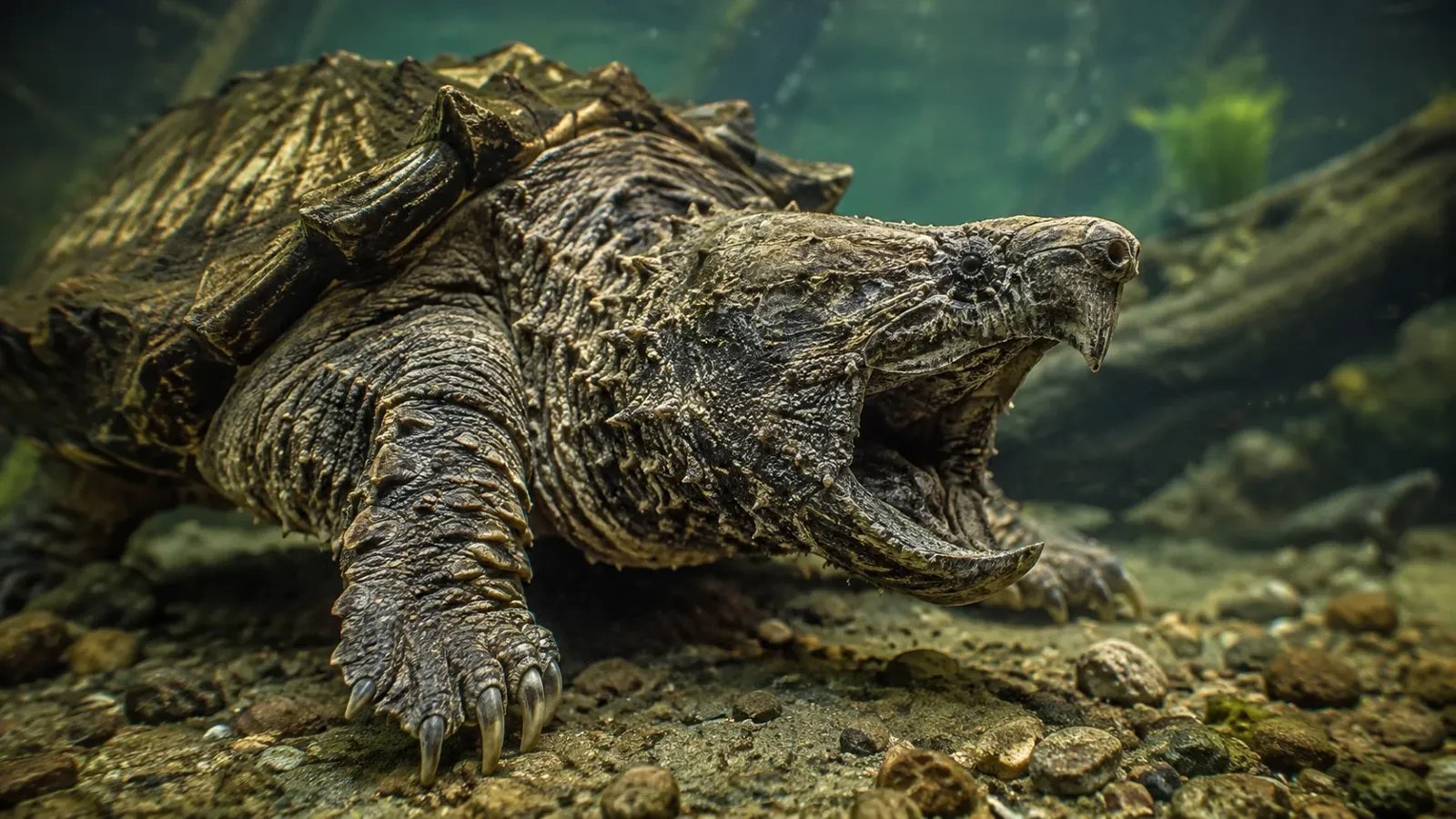
Often dismissed as just a larger, meaner version of the common snapper, the alligator snapping turtle is actually an ancient, highly specialized ambush predator. Far from mindlessly attacking swimmers, these river behemoths rely on incredible biological trickery to survive. Discover the evolutionary marvels of North America's largest freshwater turtle.
1. The alligator snapping turtle is equipped with a built-in biological lure that flawlessly mimics a wriggling worm.
Inside its mouth, the turtle has a specialized, bright pink appendage attached to its tongue. When hunting, the turtle lies completely motionless at the bottom of a river with its jaws wide open, wiggling this appendage to attract curious fish. Once a fish swims inside to investigate the false meal, the turtle's jaws snap shut with lightning speed.
2. Despite being air-breathing reptiles, males of this species will spend their entire adult lives underwater without ever stepping on land.
While females must briefly venture onto riverbanks to lay their eggs, male alligator snapping turtles remain almost exclusively aquatic. They are so thoroughly adapted to life on river bottoms that they have no need to bask on logs like other turtle species, surfacing only enough to poke their nostrils above the water for a stealthy breath.
3. They are not simply a larger variation of the common snapping turtle, but belong to an entirely distinct evolutionary lineage.
People often assume that common and alligator snapping turtles are close cousins, but they diverged millions of years ago. The alligator snapping turtle belongs to the genus Macrochelys, whereas the common snapping turtle belongs to Chelydra. Their physical similarities are the result of convergent evolution rather than a direct, recent familial bond.
4. Modern taxonomy recognizes three separate species of alligator snapping turtles rather than a single unified group.
For centuries, scientists believed there was only one species of alligator snapping turtle, known as Macrochelys temminckii. However, morphological and genetic research published in 2014 revealed that populations isolated in different river basins had evolved into distinct species, introducing the Suwannee snapping turtle and the Apalachicola snapping turtle to the scientific record.
5. Contrary to urban legends about their jaw strength, their bite force is mathematically weaker than that of a human.
While rumors claim these turtles can snap a broomstick with sheer crushing pressure, tests reveal their bite force is around 160 Newtons, whereas a human averages about 600 Newtons. The turtle's devastating bite damage does not come from raw blunt force, but rather from the razor-sharp, beak-like edges of its jaw that act like industrial shears to cleanly slice through prey.
6. They cultivate thick gardens of algae on their shells to achieve perfect invisibility in muddy waters.
The carapace of an alligator snapping turtle features three massive, dinosaur-like ridges that already resemble rough stones. Because the turtle moves so little and remains submerged in nutrient-rich waters, algae naturally colonizes its shell. This symbiotic growth breaks up the animal's silhouette, turning a massive predator into an indistinguishable mossy rock.
 Reptiles, Amphibians and Snakes
From venomous serpents and heavily armored crocodilians to shape-shifting amphibians, explore the fascinating biology and hidden secrets of Earth's most incredible cold-blooded marvels.
See All Facts
Reptiles, Amphibians and Snakes
From venomous serpents and heavily armored crocodilians to shape-shifting amphibians, explore the fascinating biology and hidden secrets of Earth's most incredible cold-blooded marvels.
See All Facts
7. The interior of the turtle's mouth is naturally camouflaged a mottled gray and brown.
If the inside of this ambush predator's mouth were the bright pink color typical of most animals, it would immediately alert prey to danger. Instead, the fleshy interior is colored to perfectly match the mud and debris of the riverbed. The only vividly colored tissue is the vermiform tongue lure, which ensures the prey's attention is focused solely on the trap.
8. Because their shells are remarkably small compared to their body mass, they cannot retract their heads for protection.
Most turtles rely on drawing their vulnerable limbs and head tightly inside their shell when threatened. The alligator snapping turtle, however, has largely outgrown this defensive mechanism over its evolutionary history. Because it cannot hide, it relies on its massive size, thick scales, and an aggressively defensive posture to deter potential threats.
9. They utilize a highly developed chemosensory system to track decaying carcasses from miles away.
While famously known as ambush hunters, these turtles are also highly efficient scavengers. They use sensory papillae on their chins and necks to detect the chemical signatures of dead animals floating downriver. This excellent sense of smell allows them to locate submerged carcasses in zero-visibility water, making them vital cleaners of river ecosystems.
10. The sex of an alligator snapping turtle is determined entirely by the temperature of the nest during incubation.
This species exhibits a biological phenomenon known as temperature-dependent sex determination. If the nest temperature is extremely warm or extremely cold, the eggs will yield female hatchlings. Conversely, an intermediate temperature produces males. This makes the species incredibly sensitive to climate fluctuations, as unusual weather can drastically skew population demographics.
11. An alligator snapping turtle can hold its breath for nearly an hour before needing to surface.
By maintaining a phenomenally slow metabolic rate and remaining almost completely motionless on the river bottom, these turtles consume very little oxygen. Their ability to go 40 to 50 minutes between breaths allows them to wait out cautious prey without breaking the illusion of being an inanimate object on the river floor.
12. Adult alligator snapping turtles are apex predators with absolutely no natural predators in their ecosystem.
Once an alligator snapping turtle reaches its adult size, which can exceed 150 pounds, nothing in its native freshwater habitat can eat it. While raccoons, birds, and fish will eagerly devour their eggs and vulnerable hatchlings, a full-grown adult sits comfortably at the top of the food chain, with human activity being the only legitimate threat to its survival.
13. They are enthusiastic cannibals that consume large quantities of other turtle species.
While their diet consists heavily of fish, frogs, and mollusks, alligator snapping turtles are highly opportunistic predators. They have been documented eating small alligators, snakes, and aquatic rodents, but stomach content analyses have revealed that other, smaller species of turtles make up a significant and regular portion of their diet.
14. They possess a specialized muscular valve in their throat that prevents them from drowning while hunting with open jaws.
Because their hunting strategy requires them to sit underwater with their mouths completely open for hours at a time, water would normally flood into their lungs. To combat this, they have evolved a specialized glottis that seals off their windpipe, allowing them to wait patiently for prey while entirely flooded with water.
15. The exact lifespan of wild alligator snapping turtles remains unknown, but scientists believe they routinely live past a century.
Due to their incredibly slow growth rates and delayed sexual maturity, it takes a long time for these creatures to reach their massive proportions. Biologists have found wild specimens with bullets from the 1800s lodged in their shells, providing tangible evidence that these slow-moving reptiles routinely outlive the humans who study them.
Sources & References
This AI-assisted post was rigorously curated and fact-checked for accuracy by:
 Martin Roháček
How fun was this article? 🤔
Tap a star to rate it
Enjoyed these facts? There's more! 💌
Fresh fun facts in your inbox. No spam, ever.