Electric Lights and a Stolen Body: 15 Facts About Benjamin Harrison
A stolen body, a president's fear of electric switches, a law-school appointment and a border dispute in Paris: Benjamin Harrison's life reaches well beyond his famous surname. These fifteen stories also examine the limits and consequences of his policies on voting rights, business and Native Americans.
1. His father's body was found during a search for someone else
At John Scott Harrison's funeral in 1878, relatives noticed that a young neighbor's grave had been robbed. They secured Harrison's grave with heavy stones and a watchman. Nevertheless, while searching an Ohio medical college for the neighbor's remains, Benjamin's brother John discovered their father's body hanging from a hoist. Benjamin hired Pinkerton detectives. He did not personally make the discovery, as compressed retellings can suggest.
2. He defended the men sued after Garfield's famous civil-liberties victory
James Garfield helped win Ex parte Milligan, the Supreme Court decision limiting military trials of civilians. The story continued in a different courtroom: Milligan later sued military officials for damages, and Harrison helped defend them in 1871. Future vice president Thomas Hendricks appeared for Milligan. The sequence puts three future national leaders on opposing sides of a dispute about wartime government power.
3. His front porch became a campaign stage
Harrison's 1888 campaign brought selected delegations and newspaper reporters to Indianapolis rather than sending the candidate on a nationwide speaking tour. He addressed visitors from home while party organizations supplied the parades, bands and torchlight rallies elsewhere. The restrained personal campaign worked: he won the Electoral College despite receiving fewer popular votes than Cleveland, and even failed to carry his own city.
4. He kept the Dakotas' signing order deliberately uncertain
North and South Dakota became states on November 2, 1889. South Dakota's official historical account says Harrison covered the identifying portions of their proclamations, signed them, and shuffled the papers so that neither state could claim precedence from the signing order. North Dakota is conventionally listed first alphabetically. The shared admission date is documented in the proclamations; the concealed-order story comes from later historical accounts.
5. Electric lighting arrived, but staff had to operate the switches
The White House received electric lighting in 1891. Wiring ran beneath the plaster, and a generator serving the neighboring State, War and Navy Building supplied power. Electrician Irwin 'Ike' Hoover later recalled that the Harrison family feared shocks: he switched lights on at night, and they could remain burning until he returned the next morning. His account captures how unsettling an ordinary modern convenience initially seemed.
6. His grandchildren enjoyed the first documented White House Christmas tree
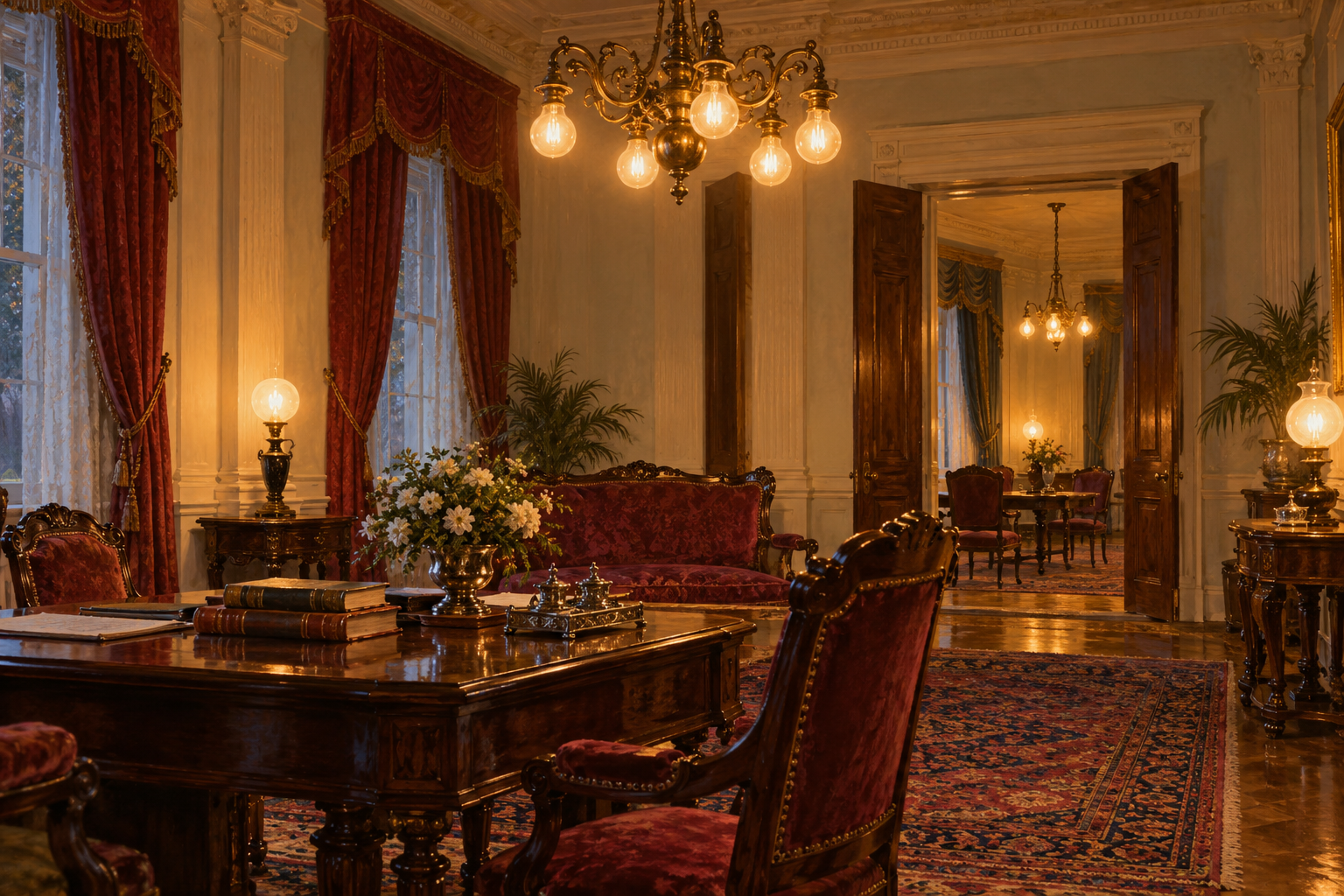
In 1889, a Christmas tree stood upstairs in the family library, the room now called the Yellow Oval Room. Candles and toys decorated it for the Harrison grandchildren. Staff also received gifts: married men were given turkeys, while unmarried men received gloves. Calling it the first documented tree is more careful than assuming no earlier family ever brought one inside; electric tree lights came in a later administration.
 You might also like
The Unprecedented Leader: 15 Fascinating Facts About Franklin D. Roosevelt
7. His wife designed presidential plates with corn on the border
Caroline Harrison was an experienced china painter, and the state service ordered during her husband's presidency reflected her own artistic interests. Corn and goldenrod appeared in gold around the border, surrounding the national arms. After samples arrived from several Limoges factories, she selected a design made by Tressemanes and Vogt. A surviving breakfast plate makes the first lady's contribution more tangible than a general account of White House entertaining.
8. His first forest reservation needed a second proclamation
On March 30, 1891, Harrison used new congressional authority to reserve forest land beside Yellowstone. This was the beginning of the federal forest-reserve system. But the first proclamation left questions about the boundary description. In September he issued another, expressly making the limits more definite. Conservation history thus includes a practical surveying problem as well as a landmark presidential decision.
9. He signed a law that let injured businesses seek triple damages
The Sherman Antitrust Act, signed on July 2, 1890, did more than authorize federal action against monopolistic practices. Section 7 allowed people and businesses injured by prohibited conduct to sue for three times their damages, plus costs and a reasonable attorney's fee. Early enforcement disappointed reformers, but the original text shows how the law recruited private lawsuits as part of its effort to protect competition.
 US Presidents
Discover the eccentricities, secret talents, and surprising hidden lives of America's most influential presidents, from frontier wrestlers to covert strategists.
See All Facts
10. His proposed federal voting protections failed
Harrison supported the Lodge election bill, which sought federal supervision of congressional elections to counter the suppression of Black voters in the South. He also backed federal educational aid intended to undermine exclusion through literacy requirements. Neither measure passed. Their failure matters when assessing celebratory claims about his civil-rights record: supporting protective legislation did not mean that his administration secured those rights in practice.
11. He praised a military response that culminated at Wounded Knee
In November 1890, Harrison ordered a substantial troop deployment amid official alarm over the Ghost Dance movement. The escalation preceded the killing of Lakota men, women and children at Wounded Knee on December 29. His subsequent message acknowledged inadequate rations and unfulfilled government commitments, yet praised General Miles for subduing the opposition with minimal loss of life. The wording exposes the distance between presidential reassurance and the catastrophe experienced by Lakota families.
12. He accepted a Stanford teaching appointment before leaving office
On March 2, 1893, two days before his presidency ended, Harrison accepted an offer to become a nonresident law professor at Stanford. He prepared lectures on the Constitution and delivered them to packed audiences in spring 1894. The appointment helped attract attention to a fledgling law department. Stanford's archives preserve correspondence about the arrangement, giving a former president's second career a precise documentary trail.
13. He represented Venezuela in a Paris boundary arbitration
Retirement did not end Harrison's international work. In 1899, he served as senior counsel for Venezuela in arbitration over its boundary with British Guiana. His papers include notes, correspondence and arguments for the Paris proceedings. The role reversed his position from national executive to advocate for another country. The eventual award largely favored Britain, so his prominence should not be confused with a sweeping courtroom victory.
14. His second wife was his first wife's niece
After Caroline Harrison died in 1892, Harrison continued corresponding with her widowed niece, Mary Lord Dimmick, who had helped her aunt in Washington. Benjamin and Mary married on April 6, 1896, and their daughter Elizabeth was born the following year. Mary later helped preserve the Indianapolis home that became the presidential site. The family's history therefore continued decades beyond his single White House term.
15. The Harrison White House nearly acquired an art-gallery wing
With living quarters and presidential offices crowded into the mansion's second floor, Caroline Harrison worked with Frederick D. Owen on an ambitious expansion. The proposal included new business space, an American art gallery and an enclosed garden linked to the existing house. Congress did not approve it. Her plans show that debates over how to combine a family home, public monument and working office predated the West Wing.
How did these facts land?
Know someone who'd love these facts? Share them 👇