The Melancholic Pulse: 15 Fascinating Facts About Blues Music
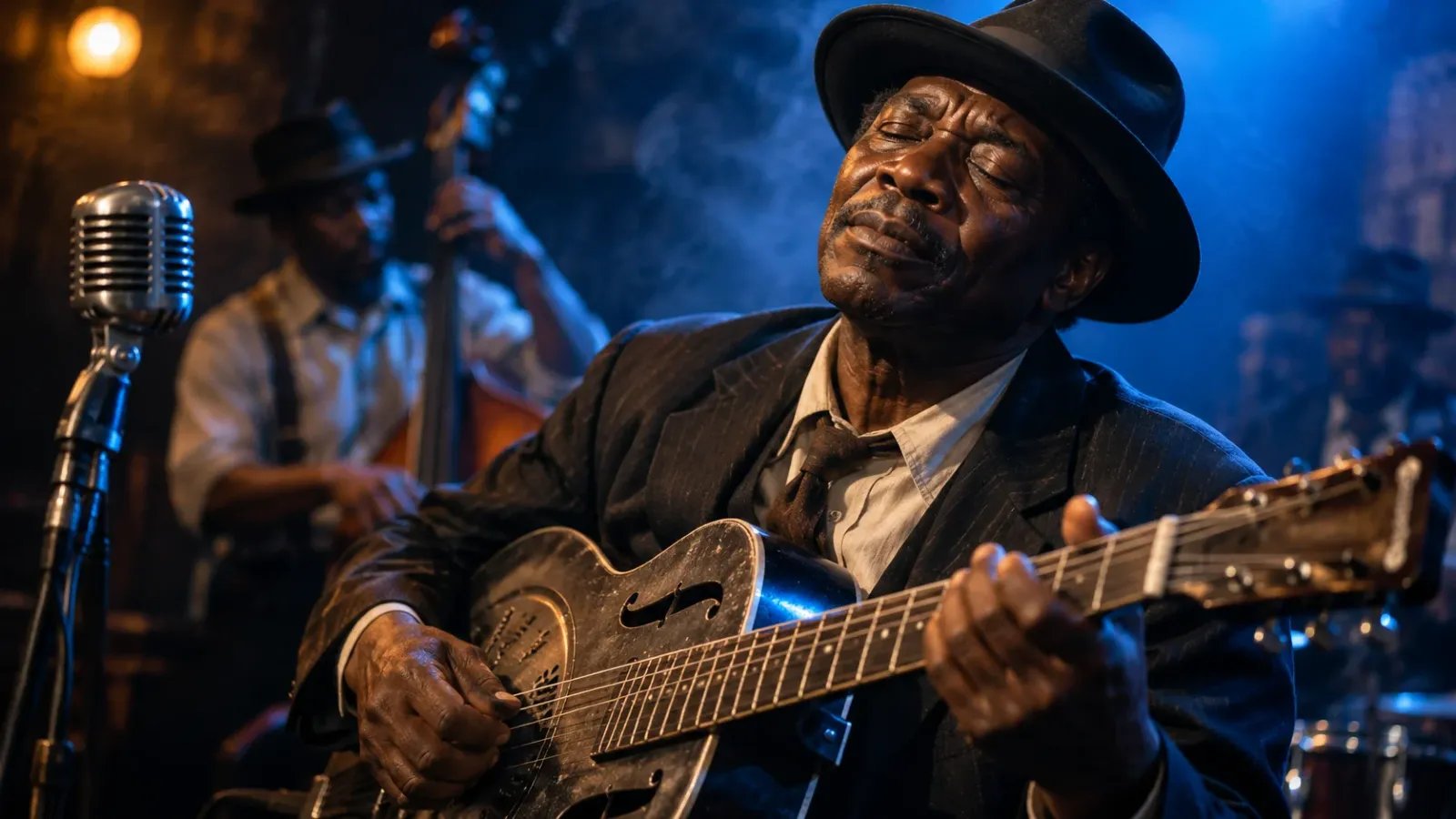
Blues is the actual blueprint of modern music. Born in the Deep South, it unites African polyrhythms with European harmonics. Far from a basic expression of misery, it is a deeply codified art form that birthed rock, jazz, and hip-hop. This enduring genre shaped the global sonic landscape and cultural history in surprisingly profound, unexpected ways.
1. The origins of the blues are rooted in the unaccompanied vocal traditions of enslaved African Americans, not in instrumental music.
Long before guitars became synonymous with the genre, the musical foundation was laid by field hollers, work songs, and spirituals sung on Southern plantations. These unaccompanied vocal traditions relied heavily on call-and-response patterns, a direct retention of West African musical practices. Workers used these rhythmic chants to pace their grueling labor and communicate across vast fields in ways overseers could not always decipher. As emancipation brought new freedoms and mobility, these vocal expressions gradually merged with the European folk instruments available at the time. This fusion birthed the distinctive, instrumental-vocal dialogue that defines traditional blues music today.
2. The genre is mathematically defined by a unique twelve-bar chord progression that defies standard European classical structures.
While many forms of popular music rely on seemingly endless chord variations, the quintessential blues structure restricts itself to a specific sequence of only three chords over twelve bars. This progression typically utilizes the tonic, subdominant, and dominant chords, cycling in a repetitive, hypnotic loop. Rather than creating monotony, this rigid framework forces musicians to rely on extreme emotional expression, vocal inflection, and instrumental improvisation to keep the music engaging. It is an architectural marvel of constraint that allows for infinite creativity within a strict boundary. This exact twelve-bar progression was later adopted almost verbatim by early rock and roll pioneers, serving as the literal backbone of modern popular music.
3. The famous blue notes responsible for the genre's emotional weight are actually microtonal pitches that do not exist on a standard piano.
Western musical scales are strictly divided into twelve specific semitones, but African musical traditions often utilize pitches that fall somewhere between these established notes. When African-American musicians attempted to replicate these ancestral sounds on Western instruments, they began bending guitar strings and sliding between vocal registers to hit these in-between frequencies. These flattened third, fifth, and seventh notes of the major scale clash beautifully with the underlying major chords, creating a distinct, haunting dissonance. This auditory tension triggers a profound emotional response in the human brain, making the music feel simultaneously sorrowful and triumphant. The physical inability of fixed-pitch instruments like pianos to play these exact microtones led to the invention of the crushed note piano technique to simulate the effect.
4. The Mississippi Delta did not invent the blues in isolation, as the music developed simultaneously across several distinct geographic regions.
A pervasive myth suggests that the genre spontaneously emerged solely from the cotton fields of the Mississippi Delta before spreading outward. In reality, researchers and folklorists have discovered that regional variants of the blues were developing at roughly the same time in Texas, the Piedmont region, and the Deep South. The Texas blues style leaned heavily on virtuosic, swinging guitar picking, while the Piedmont style of the Carolinas incorporated ragtime-based, syncopated fingerpicking. The Delta style simply gained the most historical prominence due to early commercial recording efforts and the intense, percussive nature of its slide guitar playing. The genre was a widespread cultural awakening across the American South rather than a localized invention.
5. The concept of a Devil at the crossroads is actually a misunderstanding of an ancient African trickster deity, not a literal Christian demon.
The legend of a bluesman selling his soul to the Devil at a midnight intersection is one of the most famous myths in modern music history. However, folklorists trace this motif back to the Yoruba religion of West Africa and the deity Legba, who serves as the communicator between humans and gods and resides at crossroads. When enslaved Africans were forced to adopt Christianity, they heavily syncretized their traditional beliefs, and the mischievous Legba was mistakenly conflated with the Christian Satan by outside observers. The blues musicians singing about the crossroads were originally invoking this ancestral trickster spirit for musical mastery and safe passage in a dangerous, segregated world. Over time, the sensationalized, demonic version of the story eclipsed the fascinating cultural preservation hidden within the lyrics.
6. Early blues music was fiercely dominated by female vocalists who achieved massive commercial success long before the famous male guitarists did.
Pop culture often pictures the quintessential blues artist as a lone man singing with a guitar, but the genre was actually brought to national prominence by powerful women. During the 1920s, the Classic Blues era was entirely ruled by female superstars like Ma Rainey, Bessie Smith, and Mamie Smith, who performed in massive vaudeville theaters. These women were the very first to record the genre, backed by early jazz ensembles, and they sold millions of records to both Black and white audiences. Their lyrics boldly tackled taboo subjects like female independence, domestic violence, and sexual freedom, paving the way for modern feminist anthems. The recording industry only shifted its focus to rural, male acoustic guitarists during the Great Depression when it became too expensive to tour with large accompanying bands.
7. The Great Migration transformed the genre from a quiet, acoustic rural tradition into a loud, electrified urban powerhouse.
When millions of African Americans relocated from the oppressive, agrarian South to industrial Northern cities like Chicago and Detroit, they brought their music with them. The raucous, crowded environment of urban nightclubs meant that unamplified acoustic guitars and gentle vocals could no longer be heard over the noise of the crowds and the city. To compete, musicians began plugging their instruments into amplifiers, inventing the aggressively loud, distorted sound known as Chicago Blues. This electrification introduced new instruments to the traditional lineup, cementing the modern band format of electric guitar, bass, drums, and amplified harmonica. Without this sociologically driven technological shift, the heavy, overdriven sounds that later defined hard rock and heavy metal would never have existed.
8. The blues is fundamentally a dance music genre, contradicting its reputation as an exclusively somber, depressing art form.
Modern audiences frequently associate the blues with melancholic introspection, sitting in dimly lit rooms dwelling on heartbreak and misfortune. Historically, however, this music was performed almost exclusively at juke joints, rent parties, and rural picnics for the express purpose of dancing. The driving rhythms, particularly the infectious shuffle and boogie-woogie beats, were designed to help working-class people celebrate, socialize, and physically shake off the hardships of their week. The lyrical content might have detailed tragedy and systemic oppression, but the underlying groove was always inherently uplifting and kinetic. It was a communal mechanism for survival and joy, functioning much like modern electronic dance music does for today's club-goers.
9. The British Invasion of the 1960s essentially saved the genre from fading into American historical obscurity.
By the late 1950s, the primary African-American audience for the blues had largely moved on to newer genres like soul, R&B, and rock and roll. The original acoustic and early electric pioneers were largely forgotten in their home country, often forced to take menial jobs to survive. Ironically, British teenagers discovered imported blues records and became fanatically obsessed with the genre, forming bands that painstakingly replicated the American sound. When these British bands, such as the Rolling Stones and the Yardbirds, toured America, they openly championed their idols, introducing young white American audiences to artists who lived just states away. This international feedback loop sparked a massive folk-blues revival, pulling legendary musicians out of retirement and securing their lasting global legacies.
10. The distinct sliding sound in blues guitar was originally achieved using everyday trash and household items.
The iconic slide guitar technique, which mimics the wailing sound of the human voice, requires a hard, smooth object to glide over the strings. Early rural musicians, lacking access to specialized musical equipment, resorted to using whatever they could find in their immediate, impoverished environments. They broke the necks off glass medicine bottles, polished down heavy brass pipes, or even used the edge of a pocketknife to fret their instruments. Each different improvised material yielded a completely unique tonal resonance, contributing to the highly individualized sonic signatures of early players. Today, musicians purchase manufactured glass or steel slides, but they are merely imitating the resourceful, upcycled innovations of the genre's pioneers.
11. Blues lyrics functioned as a covert communication network that shared vital survival information during the Jim Crow era.
Because African Americans lived under the constant threat of racial violence and strict segregation laws, speaking openly about their grievances was incredibly dangerous. Blues musicians developed a complex system of double entendres, metaphors, and coded slang to communicate their struggles without alerting oppressive authorities. Songs that seemingly complained about a cruel boss, a mean mule, or a natural disaster were often thinly veiled critiques of the sharecropping system, corrupt police, or specific racist politicians. They also shared logistical information, such as which train lines were safe to ride North or which towns to avoid after dark. The music served as an underground sonic newspaper, fostering solidarity and sharing crucial intelligence across isolated rural communities.
12. Hip-hop and rap music owe their lyrical structure and vocal delivery styles directly to early blues traditions.
While the sonic landscapes of a turntable and an acoustic guitar seem worlds apart, the foundational DNA of hip-hop was forged in the blues. The tradition of boasting, where a vocalist exaggerates their own prowess, sexual magnetism, or toughness, is a direct descendant of the bragging blues lyrics of the 1920s and 30s. Furthermore, the rhythmic, spoken-word delivery used in talking blues tracks laid the exact cadential groundwork for modern rapping. Both genres emerged from marginalized African-American communities as raw, unfiltered responses to systemic poverty and social invisibility. Hip-hop artists frequently sample old blues records not just for their beats, but as an homage to the original street reporters of American music.
13. The harmonica became a staple of the genre simply because it was the most affordable and portable instrument available.
Often referred to as a Mississippi saxophone, the harmonica provides some of the most haunting and recognizable melodies in the blues repertoire. Its prominence in the genre was initially a matter of pure economic necessity, as marginalized sharecroppers could rarely afford to purchase or maintain large instruments like pianos or brass horns. A pocket-sized harmonica cost mere pennies through mail-order catalogs and could be carried directly into the fields during long workdays. Musicians eventually discovered that by playing the instrument in a different key than it was designed for, a technique known as cross harp, they could easily produce the microtonal, wailing blue notes. This cheap German folk instrument was entirely reinvented by African-American players to become a vital pillar of the genre.
14. The transition from acoustic to electric blues directly catalyzed the invention of the modern distortion pedal.
When blues guitarists first started using amplifiers, they purposefully pushed the equipment beyond its intended volume limits to create a gritty, sustain-heavy tone. This overdriven sound was initially achieved by literally damaging the speaker cones with razor blades, poking holes in them, or loosening the internal vacuum tubes. Audio engineers recognized that musicians were desperate to harness this aggressive, fuzzy sound without constantly destroying their expensive hardware. In response, technicians developed early solid-state transistor pedals designed to artificially replicate the sound of a failing, overdriven blues amplifier. Without the genre's pursuit of a louder, dirtier tone, the distortion effects that define modern rock, punk, and metal would never have been engineered.
15. Blues music has a measurable, neurological impact that actively reduces anxiety and depression in listeners.
Despite its reputation for being a melancholic genre, psychological studies show that listening to the blues often produces a cathartic, mood-elevating effect. When people hear music that accurately mirrors their own feelings of sadness or frustration, the brain releases prolactin, a hormone associated with comfort and empathy. The predictable, repetitive twelve-bar structure also provides a sense of cognitive safety and grounding, which can significantly lower heart rates and cortisol levels. By externally validating negative emotions rather than avoiding them, the music allows listeners to process their grief in a controlled, rhythmic environment. Ultimately, the blues is scientifically proven to be a therapeutic mechanism for overcoming the very sadness it describes.
Sources & References
This AI-assisted post was rigorously curated and fact-checked for accuracy by:
 Martin Roháček
How fun was this article? 🤔
Tap a star to rate it
🧠 Quiz: How closely were you paying attention?
10 questions — all answers are in the article above!
Enjoyed these facts? There's more! 💌
Fresh fun facts in your inbox. No spam, ever.