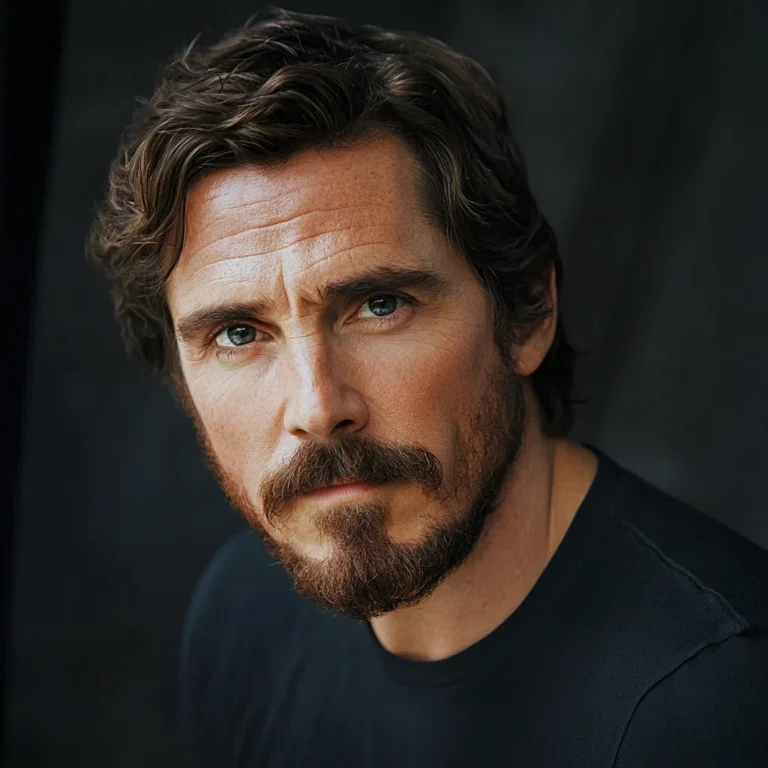
Christian Bale is known worldwide for his intense acting and complete transformations. But beyond his famous roles in Batman or American Psycho, he hides fascinating stories, quirky habits, and unexpected skills. Here are eye-opening insights about Christian Bale that keep fans intrigued long after the credits roll.
Christian Bale
Christian Bale learned to ride a unicycle when he was just a teenager, showcasing his love for unusual skills.
He speaks fluent Spanish, thanks to spending part of his childhood in Portugal and Spain with his family.
Bale almost quit acting before Batman Begins, feeling worn out by Hollywood and its relentless demands.
His first brush with fame came in a cereal commercial when he was only nine years old.
Christian Bale learned to juggle to improve his hand-eye coordination for action scenes, practicing daily during intense training.
He broke bones while filming The Machinist, but continued shooting scenes with extreme discipline.
Bale did not want to be typecast as Batman and often chose unexpected indie projects after blockbusters.
He adopted a South African accent for months on set while filming Rescue Dawn, even off-camera.
Christian Bale has an unusual phobia: he deeply dislikes wearing tuxedos and avoids them whenever possible.
He played drums in his school band and still practices music privately as a creative outlet.
Bale refuses to use email or social media, keeping his private life guarded from the spotlight.
He injured his eye with a sword during filming for Reign of Fire but finished the scene anyway.
Christian Bale often hides references to his Welsh roots by slipping subtle nods to his homeland in interviews.
He once read Moby Dick in one week to mentally prepare for heavy character roles.
Christian Bale credits his father, a pilot and activist, for teaching him resilience and fearlessness from childhood.
How useful was this post?
Click on a star to rate it!
This AI-assisted post was rigorously curated and fact-checked for accuracy by:
Die Hard redefined the action genre with its vulnerable hero and confined setting. It turned Bruce Willis into a global superstar overnight. Furthermore, it created one of the most memorable movie villains in cinema history. Consequently, this holiday classic remains a favorite for millions of fans. Explore these fascinating details about the battle at Nakatomi Plaza.
Die Hard
The studio legally had to offer the role to Frank Sinatra. Decades earlier, he starred in The Detective. Because Die Hard is a sequel to that book, they contractually had to ask him first.
Alan Rickman’s terrified face during his fall was completely real. Sneakily, the stunt coordinator dropped him on the count of two instead of three. Thus, his shock was genuine.
Bruce Willis lost hearing in one ear during filming. He fired a gun too close to his head while under a table. Unfortunately, the loud blank caused permanent damage.
The Nakatomi Plaza is actually the 20th Century Fox headquarters. Interestingly, the studio charged itself rent to use its own unfinished building. This saved them money on set construction.
The German terrorists did not speak real German. In the theatrical version, they spoke nonsense grammar that confused German audiences. Later, the studio dubbed their lines for the home release.
John McClane’s tank top is in a museum. Specifically, the Smithsonian Institute displays the dirty, bloody shirt. It represents a significant piece of American pop culture history.
Filmmakers added the “Bill Clay” scene for a specific reason. They realized Alan Rickman could do a perfect American accent. Therefore, they wrote a scene where he tricks McClane.
Bruce Willis filmed the movie while working a second job. He shot the TV show Moonlighting during the day. Then, he rushed to the movie set to film Die Hard at night.
Clint Eastwood originally owned the rights to the movie. He planned to star in it years earlier. However, he eventually dropped the project, which allowed Willis to take the part.
The glass scene used special candy glass. However, Willis also wore fake rubber feet. These prosthetic feet protected him while making it look like he was barefoot.
The famous “Yippee-ki-yay” line was a joke. Willis said it to make the crew laugh. Unexpectedly, the director loved it and kept it in the final cut.
Audience testing changed the ending. Originally, the terrorists escaped in an ambulance. However, audiences hated that the bad guys got away, so the writers changed the script.
The teddy bear appears in another famous movie. Director John McTiernan used the same bear in The Hunt for Red October. It sits on the shelf of Jack Ryan’s daughter.
Studio executives hid Bruce Willis’s face on the poster. At the time, they thought an action movie with a comedy TV star would flop. Later, they added his face after the film succeeded.
Finally, the script was based on a book called Nothing Lasts Forever. The novel features a much darker ending. In the book, the hero’s daughter dies when she falls from the building.
he Intouchables (Intouchables) charmed the world with its heartwarming story of an aristocrat and his caregiver. Initially, it seemed like a modest French comedy, but it quickly exploded into a global phenomenon that broke box office records. Furthermore, the chemistry between François Cluzet and Omar Sy turned a simple script into a masterpiece of modern cinema. Consequently, the film remains a definitive example of how humor can bridge the widest cultural gaps. Explore these fascinating details about the movie that made the world laugh and cry.
Intouchables
Actually, the story is based on two real men. Specifically, the script adapts the true friendship between Philippe Pozzo di Borgo and Abdel Sellou. Later, the directors discovered their story in a 2003 documentary. Immediately, they felt compelled to turn it into a feature film.
Surprisingly, the real caregiver was Algerian, not West African. In fact, Abdel Sellou is from Algeria. However, the directors changed the character’s background to Senegalese to cast Omar Sy. Ultimately, they felt his energy was perfect for the role, even if it meant altering the biography.
Crucially, Philippe insisted the movie must be a comedy. When the directors approached Philippe, he had one strict condition. Specifically, he did not want a depressing drama about his disability. Therefore, he told them he would refuse the project if the movie was not funny.
Remarkably, Omar Sy became the first Black actor to win a César for Best Actor. His electrifying performance as Driss earned him France’s equivalent of an Oscar in 2012. Historically, he beat out Jean Dujardin, who had previously won the actual Academy Award for The Artist.
Believe it or not, the opening car chase actually happened. The scene where Driss speeds through Paris in a Maserati is not Hollywood fiction. In reality, Abdel Sellou really did drive Philippe’s luxury cars at dangerous speeds. Frequently, they used Philippe’s disability to get out of speeding tickets.
Impressively, Omar Sy choreographed the famous dance scene himself. During the birthday party scene, Driss dances to “Boogie Wonderland.” The directors simply asked Sy to just “feel the music.” Consequently, he improvised the entire routine on the spot without a professional choreographer.
Eventually, it became the most successful French film in history. Upon its release, The Intouchables shattered records. Also, it became the most-viewed French movie outside of France. Ultimately, it grossed over $400 million worldwide, surpassing the previous record-holder, Amélie.
Symbolically, the title refers to the lowest caste in India. Specifically, the word “Intouchables” draws a parallel to the Dalit caste. The directors chose this title to symbolize that both men were cast aside. Effectively, society rejected one for his disability and the other for his social status.
Generously, 5% of the profits went to a charity. The producers and Philippe agreed to donate a portion of the box office earnings to Simon de Cyrène. Notably, this organization builds shared homes where able-bodied and disabled people live together in community.
Authentically, the actors used a real Maserati Quattroporte. The production used the high-end Italian sports car for the driving sequences. However, they used a stunt vehicle for aggressive jumps. Wisely, this prevented them from destroying the expensive luxury car.
Musically, Ludovico Einaudi composed the hypnotic soundtrack. The Italian composer provided the piano-heavy score that gave the film its emotional weight. Soon, tracks like “Una Mattina” became inseparable from the movie’s identity. Consequently, they saw a massive spike in popularity on streaming platforms.
Admittedly, the “No arms, no chocolate” joke was risky. The famous line is a dark joke well-known in France. Initially, the directors worried it might be too offensive. Yet, the real Philippe loved it because it reflected their ruthless, pity-free humor.
Later, Abdel Sellou wrote his own memoir after the film. After seeing the movie’s success, the real-life “Driss” wrote a book titled You Changed My Life. In it, he admitted that he was even more reckless in his youth than the movie portrayed.
Inevitably, Hollywood remade the film as The Upside. In 2017, an American version starred Kevin Hart and Bryan Cranston. Surprisingly, it performed well financially. However, critics felt it failed to capture the unique magic of the French original.
Touchingly, the real men remained best friends until the end. The end credits show footage of the real Philippe and Abdel together. Happily, they stayed close for decades. For example, Abdel often visited Philippe in Morocco until Philippe passed away in June 2023.