1. The Real-Life Inspiration’s One Demand
Before giving the directors his blessing to adapt his life story, the real Philippe Pozzo di Borgo had one strict, non-negotiable demand: the movie had to be a comedy. Having lived through unimaginable tragedy following a paragliding accident and the death of his wife, he was adamant that he did not want a movie that would make audiences pity him, insisting that his relationship with his caregiver was built on relentless humor and pranks.
2. Driss’s Origins Were Changed for the Film
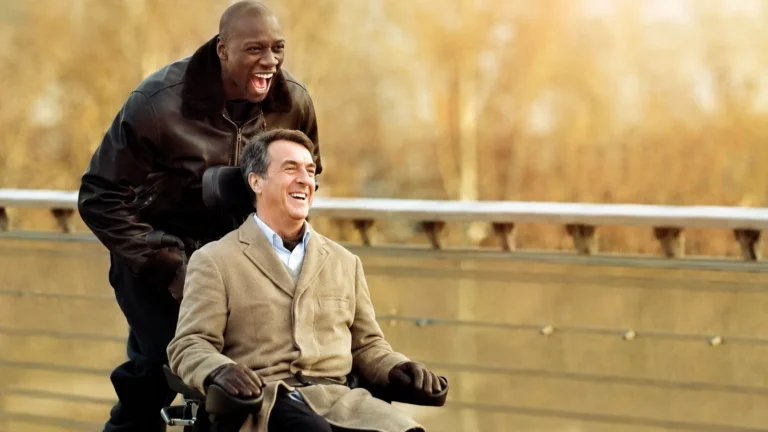
In the movie, the energetic caregiver Driss is of Senegalese descent, brought to life brilliantly by Omar Sy. However, the real-life caregiver, Abdel Sellou, is actually of Algerian descent. The directors specifically changed the character’s background because they had worked with Sy on a previous project, knew his immense comedic talent, and explicitly wrote the part of Driss with him in mind.
3. Omar Sy Beat Out an Oscar Winner
The film launched Omar Sy into international superstardom, and his performance earned him the César Award for Best Actor (the French equivalent of the Academy Award). What makes this win so spectacular is that he actually beat out Jean Dujardin for the award in the exact same year that Dujardin won the American Oscar for Best Actor for his role in The Artist.
4. A Record-Breaking Global Box Office
The Intouchables was not just a hit in France; it was an absolute global phenomenon. For a significant period of time, it held the record as the highest-grossing non-English language film in cinematic history. It generated over $400 million worldwide, easily surpassing the previous record holder, Hayao Miyazaki’s animated masterpiece Spirited Away.
5. Acting From the Neck Up
To prepare for the physically restrictive role of Philippe, veteran French actor François Cluzet spent extensive time observing the real Philippe Pozzo di Borgo. Cluzet had to learn how to completely suppress his natural body language, training himself to act entirely through his breathing, eye movements, and vocal inflections since he could not use his hands or torso to convey any emotion.
6. The Real Men Appear at the End
The movie ends with a beautiful, poignant tribute to the real men who inspired the story. Just before the final credits roll, the real Philippe Pozzo di Borgo and Abdel Sellou make a brief, silent cameo appearance, sitting together on a hillside. This beautiful inclusion grounded the hilarious movie back in its profound, real-world roots.
7. The Meaning Behind the Title
The title Intouchables translates to “Untouchables,” but it is rarely explained in the film itself. It is a dual reference to the Indian caste system, symbolizing how both men are outcasts from mainstream French society. Philippe is “untouchable” due to his severe physical disability and extreme wealth isolating him, while Driss is “untouchable” due to his extreme poverty, racial minority status, and criminal record.
8. The Shaving Scene Was Completely Improvised
One of the most hilarious and memorable scenes in the film involves Driss shaving Philippe’s beard into various historical and bizarre styles, ending with a Charlie Chaplin/Adolf Hitler mustache. This sequence was not in the original script. François Cluzet and Omar Sy completely improvised the entire interaction on set, and their genuine, uncontrollable laughter made the final cut.
9. Driss’s Dancing Was Also Unscripted
Omar Sy’s legendary dance sequence to Earth, Wind & Fire’s “Boogie Wonderland” during Philippe’s stuffy birthday party is a cinematic highlight. The directors simply played the music on set and told Sy to let loose. The joyous, infectious dance moves were entirely his own creation in the moment, perfectly capturing his character’s unbridled love for life.
10. A Staggering Number of International Remakes
The universal themes of the film resonated so deeply across different cultures that it spawned numerous international remakes. The most famous is the American version, The Upside (2017), starring Bryan Cranston and Kevin Hart. However, it was also officially remade in India (as the Telugu/Tamil film Oopiri), and in Argentina (as Inseparables).
11. The Real Abdel Actually Sold Art
In the film, Driss paints a chaotic, abstract canvas that Philippe manages to sell to a pretentious art collector for a massive sum of money as a prank. Surprisingly, this is based on a true anecdote. The real Abdel Sellou did indeed paint a canvas that Philippe managed to sell, though the real-life Abdel later admitted he felt a bit guilty about scamming the buyer.
12. A Slower Maserati for the Cameras
The exhilarating opening sequence features Driss driving Philippe at breakneck speeds through the streets of Paris in a Maserati Quattroporte. While the scene looks incredibly fast, the production team actually had to digitally speed up the footage in post-production because the real car could not be driven at those highly dangerous speeds through the narrow city streets during filming.
13. Over Five Percent of France Saw It In Theaters
The cultural impact of the film in its native country is hard to overstate. Just weeks after its release, it was estimated that an astonishing 5% of the entire population of France had gone to the cinema to see it. It eventually sold over 19 million tickets domestically, making it the second most successful French film of all time in France, just behind Welcome to the Sticks.
14. The Missing Fabergé Egg Was Real
A crucial plot point involves Driss stealing a highly valuable Fabergé egg during his initial job interview, which Philippe later demands he return. This detail was pulled directly from real life. The real Abdel Sellou admitted to stealing a precious Fabergé egg from Philippe’s estate because he assumed he would never see the wealthy man again after his interview.
15. Real-Life Neighbors Who Remained Close
Unlike the movie, which heavily dramatizes their parting of ways, the real Philippe and Abdel remained incredibly close friends for decades after Abdel stopped working as his full-time caregiver. When Philippe relocated to Morocco, Abdel also eventually bought a house nearby, ensuring that the two men and their respective families could continue to spend time together.