15 Surprising Facts About Kansas
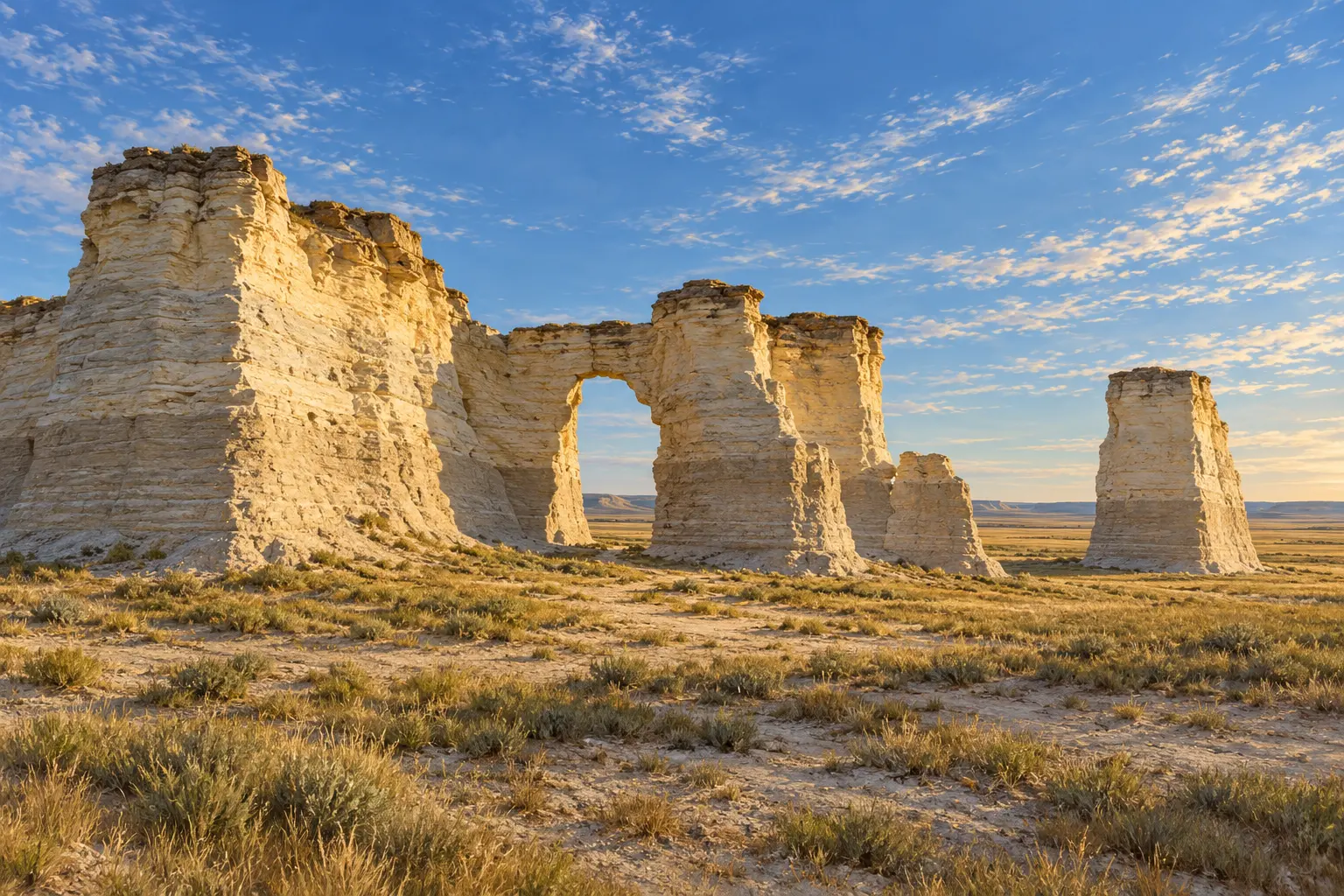
A gas well that refused to burn, a fossilized meal, and a mayoral prank that backfired: Kansas rewards a closer look at its familiar stories.
1. A failed gas-well celebration led scientists toward helium
Dexter residents expected a spectacular flame when they celebrated a new gas well in 1903. Instead, the gas extinguished the burning material brought near it. University of Kansas investigators found a mixture dominated by nonflammable nitrogen, with relatively little methane. In 1905, Hamilton Cady and David McFarland identified a significant helium component in the sample. The disappointing fuel discovery helped reveal natural gas as a practical source of helium. The nitrogen-rich mixture explains the failed flame; helium's presence was the important additional finding.
2. A Kansas fossil preserves a fish's enormous last meal
In 1952, George F. Sternberg discovered a remarkably complete Xiphactinus fossil in Gove County. Inside the roughly 14-foot predator lay a Gillicus about six feet long. The smaller fish's bones show little evidence of digestion, indicating that the predator died soon after swallowing it. The specimen records a real feeding event in the Cretaceous sea that once covered western Kansas. An ancient meal that would normally vanish through digestion remained enclosed by the predator's ribs, making the interaction visible in stone.
3. A prank helped elect America's first woman mayor
In Argonia in 1887, men opposed to women's political activity put Susanna Madora Salter's name on an election ticket without telling her. They expected an embarrassing defeat. When supporters asked whether she would serve if elected, she agreed—and won about two-thirds of the vote. Kansas women had only recently gained voting rights in municipal elections. The 27-year-old Salter became the first woman elected mayor in the United States, turning an attempt to ridicule local women into an unexpected political victory.
4. The Topeka school challenge involved 13 parents and 20 children
Brown v. Board of Education is often remembered through Linda Brown and her father Oliver, but the Topeka challenge was organized by the local NAACP on behalf of 13 parents and 20 children. The National Park Service describes the Black schools' facilities and teacher pay as comparable to the city's white schools. The challenge attacked compulsory racial separation itself and the exclusion of children from neighborhood schools. The U.S. Supreme Court ruled against racial segregation in public education in 1954.
5. Cawker City's giant twine ball became a community project
Frank Stoeber began winding leftover agricultural twine into a ball on his farm in 1953. Neighbors contributed their own, and the growing object moved into Cawker City in 1961. After Stoeber's death, the community kept adding to it, including through a Twine-A-Thon. A farmer's habit of saving baling string became a participatory local tradition. Each addition keeps an object made from discarded farm material at the center of the town's annual gathering.
6. Hard-to-plow rock helped preserve tallgrass prairie
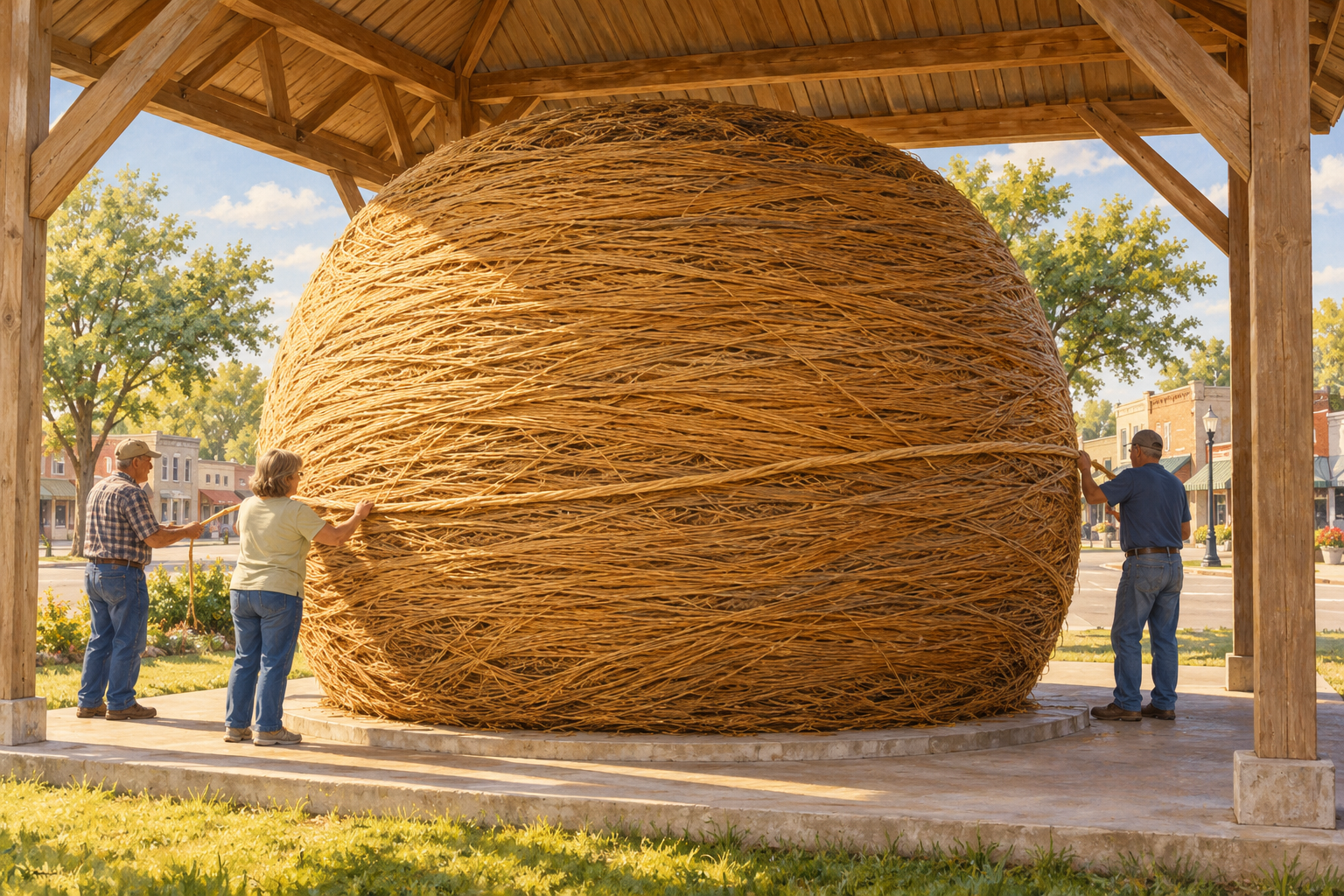
The Flint Hills' shallow limestone, shale, and chert made much of the landscape difficult to plow. That obstacle helped protect prairie that was converted to cropland elsewhere. At Tallgrass Prairie National Preserve, fire and grazing remain important parts of managing the grassland. In 2009, 13 bison from South Dakota's Wind Cave National Park were introduced to start a conservation herd. The surviving prairie reflects geology as well as generations of human decisions about burning, grazing, and land use.
 You might also like
The Ice-Cold Legend: 15 Fascinating Facts About Joe Montana
7. A railway bypass changed the future of Nicodemus
Black settlers, many formerly enslaved and arriving from Kentucky, began building Nicodemus in 1877. The town developed stores, churches, a post office, and other businesses, becoming a center for a wider farming community. Hopes rose that a railway would bring lasting growth. In 1887, the Missouri Pacific bypassed Nicodemus, and nearby Bogue gained the station and some of its businesses. Nicodemus endured despite the economic setback, with descendants maintaining its history and homecoming traditions. A missing rail connection helped shape the town that survives.
8. A salt mine became a storage site for Hollywood material
Hutchinson's room-and-pillar salt mining left extensive underground chambers about 650 feet below the surface. In 1959, Underground Vaults and Storage began using mined-out space for secure storage. The collections have included film, costumes, art, and business records, placing entertainment-industry material in an unlikely Kansas setting. The Strataca museum, opened in 2007, occupies another part of the underground world. Mining created the space; controlled storage and museum exhibits gave portions of it new purposes.
9. A retired Kansan turned his yard into a concrete argument
Starting in 1907, retired teacher and Civil War veteran Samuel P. Dinsmoor built his Garden of Eden in Lucas. Around a limestone house made to resemble a log cabin, he created cement trees and figures mixing biblical scenes with his Populist politics. One group represents Labor crucified, with a lawyer, doctor, preacher, and banker among the surrounding figures. Dinsmoor's own guide explained the symbolism. By 1927, he reported using more than 113 tons of cement: a personal worldview made into a walk-through environment.
10. A Kansas survey station helped anchor continental maps
Meades Ranch became the origin of the United States Standard Datum in 1901, providing a fixed reference for a growing survey network. Canada and Mexico adopted the framework in 1913, and it became the North American Datum. The station's assigned position was retained in the later 1927 adjustment. That shared survey reference helped connect maps drawn across national borders. Changing the reference framework can change a place's listed coordinates even when the place itself has not moved.
11. Greensburg's hand-dug well survived the 2007 tornado
Built in 1887–1888, Greensburg's Big Well reached about 109 feet deep and 32 feet across. Local crews dug the shaft and used stone hauled from the Medicine River area to line it. It supplied the town and steam-era railway needs before becoming a visitor attraction in 1939. The devastating 2007 tornado destroyed the surrounding museum, but the well itself survived. Its history joins nineteenth-century water engineering with the later rebuilding of a community whose landmark lay mostly underground.
12. Pizza Hut's founders recruited an airman for their recipe
Dan and Frank Carney opened their first Pizza Hut in Wichita in 1958 with $600 borrowed from their mother. But they also needed someone who knew how to make pizza. In a later Wichita State interview, Frank recalled recruiting John Bender, an airman at McConnell who knew their family through an apartment complex. Bender brought the recipe and was offered a job and a third of the business. The familiar two-brother origin story included another contributor's practical cooking knowledge.
13. Railroads recruited farmers for the Kansas wheat belt
Kansas's agricultural growth was also a transportation business strategy. Railroad companies recruited skilled German-speaking farmers from the Russian Empire, hoping that new communities would produce grain and other goods to ship. Mennonite and Volga German Catholic immigrants brought experience with prairie farming in similar climates. They helped winter wheat thrive in Kansas. Farming knowledge moved with the families, while successful harvests supplied the grain traffic that the companies hoped to carry.
14. Amelia Earhart's childhood experiments included a homemade roller coaster
Before her aviation career, Amelia Earhart tested a very different ride in Kansas. Accounts of her Atchison childhood describe a homemade roller-coaster ramp attached to the family's tool shed in 1904. She rode down in a wooden box, and the experiment ended in a crash. The Kansas Historical Society connects the idea to a coaster she had seen at the St. Louis World's Fair. The story offers a small, unruly glimpse of the curiosity that preceded her years of formal flight training and record-setting journeys.
15. Kansas players won Olympic basketball gold on a muddy outdoor court
Six members of the McPherson Globe Refiners joined the U.S. team for basketball's first Olympic medal tournament in 1936. The Refiners were sponsored by a Kansas oil refinery, part of an industrial-team sporting culture far removed from today's NBA-centered Olympics. In Berlin, games took place outdoors on clay courts. Rain turned the final against Canada into a muddy, low-scoring contest that the United States won 19–8. Four Refiners played in that final, connecting a Kansas company team directly with the first Olympic basketball gold.
How did these facts land?
Know someone who'd love these facts? Share them 👇