A White House Library and a Bathtub Hoax: 15 Facts About Millard Fillmore
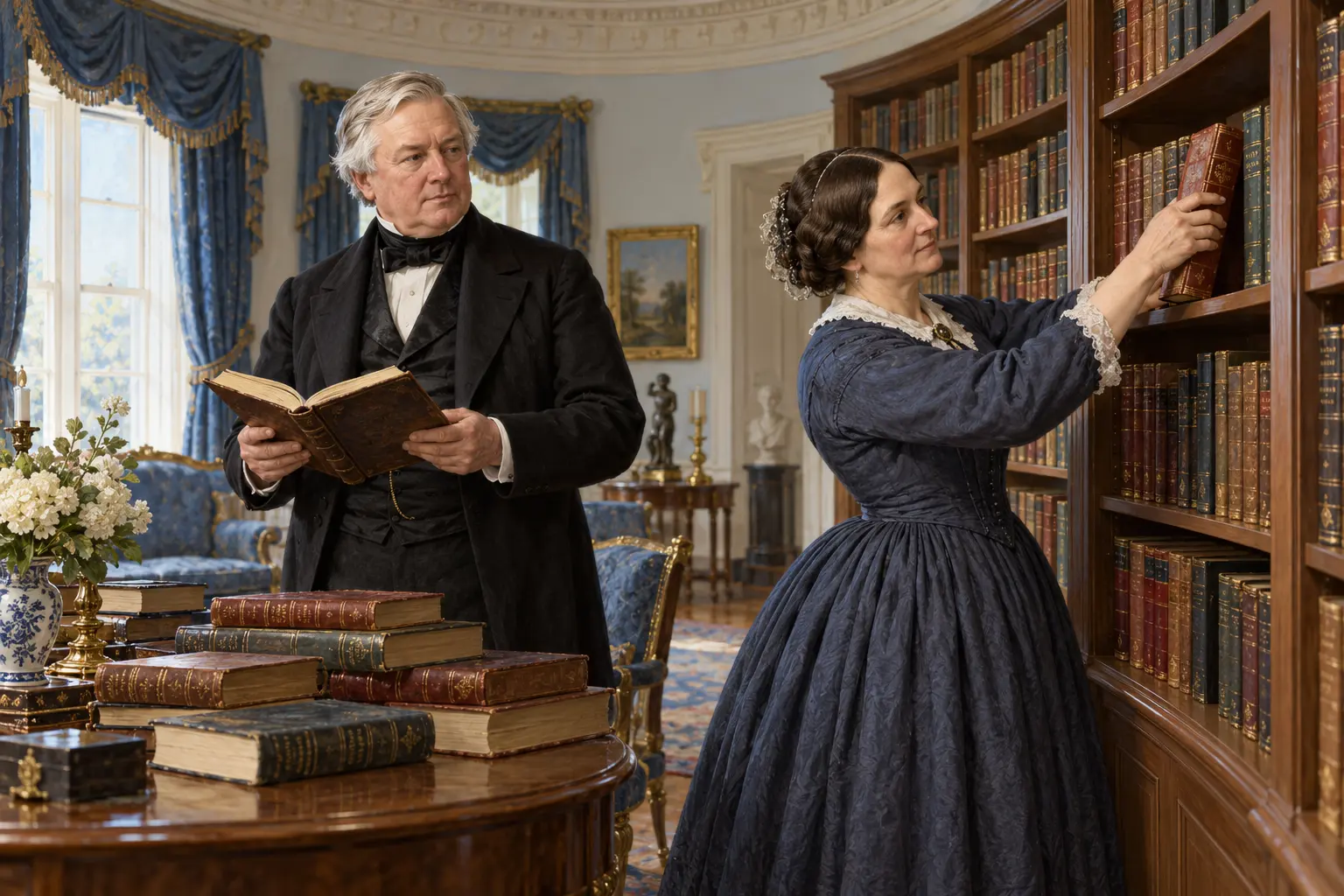
Millard Fillmore's story runs from a cloth-making apprenticeship to a White House library fitted around curved walls. His papers include a surprisingly ordinary champagne order, while his name became attached to one of America's most durable historical hoaxes. His presidency also left a much graver documentary record: orders to enforce slavery's reach into free states.
1. He bought a dictionary while working as a cloth-making apprentice
As a teenager, Fillmore hated the exhausting apprenticeship his father had arranged with a cloth maker. Determined to educate himself, he spent scarce money on a dictionary and studied when he could. He eventually borrowed thirty dollars to leave the apprenticeship and walked roughly a hundred miles home. The future lawyer's route out of manual work began with stubborn self-education.
2. His future wife first knew him as her student
In 1819, nineteen-year-old Fillmore attended New Hope Academy, where twenty-one-year-old Abigail Powers taught. Their courtship continued as he studied, taught school himself and prepared for the law. They married in 1826. Abigail continued teaching after marriage, long before the couple's later move to the White House, and remained an important intellectual companion.
3. The family library needed bookcases built around curved walls
Abigail Fillmore encouraged her husband to request money for a White House library, and Congress provided $2,000. Bookcases were fitted to the curved walls of the upstairs oval parlor, now the Yellow Oval Room. The space became a family retreat and a setting for political conversation and music. Its furniture included custom work by Washington cabinetmaker William Cripps.
4. The Fillmore White House had three pianos
The family made music a prominent part of home life. Abigail ensured that the White House had a music room and three pianos; she played duets with daughter Mary Abigail, who also played harp and guitar. The daughter, known as Abbie, was only eighteen when she entered the White House and sometimes handled hostess duties when her mother's health prevented it.
5. His famous bathtub achievement was invented decades after his death
The claim that Fillmore installed the first White House bathtub came from H. L. Mencken's fabricated history of bathing, published in 1917. Mencken admitted the hoax in 1926, but it kept circulating as fact. The Early American Industries Association later checked its supposedly authoritative details against directories and records, exposing invented people, businesses and controversies behind the convincing narrative.
6. Congress asked him to settle an architectural argument
In 1851, senators wanted new wings at the north and south ends of the Capitol, while the House preferred a single addition to the east. Unable to agree, they turned to Fillmore. He chose the two-wing design. He also favored a Senate chamber with windows, fresh air and pleasant views; a later administration moved the chamber into its wing's center instead.
 You might also like
The Unconventional President: 15 Fascinating Facts About Jimmy Carter
7. He went to help when the Library of Congress caught fire
On Christmas Eve 1851, fire swept through the Library of Congress in the Capitol. Fillmore joined lawmakers and other officials who gathered to offer assistance. About 35,000 volumes were destroyed, including nearly two-thirds of Thomas Jefferson's former collection. A faulty chimney flue was blamed. The disaster led to new library quarters built with fireproof iron rather than vulnerable wood.
8. He challenged a treaty that reserved privileges for Christians
A proposed 1850 treaty with Switzerland promised certain privileges there only to Christian Americans. When submitting it to the Senate in February 1851, Fillmore called the religious distinction a decisive objection. He argued that a privilege secured for one American citizen must be secured for all, rather than left to individual Swiss cantons to extend at their discretion.
9. He ordered citizens to help recapture a man rescued from slavery
After Black Bostonians rescued Shadrach Minkins from federal custody in February 1851, Fillmore issued a proclamation demanding assistance in recapturing him and prosecuting those who helped. The order reveals how actively his administration enforced the Fugitive Slave Law he had signed. The resistance succeeded in getting Minkins away, despite presidential insistence that officials and citizens uphold the law.
 US Presidents
Discover the eccentricities, secret talents, and surprising hidden lives of America's most influential presidents, from frontier wrestlers to covert strategists.
See All Facts
10. He also contributed to a coachman's effort to free his family
White House coachman William Williams had bought his own freedom, but his relatives remained enslaved and faced removal from Washington. An 1850 newspaper account describes Fillmore providing travel money and joining a subscription to help purchase their freedom. A surviving bill of sale differs from the newspaper on the amounts involved, so the exact figures should be treated cautiously.
11. His party took fifty-three ballots to choose someone else
Fillmore sought the Whig presidential nomination in 1852 while his own secretary of state, Daniel Webster, also competed for it. Neither could secure the delegates needed to win. Webster's supporters gradually shifted toward General Winfield Scott, who finally prevailed on the fifty-third ballot. The sitting president thus lost his party's nomination before the general election even began.
12. His letter reached Japan after he had left office
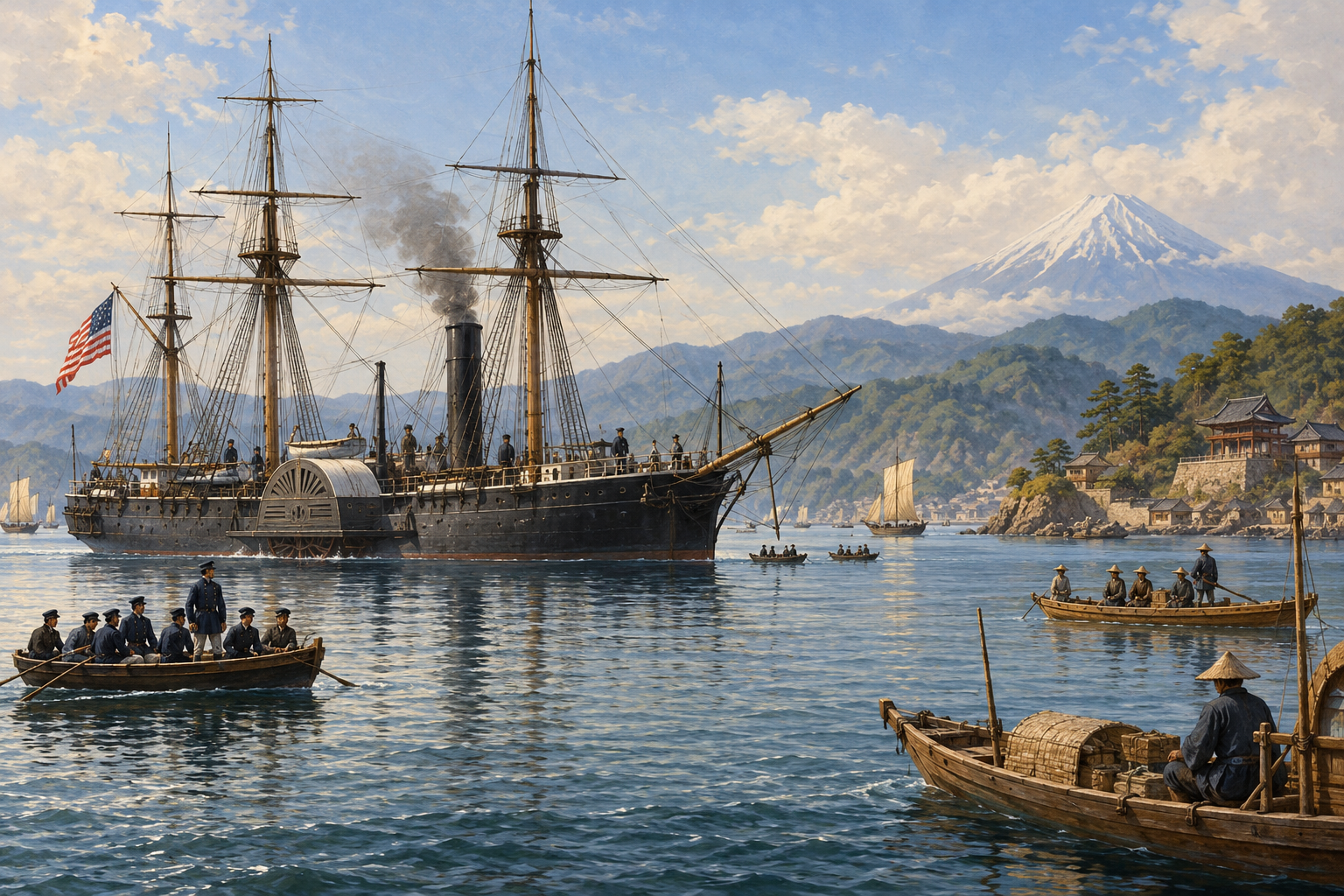
Fillmore dispatched Matthew Perry's expedition to Japan, but Perry arrived in July 1853, months after Franklin Pierce became president. The letter he carried addressed Japan's emperor, although effective power lay with the Tokugawa shogunate. The resulting Treaty of Kanagawa was signed in 1854. Fillmore launched the initiative; its crucial encounters and agreement occurred under his successor.
13. His comeback won one state despite more than a fifth of the vote
In 1856, Fillmore ran for president as the candidate of the American Party, better known as the Know-Nothings, which drew support from hostility to immigration and Catholicism. He won more than twenty percent of the popular vote but carried only Maryland. James Buchanan won the presidency, and Fillmore never again sought public office.
14. He remained a university chancellor while serving as president
Fillmore helped found the University of Buffalo and held its largely ceremonial chancellorship from 1846 until his death in 1874, including his White House years. The connection later became controversial: in 2020, the university removed his name from part of its Ellicott Complex because of his support for the Fugitive Slave Act. His civic legacy and presidential record remained inseparable.
15. One surviving letter orders six quarts of champagne
Presidential archives preserve everyday errands alongside affairs of state. The House's guide to Fillmore manuscripts identifies a December 2, 1873, letter to Buffalo grocer Edward Jehle ordering six quarts of Mumm champagne. The order does not tell us who would drink it, but it offers an unusually specific glimpse of the former president's private household shortly before his death.
How did these facts land?
Know someone who'd love these facts? Share them 👇