The Austrian Masterpiece: 15 Fascinating Facts About Silent Night
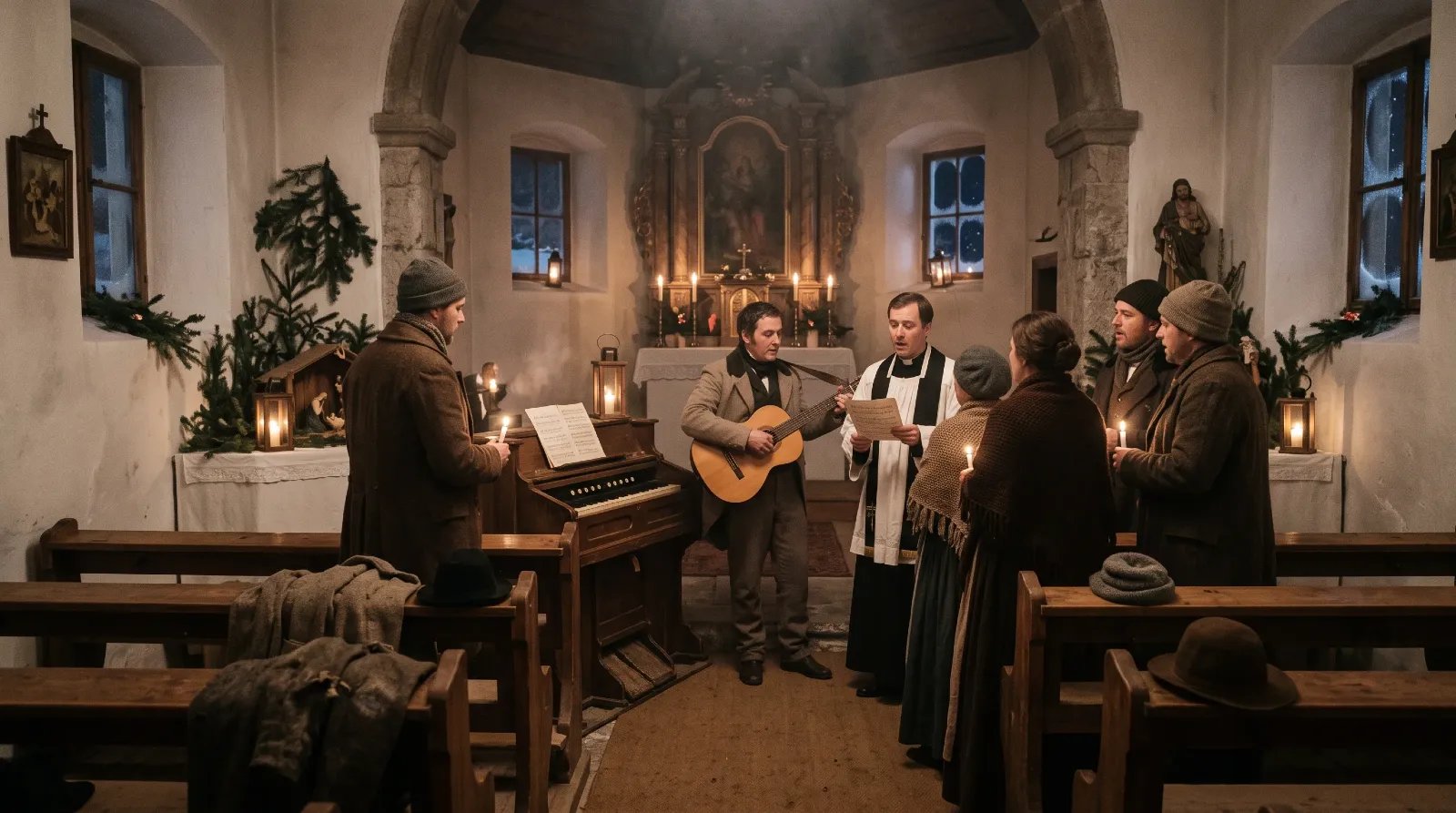
Forget the myth that a broken organ forced the hasty creation of "Silent Night" on Christmas Eve. This haunting carol was actually a deliberate collaboration between a resilient priest and a gifted headmaster during a European crisis. Prepare to uncover the obscure history, global impact, and unlikely survival of this iconic Austrian masterpiece.
1. Joseph Mohr actually wrote the lyrics as a poem in 1816, two years before the song was ever performed.
Most people assume the lyrics and melody were penned simultaneously in a frantic rush before midnight mass. In truth, the young priest Joseph Mohr composed the six-stanza poem "Stille Nacht" while stationed at a pilgrim church in Mariapfarr, Austria. He was deeply moved by the aftermath of the Napoleonic Wars, which had devastated the region and left its people starving and traumatized. It was not until he was transferred to St. Nicholas Church in Oberndorf in 1818 that he brought the poem to his friend Franz Xaver Gruber, asking him to compose a fitting melody for two solo voices, choir, and guitar. The delay between the lyrics and the music reveals a careful, meditative creative process.
2. The guitar accompaniment was a deliberate choice, not an emergency backup.
The enduring legend claims that a mouse gnawed through the bellows of the St. Nicholas church organ, leaving the congregation in silence. However, historical evidence suggests Mohr intentionally requested a guitar arrangement because he wanted a simple, portable tune that could be sung outside the formal liturgical mass. The guitar was heavily associated with tavern music and folk songs at the time, making its use in a Catholic service highly unusual and subtly rebellious. This deliberate choice helped ground the song in the vernacular of the common people rather than the high art of the church elite.
3. Franz Xaver Gruber composed the original melody in a lively 6/8 time signature meant to resemble a siciliana dance.
Modern renditions of the carol are almost universally performed as slow, melancholic lullabies that stretch out the tempo. Gruber's original 1818 manuscript, however, indicates a moderate, lilting pace akin to a traditional Italian siciliana. This rhythmic structure gave the piece a gentle but distinctly buoyant groove, designed to lift the spirits of a war-weary congregation rather than put them to sleep. Over decades of oral transmission and international adaptation, the tempo gradually slowed down to the solemn, reverent dirge we recognize today. Strikingly, early audiences would have likely swayed to the music rather than stood in quiet reverence.
4. Master organ builder Karl Mauracher discovered the sheet music while fixing the church's organ and took it back to his home region.
If not for a routine maintenance call, the carol might have died in obscurity within the parish limits of Oberndorf. In 1819, Karl Mauracher arrived to rebuild the church organ and was captivated by the sheet music Gruber and Mohr had left behind. He took a copy of the composition back to the Zillertal valley, a region famous for its traveling folk-singing families. These itinerant musicians integrated the song into their winter repertoires, acting as the crucial catalyst that propelled the local hymn onto the international stage.
5. The Strasser and Rainer singing families performed the carol across Europe and the United States, popularizing it as a Tyrolean folk song.
Before the era of recorded music, the Rainer and Strasser families operated much like modern pop stars, touring extensively in traditional Alpine costumes. They learned the song from Mauracher and began singing it for European nobility, eventually bringing it to an audience of Russian Tsar Alexander I and Emperor Franz I of Austria. In 1839, the Rainer family debuted the song in the United States outside Trinity Church in New York City. Because they rarely credited the original composers, the song was widely misattributed for decades as an anonymous Tyrolean folk melody. It took decades of historical research to finally restore proper credit to the original Austrian creators.
6. King Frederick William IV of Prussia loved the song so much that he ordered his Royal Concert Master to track down its creators in 1854.
By the mid-19th century, the carol was a massive hit across the Germanic world, but rumors swirled that it was the work of Michael Haydn or even Ludwig van Beethoven. The King of Prussia, desperate to know the true origins of his favorite Christmas tune, dispatched investigators to the Austrian city of Salzburg. The inquiry eventually reached the St. Peter's Abbey choir, where Franz Xaver Gruber's son happened to be a member. The son directed the royal investigators to his father, who subsequently penned a document titled "Authentic Reason for the Composition of the Christmas Carol," finally securing his rightful place in history.
 You might also like
The Clowns of the Sea: 15 Fascinating Facts About Puffins
7. The standard English version of the song translated by John Freeman Young includes only three of Mohr's original six stanzas.
When Episcopal priest John Freeman Young translated the lyrics in 1859, he selected only verses one, six, and two from the original German manuscript. The omitted stanzas contain profound reflections on Christian theology, universal brotherhood, and the specific historical despair of post-war Austria. One missing verse explicitly praises Jesus for bringing peace to a world plagued by the wrath of the times, a direct nod to the recent Napoleonic devastation. Young's distillation successfully crafted a gentle nativity scene but stripped the carol of its historical and political urgency.
8. The carol triggered the legendary Christmas Truce of 1914 when German soldiers began singing it from their trenches.
Amidst the horrific carnage of the First World War, the universally recognized melody of "Stille Nacht" served as a rare bridge between warring nations. On Christmas Eve in Flanders, German troops placed candles on the edges of their trenches and began singing the carol in their native tongue. British soldiers, recognizing the tune, responded by singing the English lyrics back across No Man's Land. This impromptu musical exchange culminated in soldiers abandoning their weapons, meeting in the center to exchange rations, play football, and bury their dead in a fleeting moment of shared humanity. Sadly, military commanders strictly forbade any future fraternization, making this musical armistice a singular historical event.
9. St. Nicholas Church in Oberndorf was demolished in the early 20th century due to severe and repeated flooding from the Salzach River.
History buffs hoping to visit the exact spot where the carol debuted are often disappointed to learn that the original structure is gone. The Salzach River, which forms the border between Austria and Germany, repeatedly overflowed its banks, causing irreparable structural damage to the church's foundation. By 1906, the town decided to demolish the unsafe building and relocate the parish center to a higher, safer elevation. Today, a small octagonal memorial chapel known as the Stille-Nacht-Kapelle stands roughly on the site of the original church's altar.
10. Bing Crosby's 1935 rendition of the carol became a monumental commercial success, selling an estimated 30 million copies worldwide.
While the song was already a ubiquitous holiday staple by the 1930s, the advent of radio and modern recording technology skyrocketed it into the commercial stratosphere. Bing Crosby's warm, baritone croon perfectly matched the nostalgic, lullaby-like tempo that had become the standard arrangement. It ranks as the third best-selling physical single of all time, trailing only Elton John's "Candle in the Wind 1997" and Crosby's own "White Christmas." Remarkably, Crosby felt uncomfortable profiting from a sacred hymn, so he donated the massive royalties from the record to various charitable causes.
11. In 2011, the United Nations Educational, Scientific and Cultural Organization officially designated the song as a vital piece of Austria's intangible cultural heritage.
This prestigious classification is usually reserved for complex oral traditions, indigenous rituals, or ancient crafts, making the inclusion of a relatively modern song quite exceptional. UNESCO recognized that the carol had transcended its origins as a regional Catholic hymn to become a universal symbol of peace and cultural unity. The organization highlighted how the song's themes of hope and serenity resonate across linguistic and religious barriers globally. This designation legally obligates Austria to protect, research, and promote the historical authenticity of the composition.
12. Both the Nazi regime and Soviet authorities attempted to rewrite or suppress the song to align with their secular, state-sponsored ideologies.
Because of its immense psychological grip on the public, the carol was seen as a threat by 20th-century dictatorships seeking to eradicate religious devotion. In Germany during the 1930s and 40s, the Nazi party mandated alternative lyrics that removed all references to God and Jesus, praising instead the winter solstice and Adolf Hitler. Similarly, communist regimes in the Eastern Bloc tried to suppress the original Christian verses, promoting localized secular winter songs in its place. Despite severe penalties for performing the original version in these territories, citizens continued to sing it in secret, ensuring its survival.
🤔 Quick guess
What did the 1995 discovery of Joseph Mohr's handwritten manuscript prove?
13. The lyrics have been translated into more than 300 languages and dialects.
Very few pieces of music have penetrated as many distinct linguistic communities as this Austrian hymn. Missionaries, emigrants, and later radio and recordings carried the melody to every continent, where local communities adapted the lyrics to fit their own languages and dialects. The Silent Night Association in Austria has documented translations numbering in the hundreds, making it one of the most widely translated songs in the world. This massive catalog proves that the melody's structural simplicity allows it to support vastly different syllabic rhythms with ease.
14. An authentic, handwritten manuscript by Joseph Mohr was unearthed in 1995, proving conclusively that he wrote the lyrics in 1816.
For over a century, historians fiercely debated the timeline of the song's creation, with many believing Mohr wrote it in a frantic rush just hours before the 1818 debut. The discovery of an early manuscript tucked away in a Salzburg archive silenced the skeptics. The document clearly features Mohr's handwriting, dates the poem to 1816 in Mariapfarr, and explicitly credits Franz Xaver Gruber with the musical composition. This singular piece of paper dismantled the famous "Christmas Eve emergency" myth and cemented the true, deliberate collaborative nature of the masterpiece.
15. The carol has its own dedicated society that researches and protects its history.
It is exceptionally rare for a single short piece of music to warrant its own organization, but the Stille Nacht Gesellschaft, or Silent Night Association, proves this carol is the exception. Founded in Austria in 1972, the association collects historical documents about Mohr and Gruber, supports research into the song's origins, and works to correct the persistent legends that surround it. It also helps keep the memory of the song alive in the places connected to its history, such as Oberndorf, Arnsdorf, and Mariapfarr. Thanks to its work, the true story of the world's most famous carol is far better documented than the myths that once replaced it.
How did these facts land?
Know someone who'd love these facts? Share them 👇
🧠 Quiz: How closely were you paying attention?
Think you remember the facts? 10 questions, tap an answer.