Boundary Stones and a Capital Built Twice: 15 Fascinating Facts About Washington, D.C.
Washington's grand avenues are only part of its story. The capital began as a surveyed square, lost a large piece of its territory, and grew around communities whose struggles changed the meaning of American citizenship. Its cherry trees, wooded valleys and modest boundary markers reveal a city far more layered than the postcard view from the National Mall.
1. The capital began with a law, not a ready-made city
The Residence Act of 1790 established a permanent seat of government on the Potomac and gave the president responsibility for selecting the site within specified limits. The new government needed buildings ready by 1800. Planning the capital was therefore both an architectural project and a timetable. The grand public spaces visitors know today grew from a decision made when the federal government was still finding its permanent home.
2. Its diagonal avenues overlay a street grid
Pierre Charles L'Enfant's 1791 plan combined an orthogonal street grid with broad avenues radiating from important sites. That combination creates the circles, intersections and long views that distinguish central Washington. The design drew on European planning traditions while giving the new republic its own monumental setting. The city's apparently unusual junctions are often the everyday consequences of a deliberate relationship between ordinary streets and ceremonial routes.
3. Its earliest monuments are surprisingly modest stones
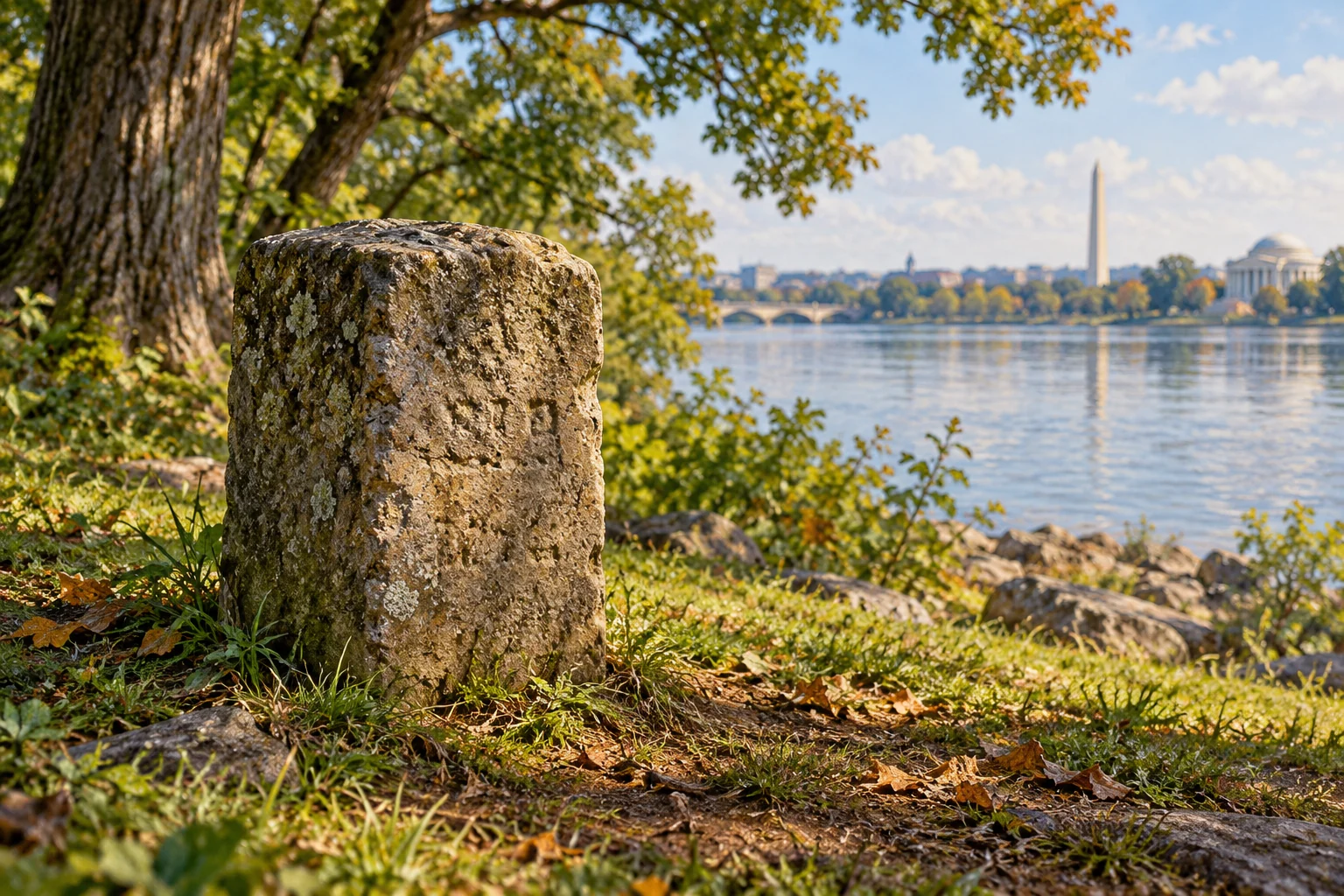
The original federal district was a square ten miles on each side, marked by forty boundary stones. Andrew Ellicott's survey team placed the markers in 1791 and 1792, with adjustments where a precise location fell on unsuitable ground. Surviving stones stand far from the celebrated memorials downtown. Together they turn the capital's founding geometry into something tangible, distributed among parks, streets and residential neighborhoods.

4. Benjamin Banneker helped anchor the survey
Banneker, a free Black astronomer and almanac maker, assisted Ellicott with astronomical observations used in the early boundary survey. His contribution belongs to the practical work of establishing the federal district. Popular retellings sometimes give him much larger, unsupported roles in designing the entire city. The documented surveying work is compelling in its own right: observations of the sky helped establish lines on the ground.
5. The capital gave back part of its original territory
The district originally included land on both sides of the Potomac, including Alexandria. Congress authorized the return of the Virginia portion in 1846, and the transfer took effect the following year. This explains why some original boundary markers stand in Virginia today. The modern district's outline is the remainder of a larger experiment, rather than the complete square chosen at its founding.
6. Congress first met here in 1800
The federal government moved to Washington in 1800, when the city and its principal buildings were still works in progress. Congress's arrival made the planned capital an operating seat of government. The transition was much less polished than the monumental city suggests. Washington acquired its national role before it acquired the complete urban setting that later generations would come to associate with that role.
 You might also like
The Comeback Kid: 15 Fascinating Facts About Bill Clinton
7. Slavery ended here before the Emancipation Proclamation
Lincoln signed the District of Columbia Emancipation Act on April 16, 1862, freeing roughly 3,100 enslaved people in the capital. It preceded the Emancipation Proclamation by nearly nine months. The legislation used compensation for eligible former enslavers, an important and troubling feature of its design. Washington's Emancipation Day commemorates a specific local turning point within the much larger struggle to destroy slavery.
8. Presidential voting came through a constitutional amendment
The Twenty-third Amendment gave the district presidential electors, allowing residents to participate in choosing the president and vice president. Ratified in 1961, it addressed one part of the capital's unusual political position. The amendment's formula caps the number of electors at that of the least populous state. It did not turn the district into a state or resolve every question about representation in the national government.
9. Modern home rule arrived after decades of argument
Congress passed the Home Rule Act in 1973, establishing an elected mayor and a thirteen-member council, with elections following in 1974. The arrangement restored an important measure of local self-government after repeated failed proposals. Congress retained substantial authority over the district. The familiar presence of a mayor and council consequently sits within a form of government unlike that of an ordinary American municipality.
10. Street width helps explain the low skyline
Washington's Height of Buildings Act ties ordinary height limits to the width of the street, subject to maximums and exceptions. On business streets, the familiar formula is street width plus twenty feet. It is often misremembered as a rule simply forbidding buildings taller than the Capitol or Washington Monument. The actual planning framework helps produce broad views and a low urban profile across much of the city.
11. The 1912 cherry-tree gift contained twelve varieties
The celebrated gift from Tokyo brought 3,020 trees in 1912, including 1,800 Somei-Yoshino trees and eleven other varieties. Helen Taft and Viscountess Chinda planted the first two that March beside the Tidal Basin. The spring display therefore began as a substantial horticultural and diplomatic undertaking, rather than a handful of decorative trees. Different cultivars also help explain why not every cherry tree blooms at precisely the same time.
12. An earlier shipment of cherry trees failed inspection
The successful 1912 planting followed a troubled 1910 shipment whose trees carried pests and disease. Authorities destroyed that initial shipment, and a replacement gift followed. The episode adds an unexpected chapter to a symbol of international friendship: plant health and inspection were part of the story from the beginning. The familiar blossoms survived a diplomatic setback as well as the long ocean journey.
13. A wooded national park runs through the city
Rock Creek Park was created in 1890 and protects a landscape very different from the formal Mall. Its central park reservation covers roughly 1,750 acres of wooded terrain, with the creek cutting a green corridor through the capital. The National Park Service also manages associated historic places and small reservations. A visit can shift from a busy street to forested slopes without leaving Washington.
14. Frederick Douglass made his home above Anacostia
Douglass purchased Cedar Hill in 1877 and lived there until his death in 1895. The house preserves objects associated with his household and offers a view of the abolitionist's later life, after emancipation had made the struggle for full citizenship no less urgent. Its setting across the Anacostia River broadens the capital's historical map beyond the institutions and memorials around the Mall.
15. The familiar monumental core is a later reinvention
By the late nineteenth century, development had obscured parts of the original vision for the Mall. The Senate Park Commission, associated with Senator James McMillan, proposed a new monumental landscape in 1901–1902, restoring long axes and extending the composition. Much of the postcard capital reflects that later planning campaign. Washington's apparent visual unity emerged through revision over generations, not from completing one founding drawing exactly as it stood.
How did these facts land?
Know someone who'd love these facts? Share them 👇