Silent Cal on Camera: 15 Facts About Calvin Coolidge
Calvin Coolidge's quiet reputation sits beside an unexpectedly public life: sound films, radio addresses, a mechanical horse and a pet raccoon. These fifteen stories also follow a family tragedy, contested citizenship and immigration laws, flood relief, European debts and his carefully worded decision to leave office.
1. His father administered the presidential oath by lamplight
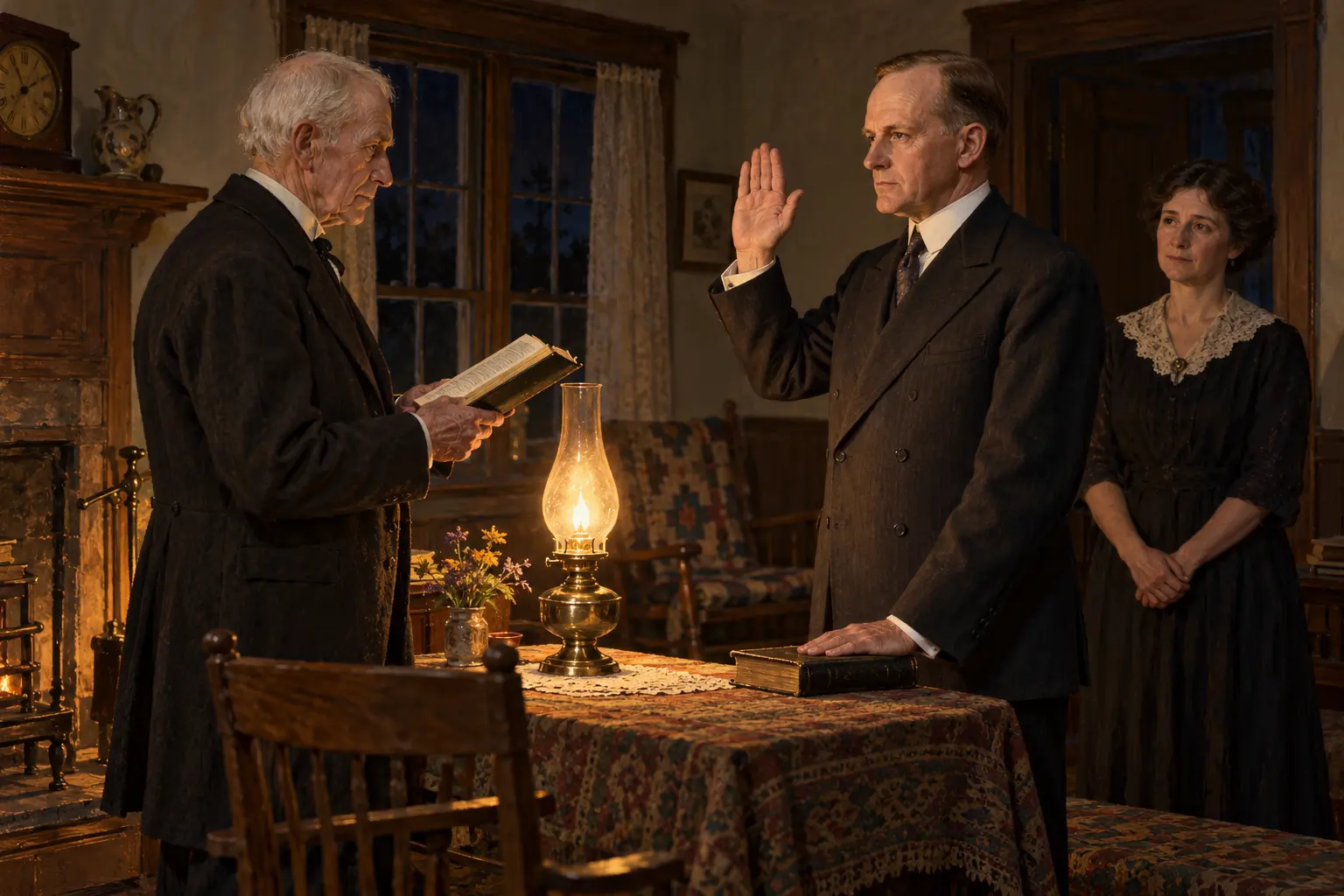
When Harding died, Coolidge was visiting the family home in Plymouth Notch, Vermont, which lacked electricity. In the early hours of August 3, 1923, his father, a notary public, administered the oath by the light of a kerosene lamp. The room and its furnishings survive at the historic site. The setting made an unusually domestic beginning to a presidency: a village official swore in his own son.
2. A police strike helped carry him into national politics
As Massachusetts governor during the 1919 Boston police strike, Coolidge backed a hard line against striking officers and deployed the National Guard. His message to labor leader Samuel Gompers declared that public safety could not be held hostage to a strike. The position won national attention and helped make him the Republicans' vice-presidential nominee in 1920. A dispute over local working conditions thus became a major step toward the White House.
3. His teenage son's death darkened an election victory
Calvin Coolidge Jr. developed an infected blister after playing tennis at the White House and died on July 7, 1924, aged sixteen. Effective antibiotic treatment was not available. His father later wrote that the presidency's power and glory had gone with him. Coolidge won election that November, but his recollection makes clear how little political success could compensate for the family's loss.
4. He exercised on a mechanical horse
Coolidge installed an electrically powered riding machine at the White House. A contemporary newspaper account, reproduced in the Congressional Record in 1925, described a stationary, headless and tailless device that could imitate different gaits. It even reported a wiring fault that required repairs. This was an exercise apparatus, not a toy animal galloping through the mansion, and it fits a broader early-twentieth-century enthusiasm for mechanical fitness equipment.
5. He explained his pet raccoon to reporters in his own words
A tame raccoon arrived at the White House in 1926 as a possible Thanksgiving meal, but became the pet Rebecca instead. At a November press conference, Coolidge said he did not especially enjoy raccoon meat and had arranged suitable housing on the South Lawn. He described the animal as playful and well behaved. The transcript gives the story a firmer foundation than the many embellished presidential-pet anecdotes.
6. Silent Cal spoke through radio and early sound film
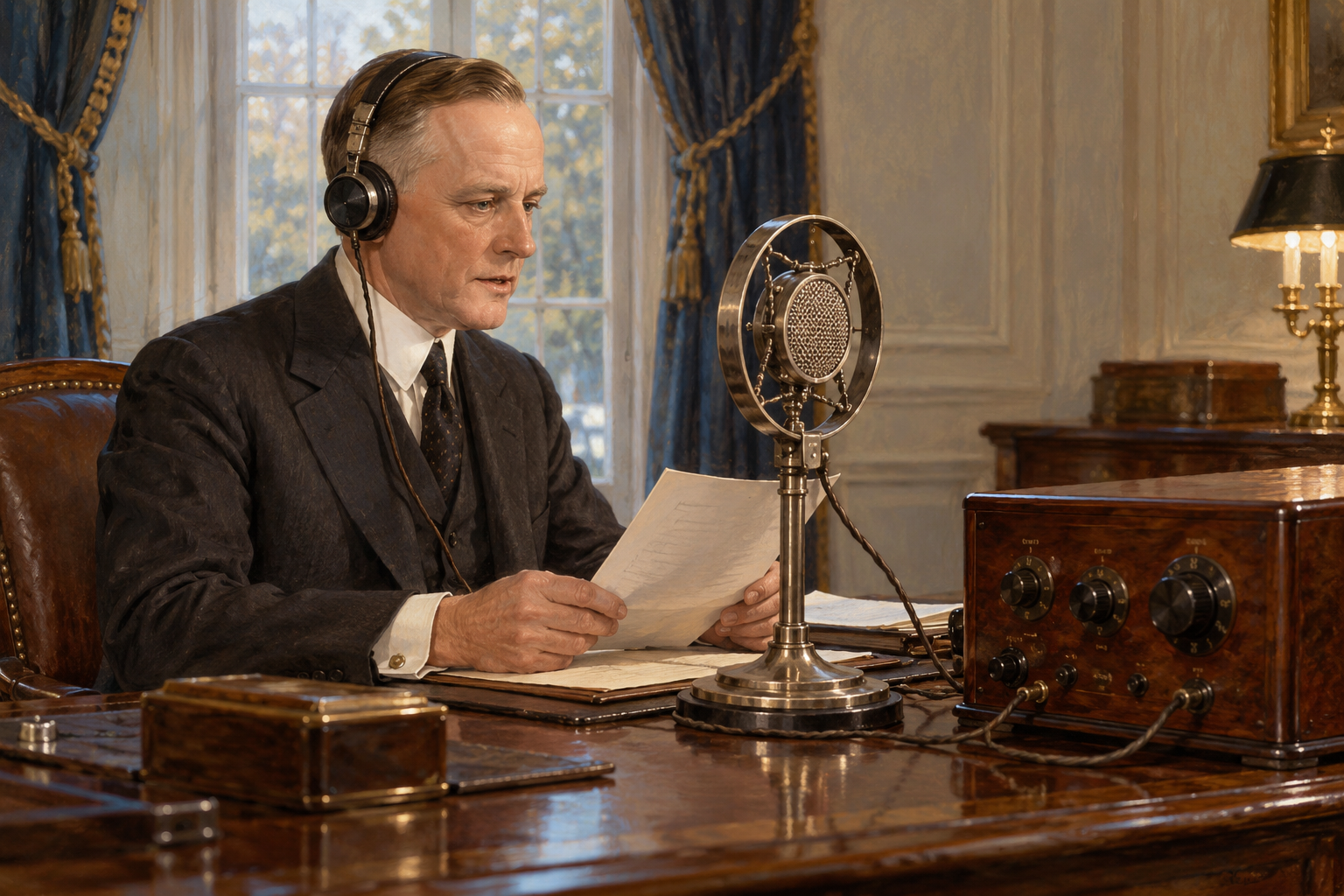
Coolidge used radio to reach large audiences, including for his December 1923 address to Congress. In August 1924 he also stood before a De Forest Phonofilm camera on the White House lawn, delivering remarks about spending and taxation with synchronized sound. The Library of Congress preserved the original film material. His reserved public persona coexisted with active experimentation in media that let voters hear his actual voice.
 You might also like
Unexpected Barack Obama: 15 Lesser-Known Facts
7. He lit the first National Christmas Tree on the Ellipse
On Christmas Eve 1923, Coolidge walked to the Ellipse and pressed a button lighting a Vermont balsam fir supplied by Middlebury College. The tree carried approximately 2,500 electric bulbs. Grace Coolidge had approved the Ellipse location to avoid competing with her separate White House carol event. This began the National Christmas Tree ceremony; it was a different tradition from earlier Christmas trees inside the presidential home.
8. His citizenship law did not remove every barrier to Native voting
The Indian Citizenship Act of June 2, 1924, declared previously noncitizen Native people born within U.S. territorial limits to be citizens. Its text also protected tribal and other property rights from being impaired by that grant. Citizenship did not automatically end discriminatory state voting restrictions. Describing Coolidge as simply giving every Native American the vote collapses two different legal and political struggles into one.
9. He signed a restrictive immigration act while objecting to one part
The Immigration Act of 1924 tightened national-origin quotas and excluded immigrants ineligible for citizenship, effectively ending Japanese immigration under the existing naturalization rules. Coolidge signed it despite objecting to the Japanese exclusion provision, which his administration viewed as diplomatically damaging. The law sharply favored immigration from northern and western Europe. His objection to one provision did not stop the broader restrictive policy from becoming law.
 US Presidents
Discover the eccentricities, secret talents, and surprising hidden lives of America's most influential presidents, from frontier wrestlers to covert strategists.
See All Facts
10. The great Mississippi flood tested his limited-government beliefs
After the catastrophic 1927 flood, Coolidge assigned Herbert Hoover a central relief role. Debate then turned to who should finance long-term protection. In April 1928, Coolidge complained that proposed legislation shifted the entire burden onto the federal government instead of requiring local contributions. He nevertheless signed a major flood-control act in May. His own remarks expose the tension between his fiscal principles and the scale of the disaster.
11. His administration backed an agreement renouncing war
The Kellogg–Briand Pact began as a proposed U.S.–French agreement. Coolidge and Secretary of State Frank Kellogg preferred a broader pact, partly to avoid creating a special obligation to defend France. Fifteen nations signed in Paris in August 1928, renouncing war as an instrument of policy. Its lack of effective enforcement helped make its promise fragile, but the episode complicates the idea that Coolidge's foreign policy was simply disengagement.
12. A wreath dropped from an aircraft helped bring him to Mount Rushmore
During Coolidge's 1927 Black Hills stay, sculptor Gutzon Borglum arranged an airborne invitation: a plane dropped a wreath at the State Game Lodge. Coolidge accepted and addressed the Mount Rushmore dedication on August 10. His participation and support for federal funding gave the ambitious carving project national standing. The event marked the beginning of work, long before the completed presidential faces became a familiar American image.
13. He announced his retirement on slips of paper
On August 2, 1927, Coolidge handed reporters a brief statement that he did not choose to run for president in 1928. His original handwritten note survives in the Library of Congress. The announcement came during his South Dakota stay and left journalists parsing the precise meaning of his words. In his autobiography, he explained that he wanted the party to have time to select someone else and was ready to return to private life.
14. His vice president's European debt plan relied on American loans
Charles Dawes helped formulate the 1924 plan easing Germany's reparations schedule before becoming Coolidge's vice president. American banks then lent to Germany, which paid reparations to former enemies; those governments used part of the proceeds to service debts to the United States. The interconnected flow supported temporary stabilization while leaving dependence on continuing credit. Coolidge's era was deeply involved in European finance even without joining the League of Nations.
15. His famous business remark came in a speech about newspapers
Coolidge's often-shortened business quotation came from a January 1925 address to newspaper editors. He discussed the press, commerce and the danger of reducing national life to material motives. In the same speech, he emphasized peace, honor, charity and idealism. Reading the full address does not erase his pro-business policies, but it restores an argument about public values that the familiar slogan leaves out.
How did these facts land?
Know someone who'd love these facts? Share them 👇