A Geometry Proof and a Forged Letter: 15 Facts About James A. Garfield
James A. Garfield's short presidency can obscure an unusually varied life: school janitor and educator, Supreme Court advocate, mathematical amateur and experimental farmer. His campaign faced a forged letter, his appointments left a mark on American banknotes, and the effort to save him brought Alexander Graham Bell into a presidential sickroom.
1. He worked as a school janitor before leading the school
Garfield helped pay for his education at Ohio's Western Reserve Eclectic Institute by working as a janitor. After graduating from Williams College, he returned to the institute as an instructor, teaching subjects that ranged from classical languages to mathematics and geology. In 1857 he became its president. The student who had cleaned the buildings was now responsible for the institution.
2. His first courtroom appearance was before the Supreme Court
Garfield had studied law privately and entered the Ohio bar before the Civil War interrupted his plans. His first appearance as a lawyer in any courtroom was in Ex parte Milligan in 1866. He helped defend civilians sentenced by a military tribunal in Indiana, where civilian courts were functioning. The Supreme Court agreed that the military tribunal lacked jurisdiction.
3. His farm experimented with a water-powered pump
At Lawnfield, Garfield tried hydraulic-ram technology to move water to the house and fields. The machine used flowing water to create pressure rather than relying on an external motor. It offered ingenious practical science for a farmer who loved learning, but there were drawbacks: falling water levels reduced its effectiveness, the long pipe required maintenance, and the valve made a persistent clicking noise.
4. He published a proof of the Pythagorean theorem
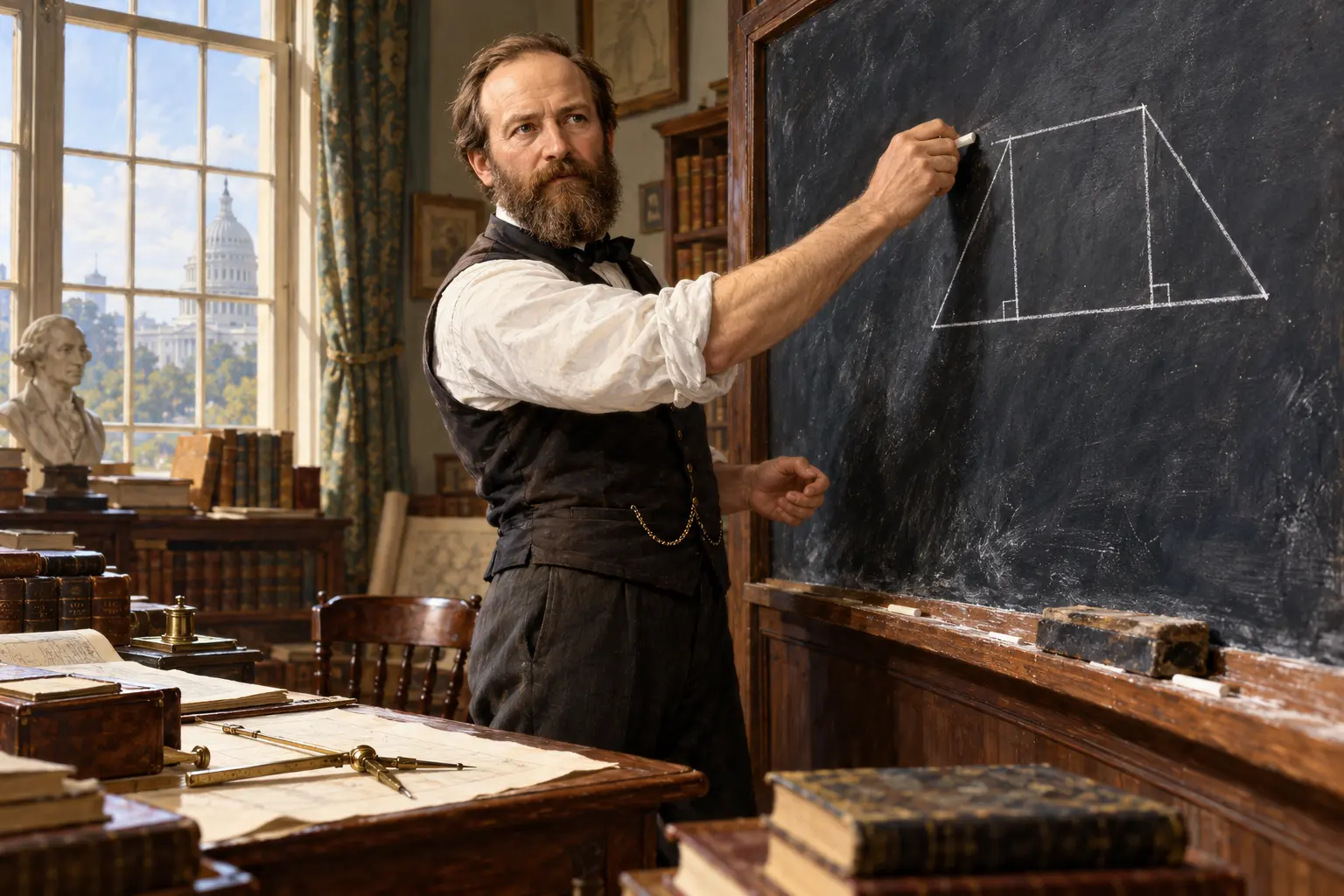
While serving in Congress in 1876, Garfield devised a geometric proof of a² + b² = c². It compares the area of a trapezoid with the areas of three triangles inside it. The New-England Journal of Education published the proof on April 1. He did not discover the ancient theorem; his contribution was an elegant alternative way to demonstrate why it works.
5. He went to the convention to nominate someone else
Garfield arrived at the 1880 Republican convention supporting Treasury Secretary John Sherman. After repeated deadlock among Sherman, James G. Blaine and Ulysses S. Grant, delegates turned toward Garfield himself. He won on the thirty-sixth ballot. His wife had already written that she feared a nomination born merely of other candidates' failure; afterward he telegraphed to ask whether the result met her approval.
6. His quiet farm became a campaign communications hub
An estimated fifteen to seventeen thousand people visited Garfield's Mentor, Ohio, home during the 1880 campaign. They heard brief speeches from his front porch while reporters camped on the property. Behind the house, a small library building became an office equipped with a telegraph and letter press. The apparently homely campaign depended on careful scheduling and modern communications.
 You might also like
Rolling Campaign Balls and a Medical Mystery: 15 Facts About William Henry Harrison
7. A forged letter nearly hijacked the campaign's final days
In October 1880 a newspaper published a supposed Garfield letter defending employers' access to cheap Chinese labor. Democrats circulated vast numbers of copies, exploiting anti-Chinese prejudice. Investigators could find neither the alleged recipient, H. L. Morey, nor his purported organization. Garfield denounced the document after examining a facsimile. It was a forgery, but its actual author was never established.
8. Two senators resigned in a failed challenge to his authority
When Garfield nominated William Robertson to the powerful New York customs collectorship, Senators Roscoe Conkling and Thomas Platt resisted. They expected influence over federal appointments in their state. Both resigned in protest during the struggle. Garfield ultimately secured the appointment, turning a seemingly administrative vacancy into a confrontation over whether a president or party bosses would control patronage.
9. One appointment put a Black American's signature on banknotes
Garfield appointed former senator Blanche K. Bruce Register of the Treasury in 1881. Bruce, who had been born enslaved, became the first African American whose signature appeared on American paper currency. The distinction was an engraved official signature, rather than a portrait. Garfield also appointed Frederick Douglass recorder of deeds for the District of Columbia during his short presidency.
 US Presidents
Discover the eccentricities, secret talents, and surprising hidden lives of America's most influential presidents, from frontier wrestlers to covert strategists.
See All Facts
10. He gave the author of Ben-Hur a diplomatic posting
Garfield admired Lew Wallace's novel Ben-Hur and sent the author a grateful note after reading it. Wallace subsequently became United States minister to Turkey. Garfield also hoped the posting might provide material for another novel. The appointment linked a Civil War general and a bestselling biblical story with American diplomacy in the Ottoman Empire.
11. His assassin said Lucretia's illness made him delay
Charles Guiteau had stalked Garfield before the July 1881 shooting. In prison, he claimed that an earlier sight of the president escorting the frail Lucretia, who was recovering from malaria, made him hesitate. This is the assassin's retrospective account, rather than independent access to his motives. It places a disturbing earlier encounter at the same railway station where he later attacked.
12. Lucretia's rush to his bedside nearly ended in another disaster
When news of the shooting reached Lucretia in New Jersey, a special train hurried her toward Washington. Near Bowie, Maryland, a locomotive rod broke and began striking the track and wheels. The engineer stopped the train before it derailed. After that dangerous delay, she reached her wounded husband that evening; their son Jim's diary recorded how her arrival encouraged him.
13. Alexander Graham Bell tried to find the bullet electrically
Bell adapted an induction-balance device into a metal detector and tested it on Civil War veterans carrying bullets. His examinations of Garfield failed. Physician Willard Bliss restricted the search to the right side, while the bullet was actually on the left; metal in the bed was another possible interference. The episode was an early attempt to use electrical technology to locate something inside a patient.
14. Guiteau admitted shooting him but denied responsibility for his death
Garfield survived the July 2 shooting until September 19, 1881. Repeated probing with unsterilized fingers and instruments introduced serious infections during his treatment. At trial, Guiteau tried to distinguish shooting the president from killing him, blaming the doctors for the death. The jury rejected his defense, found him guilty, and he was executed in June 1882.
15. His widow built a library into their home to preserve his memory
After Garfield's death, Lucretia commissioned a memorial-library addition at Lawnfield, completed in 1885–86. She chose architects Coburn and Barnum, whose work had included the ceremonial structure used when his body lay in public view in Cleveland. Preserving books and papers became a lifelong project. The National Park Service identifies her home library as an early foundation of the presidential-library idea.
How did these facts land?
Know someone who'd love these facts? Share them 👇